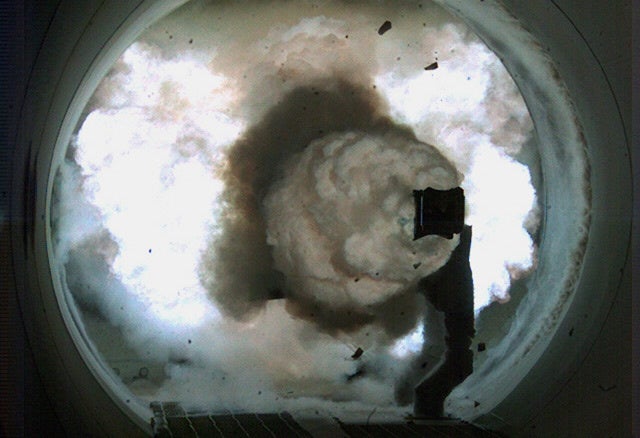
The Navy just broke its own record for an awesomely powerful railgun, which can hurl a projectile hundreds of miles at superfast speeds without using explosives.
Today's 33-megajoule shot — powerful enough to launch 33 Smart cars at 100 mph — means the Navy can fire projectiles at least 125 miles, keeping military personnel at a safe distance from their targets, according to the Office of Naval Research.
Rather than using an explosion to fire a bullet, the futuristic weapon uses an electromagnetic current to accelerate a projectile to March 7.5. The video pretty much says it all.
The eventual goal is a ship-mounted railgun that can fire a projectile more than 200 miles at speeds of more than 8,000 feet per second. A kinetic energy warhead would eliminate the use of hazardous explosives on ships and on the battlefield, the Navy says.
Today’s test beats the Navy’s previous record, set in 2008. The old video is still pretty impressive.
Five amazing, clean technologies that will set us free, in this month's energy-focused issue. Also: how to build a better bomb detector, the robotic toys that are raising your children, a human catapult, the world's smallest arcade, and much more.


Online Content Director: Suzanne LaBarre | Email
Senior Editor: Paul Adams | Email
Associate Editor: Dan Nosowitz | Email
Assistant Editor: Colin Lecher | Email
Assistant Editor: Rose Pastore | Email
Contributing Writers:
Rebecca Boyle | Email
Kelsey D. Atherton | Email
Francie Diep | Email
Shaunacy Ferro | Email
Why can't I have one :(
Looks like a stargate.
the picture i mean. ;-)
@alias007 - I wish it were a Stargate :)
its still just as dangerous as a stargate. o.o
dont get caugt in the unstable vortex. except this one extends 200 miles.
it would be epic if the stargate franchise redid thier shows in 3-D so the unstable vortex really looks like its coming out at you. :)
god damn pop sci your expando-ads are really getting annoying... that being said, i want to see the ungodly cap bank this thing must use to store up that much juice for a 33MJ shot, got to be the size of a small house
ok so I understand that it uses electromagnets to launch the projectile but when the article says "A kinetic energy warhead would eliminate the use of hazardous explosives on ships and on the battlefield" does that mean that the projectile itself doesn't have any explosives either and just uses its own momentum/inertia/whateverthepropertermis to do damage???
@hamstrahammer
indeed. there would be no need for explosives if you account for the shockwave and damage it could produce if designed right. i mean imagine having a 10 pound slug hit you at mach 8...gonna hurt.
as far as size of the capacitors etc, the battleships have more than enough space which is why this is practical. plus there is less space used for explosives, guns, bullets etc. though i thought the ships were nuclear powered.... lol
What is all that smoke and fire if it is electromagnetic?
there is smoke and fire because it is so fast that the friction ignites the air around it... i believe...
Could this be a way to get spacecraft into orbit without all the fuel?? Someone please answer.
@Brett- Yes, NASA has been exploring rail gun launchers for spacecraft for a long time, but up until now it has not been financially feasible. The December issue of PopSci magazine actually has an article on that very thing. NASA wants to use a railgun and scramjet to put things into orbit.
Get it mounted on a ship and get it in the fight!
wow i'm impressed. it takes skill to launch something to MARCH 7.5th!!! :D lol that made my day. anyway this is really intriguing, i hope to hear more about this technology soon.
@hamstrahammer, yosemite
I did a report on this for one of my classes about a year ago. What's actually happening there is that the projectile is cutting through the air at such a rate that the friction between the projectile and the surrounding air is so great, it superheats the particles in the air into the fourth state of matter, or plasma. It's not that it's being propelled like a rocket, it's just creating plasma in its wake.
I'm sorry, I meant @atomicant and novacon.
The effectiveness of a Kenetic energy warhead can be found in the phrase "Energy cannot be created nor destroyed."
Mass and Speed determines the amount of energy released.
Once you expend that much engery getting the object moving it doesnt dissapear once it comes to a sudden shock. Besides the shockwave there will be a tremendous about of heat created from the impact. The same thing happed when a meteor hits the ground.
I am quite fascinated with the Rail Gun, as I sit here ruminating over my long love affair with electricity; I am recalling a discussion in my electronics school in 1965. If I recall correctly developing 33MJ of EMF would require 2.059 698 214 2 X 10 to the 26th electron volts, Converting 33MJ to teslas is 3,3 X 10 to the 4th.
The Russians were able to produce 2.8 X 10 to the 4th teslas in a laboratory in Sarov Russia in 1998. So I highly doubt you would need a "Battleship." More likely I think, might be one of the new multi-mission vessels like the U.S.S, New York. I am wildly speculating that this much energy could be developed by linking several very large magnetrons together. In my research tonight the thought occurred to me that having two enormous rails identically charged and co-aligned to load at the magnetic north pole of the rails and launch at the south pole.
205,969,821,420,000,000,000,000,000 electron volts plus or minus will probably do the trick. Yeah, Mach 7 Dude
@ Scuffy:
The New York is an amphibious transport ship, meaning its primary mission is as a Marine taxi (thus no deck guns). A weapon of this nature would therefore serve little purpose. While you would not need a full battleship to produce the power, this would probably be used on CRUDES (CRUisers and DEStroyers), if that's what you meant by "battleship." Their missions do include anti-surface warfare and naval gunfire support, which would seem to be the best use for these - though honestly, without the Soviet fleet around, neither of those functions are given much emphasis anymore. Unless al-Qaeda is hiding their warships very well, of course.
Impressive. But the camera shot outside the building, where the projectile is moving in the field, is it reality? Seems hard to believe that if that projectile was moving at 7.5mach that camera could turn that fast, being so close to the subject.
I don't know, cool though !
Killergoa, think about it. You can pan (angular pointing) a camera at superluminal speed (at a great enough distance). Mach 7+ should not be a major problem provided you can get a proper frame rate. That the frame rate was achieved in ordinary daylight w/o looking too dark was what impressed me, but I don't get out much . . .
Or the frame could have covered the entire flight path but the picture was zoomed in to see the projectile better. All you would need is a guy with basic video editing skills.
Better not let any terrorists get a hold of this thing. Imagine something striking your house from 200 miles away, and not ever being able to figure out what it is.
so, where does it end up at March 7th @noon? March 7.5 would be at noon, right? does the projectile still travel in the same direction, does it reverse direction, will it be in space because the Earth will be in a different position in space @ March 7.5? does it maintain its velocity or just stop once it reaches March 7.5, and does it travel to next March 7.5 or last March 7.5? Finally, What happens if you launch it on.. say: March 7th at Midnight, while at noon, you are standing in the projectile's path? If you collide with the projectile before you ever launched it, how could you have launched it in the first place, in which case, do you die or do you end up back at March 7th @ midnight, realizing that you fainted before you could initiate the launch sequence, or does the device malfunction, as in Capacitorbankgoboom? I have plenty more questions where that came from.. such as: if we had a nuclear power plant on the moon, to power this thing, and launched it, would it have enough kick to alter the moon's orbit, or rotational speed, depending on the orientation of the railgun when firing?
I have one.
At sea level you can see what 11 miles in any direction if it's flat? This is a direct fire weapon. Strictly staightline line of sight. Artillery is indirect fire like a basketball going into a hoop. Range for 16" naval guns is about 60 miles with a R.A.P. round. Forward observers can have it hit stuff behind hills and mountains this won't do that. Cruise missiles are porthole accurate and range is dependent on model of course but well past the horizon. As a point defense weapon it's almost useless. It would be like a sniper trying to shoot curve balls besides the phalanx pds throws up a pretty convincing wall of lead. This weapon really serves no purpose on a ship. However if you could put it in a tank that fills a direct fire role. Every crewman is extremely aware of the ring of explosives they are sitting in. Hint all those pointy shells point into the turret from a curved wall. If you had a big bucket of .50 cal nickle/iron slugs flying out of the barrel at Mach 7 that would be a very hard tank to kill and be able to obliterate pretty much anything on the battlefield today. Maybe even light bunker busting hmm.
Ha! Just thought of a quote from the movie Johnny Dangerously. " Dis is da .88 magnum. It shoots through schools. "
@ killergoa: yes I've been wondering the same thing. Can anyone confirm?
nvm im retarded had to keep reading comments.
ARTILLERY STILL USES EXPLOSIVES!!! @hamstrahammer they are just working on a delivery system right now. but now a days artillery uses many many different types of explosives. SOME does use solely kinetic energy for impact damage. You can even have nuclear artillery. A rail gun could EASILY be made in the near future to fire nuclear bombs, but by definition it would still be artillery. Artillery is basically any long rang ballistic weapon. This rail gun would fall into that category. Its projectiles could be ANY number of thigs, but I think the want to refine the system a little before they are start firing air burst or time burst artillery in a laboratory. (on a side note I saw on the now canceled future weapons some of the most futuristic artillery shells made. The electronics have to survive a tremendous g-shock, I believe WAY over 100 Gs. so I think it would help to design a delivery system before we start designing highly advance munitions for it.
@androidos10 ummm... yeah. they are called missles. we have had those for a while now. I think there are more than a few Afaganis and Iraqs who wandered what the $%$% just flew into their kitchen and killed them.
at @sykosmurph why do you think this is a straight fire gun. that does not make any logical sense.
@sykosmurph
The Rail Gun is Artillery. It can NOW AS I TYPE, fire Smart, High Explosive, Air Burst, artillary rounds or a kinetic round which is basically firing something heavy without explosives and letting it just fall on the target damaging it from the kinetic energy generated by the terminal velocity achieved from falling.
It is not a large Line Of Sight sniper rifle.
and ever hear of satellites? what makes you think we have to SEE the target with the naked eye to target and destroy it?
Go back to playing xbox and let the grown ups talk.
ALSO:
This would be HORRIBLE on a Tank. You need a bank of capacitors and a small nuclear reactor to get enough power to run that thing on a tank. Unless of course you only wanna fire it once.
Kinetic rounds wont work against armor
A sabo tank round has a core of depleted uranium and copper or magnesium which lights up at super hot temperatures on impact sending burning molten metal through the armor like a knife through butter. (unless its reactive Armor) -for all you nit pickers.
A kinetic round would just bounce off of a tank.
Now that is one very big gun :)
Ivan Malagurski
Looks like a stargate.
For more tech news visit:
gizmoot.blogspot.com/
With GPS and computer aiming, direct line of sight is not an issue - line of fire, however, is. Also, since the energy is direct, not payload, there is a direct power loss the more arch you put on the shot (though as anyone with a firearm knows, anything up to 45 degrees keeps most of the energy going forward.
Why would someone build this?
@Cadillac ha! Wrong! Forward observer in the Marines during Desert Storm and Somalia. Did time with tanks in Camp Fuji. Eat it.
An anti tank saboted round IS a kinetic round. Fool! It uses kinetic energy to kill a tank. No explosives.
When this actually fires an airbursting, smart, Taliban sniffing, nuclear, ninja warhead it'll be really cool. Currently it seems to fire dumb slugs in a straight line. Once.
I don't think anyone here understands what a 10 pound lump of metal moving at 7 times the speed of sound will do to just about anything it hits.
rofl @ cadiallac... Bounce? Things travelling at mach 7 don't bounce... at those speeds rocks get sticky on impact... unless someone finally found two materials hard enough to maintain surface integrity under the kind of energy released by their impact.
Although the first tank might bounce off the second one... or a turret might bounce off the ground if its a clean shot... this thing would actually be awesome on a tank... granted not in its current building sized form... We'll need some much smaller energy producers as well as capacitors to mount one in a tank.
And I was wrong about direct fire only. Firing rounds up to 500k ft at Mach 7 and dropping them at a "mere" Mach 5. With up to a 6 minute hang time? Wacky. Calling fire was rough when we had up to 15 second hang times.
The navy badge for this project has "velocitas eradico" as a rocker which I believe roughly translates to speed kills.
This is actually old news and an old video. is there anything new to show about the governments developments. The government has been working on this since the early 90's. And I suspect they would be using this technology on a zero gravity space propulsion system. Theoretically it should work better than the current system using explosive materials. Maybe a nuclear powered mag-rail pulse system....going to Hyper drive chewbacca.
To all the nay-sayers: If you don't know basic Physics, please stop pretending as though you know what you're talking about. I'm sorry to sound smug, but I get real irritated with all the comments that bash these sorts of projects... IF THERE WAS NO HOPE FOR THIS TO DO ANYTHING BENEFICIAL, THEY WOULDN'T BE WORKING ON IT.
Going off of neuenkir's "data" - If a 10 pound piece of metal gets flung towards something at mach 7.5 ( 7.5x the speed of sound ), you have a mass of approximately 4.54kg moving at a speed of approximately 2552.18 meters/second ( assuming we're at sea level.) This causes the projectile to have Kinetic Energy of about 3.0x10^7 ( that's 30,000,000 ) N * m ( Newton meters, or, force over a distance ).
Let's put that in perspective -
Say you're traveling in a car that weighs 3000lbs, or about 1360.8kg ( keep in mind that is 3000x the weight of this projectile ). If you wanted to MATCH the kinetic energy of this projectile in your 1360.8kg vehicle, you would need to travel about 148.5 m/s or 332.19 MPH. 332.19 MILES PER HOUR. Can you imagine how horrible of an accident it would be to travel at that speed?
It's all about kinetic energy boys and girls. I would NOT want to even be in a building that gets hit by this 10 pound chunk of death.
All the doubters need to realize something. Where have we seen something like this before? In a cannon. This is essentially a glorified cannon. I saw a futureweapons episode on this a while back... they can fire basically ANYTHING ( within reason ) out of this. In a bind? Grab your portable toolbox, chuck it in there, and fire the damn thing! Or grab a wrench and toss it in there! It's that simple!
Obviously they will develop some sort of munition for this to optimize it's impact force, but these munitions could be EXTREMELY inexpensive.
Just give it a chance.
So, looks as though I forgot a factor of a half in my kinetic energy equation. Finals must really be racking my brain -_-
So, take those results and divide them by 2, and you still have "proportionally" the same amount, but less. So, you would have to be traveling about 166 mph in your car.
Still pretty damn fast.
And since I'm also an ex-professional photographer who dabbled in high-speed imaging (plus I'm bored at work), I'll give my opinion on how the heck they managed to capture the projectile in flight in that first video.
In my opinion, determining the method used really depends on whether the Navy cared if we saw the projectile flying beyond where the video shows. For high-speed imaging in daylight like this, a very large aperture is necessary in order to capture enough light in a short enough period of time to capture the desired image. Zoom lenses typically sacrifice, at least to an extent, their aperture range in order to allow a closer look at the object being photographed. No doubt the military spent hundreds of thousands (if not millions) of dollars on the camera that was able to capture that footage, but my guess is that the camera was stationary and the "panning" you see is due to post-processing of the video.
I really don't feel like doing the math right now on how fast the camera would have to pan when positioned "x" meters from the projectile's path, but here's something to think about- If the camera was relatively close to the projectile, it would undoubtedly have to pan/rotate above mach 1 at the minimum. And with the projectile traveling at "March 7.5" (sorry, couldn't resist), timing the movement of the camera would require EXTREME precision. When I was experimenting with high speed photography I was dealing with bullets traveling, at the very most, 1200fps (about Mach 1 at sea level) and it was quite difficult to calibrate everything where the bullet was in the desired location of my image (in my case, impacting fruit, lightbulbs, Christmas ornaments, etc). Considering that this railgun set that speed record, I think it's safe to say that the camera had to be stationary, and recording slightly before and after the test, in order to successfully capture the flight of a projectile traveling at such a high speed.
If you'd like to take a look at a few of the high speed images I took, here is a link to one of my flickr albums: http://www.flickr.com/photos/14516424@N03/sets/72157603549767778/
There are some other sets on there, some are more high-speed shots and some are just snapshots, don't judge haha.
Ugh, my huge post about using depleted uranium and how the equation for kinetic energy (assuming the velocity is independent of the projectile's mass) shows that using a material with an extremely high density (such as depleted uranium) would be ideal considering that the size of the projectile is undoubtedly limited by the railgun.
But I'm just a humble engineer, maybe I don't know what the he** is going on here. At least my photography post was successful.
Those of you who are bored enough to browse the rest of my flickr will be blessed with the opportunity to also see pictures of flowers, kittens, the holes I accidentally shot into my guest house wall when taking the high-speed photos, my $150 Craigslist 4Runner stuck in a mud trap, and me without a shirt on. Don't judge me, I just like to have a good time =)
As a former Air Force intelligence analyst who used to work at NSA with a Top Secret Crypto clearance trust me when I say we've seen nothing of the true capabilities of this thing or lack thereof. Does anybody really think this video shows anything at all about that? C'mon guys.
All this talk about oh, it's straight line, oh you can load in wrenches if you want, oh, put it on a tank or whatever is pure spec. Might as well talk about mounting it on a UFO. They're not telling us anything about what it can or can't do. It could be a useless waste of research or it could be the next big thing. I've read reports that one shot basically destroys the gun and it takes a week to rebuild it. Is that really true? Who knows. The point is don't get too excited until it's actually deployed somewhere.
Bob
@boka. I'm kinda wondering the same thing, but from what I know I would think you would use it for making enemy ships go KABOOM, or possibly just make them sink I dunno.
This makes me want to rebuild my super-tank and replace the old ballistic nuclear cannon with a mass-driver, and perhaps change the twin fission reactors to fusion, as to prevent contamination from waste and a horrible nuclear fallout in the case of a meltdown, as the last one had. I also need thirty-five billion dollars worth of coverage...
I literally lol'd at reaching March 7.5 :)
<3 popsci
Ships are turning to electric drive machines with the advent of high temperature superconductors. This same power can be used to run these rail guns.
Scotty, we need to divert power from the main deflector shields for the photon torpedos!
Dear Pop-Sci. No one can access your home page when you have an advertisement. The ad just starts over, instead of redirecting us to the homepage. For weeks it was an ad for "top gear" on the history channel. The same problem is occurring again for the nikon camera ad. Please fix this permanently.
imagine a clown getting fired out of this cannon :)
Anyone out there ever heard of a "Glitter Boy". Shoot, all that sci-fi from my youth is coming to fruition.
p=mv
Any tank sized object hit by this thing (at even 1/2 speed) will basically do a very good disappearing act.
"Fly me To the Moon Doo dah doo"
Well if a scramjet can ever be kept from blowing out it's own ignition capability we will very soon after be able to just let the targeting computer determine point of release and let our kinetic rounds or whatever go without being tied to a nuclear reactor, isn't this correct? With true instant , or nearly instant repeating ordnance drops? No railgun needed, no reactor, no ship limitation of a relatively short distance from a coastline whose artillery batteries are likely not as good as our current large gun capabilities anyway.
A railgun round can kill a target that a missile can't. the missile will take a few hours to get to a target if it traveling from the US. A railgun can shot more rounds in less time. Also railguns are cheap. what can it cost afew thousnd dollars per round shot. One tomahawk costs $500,000. The cost of a ship is a one time thing the cost of missles on other hand just keep going up and up and up. what you are doing is apples to oranges. Each has its job at times one does a better job at what needs done but both have a place
@ kokofan50 ; If this tech has a functional or maximum effective range at 200 miles or thereabouts; that puts all those sailors, Marines, and Special Ops and the multibillion dollar ship that fired the kinetic round at about a hundred miles or so from the coastline to be out of range of artillery or short range missiles, and gives some small reaction time for longer range missiles. A Phalanx still does have to have time to target and kill incoming missiles especially if it's taking on a big spread of them at different ranges. I just don't think a kinetic and unassisted round is a real option for this weapon in actual battlespace. You say the railgun is cheap, comparatively to a tomahawk, but the railgun needs a dedicated nuclear reactor, minimum, and the massively expensive superconductors to the massively expensive capacitors to another massively expensive superconductor. THAT is what the railgun actually is, and the shipdeck that is planned for a firing platform is not. That's assuming that our existing battle computers can deal with it, and a dedicated power monitoring apparatus in any event.
This is kinda funny I know this may seem dumb but in Pokemon Soul Silver they have a magnet train and I think it's supposed to go faster then an airplane one of the guys in the station tells you how fast it goes but I can't quite remember what he said.
A kinetic energy warhead? Probably top secret how that works, huh?
@ sykosmurph
No explosives huh? How did you get it out of the gun? wishful thinking?
I was in both current theaters, and OUR FACker's were Air Force.
@trembyl
I havent seen the field test of mach 7 + projectiles personally but you should look up reactive armor.
AND I lost sight and am to lazy to back read but did anyone give credit to the GERMANS for this piece of WWII swag technology?
@cadillac This is not just a bigger better gun. The round rides a magnetic feild. It works something like a maglev train.