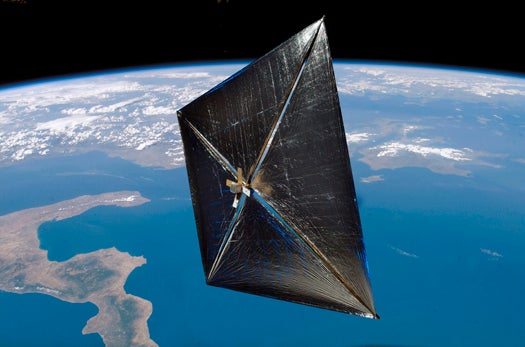
An Artist's Rendering of NanoSail-D NASA

In the wee hours of the morning today something very small did something very big very high above the Earth. NanoSail-D, a demonstration nanosatellite launched aboard the Fast, Affordable, Science and Technology Satellite (FASTSAT) last month, ejected from the mothership, marking the first time a small cubesat has been deployed from a larger autonomous microsatellite in space.

All of those qualifying nano- and micro- descriptors may obscure the real achievement here, so let’s look at it another way: NASA launched an autonomous satellite, and that satellite has successfully deployed a second, smaller satellite. That’s big news for FASTSAT, which was designed to be a small, cost-effective, and independent means to launch small commercial and scientific satellites without having to piggyback on larger, expensive NASA missions.

Of course, the technology proving doesn’t stop with NanoSail-D’s launch into orbit. A three-day timer is now ticking down within the nanosatellite; when it reaches zero, Nanosail-D will unfurl a solar sail boom that should deploy an entire 100-square-foot thin polymer solar sail in just five seconds. If that goes well, NanoSail-D will stay in low-Earth orbit for another 70 to 120 days, cruising on sunshine.

Compact solar sails could be used to degrade satellites orbits at the ends of their lives, thus extending the length of their service by not requiring them to use the last of their propellants to de-orbit. NanoSail-D also aims to prove one other key capability: to eject from FASTSAT successfully without coming back into contact with it sometime later. We should know fairly soon if that part of the mission is also successful. If so, NASA will have demonstrated its first nanosatellite-launching microsatellite, which could change the way institutions and businesses get small payloads into space.

[NASA]

5 Comments

how small IS this nanosatellite?

Still not as cool as a landing party taking a shuttle down to the moon, driving around in an all terrain vehicle, redocking with the ship and heading back to Earth. But I suppose this deserves some props.

10 cm wide to qualify as a cubesat. Described as "the size of a loaf of bread" by NASA. The image seems accurate, then - a box six inches wide attached to a 10' x 10' sail.

The article doesn't seem to accurately represent the purpose of solar sails on satellites, though. The original article on the cubesat doesn't imply that the sail on future sats would be used only for de-orbiting, and it wouldn't make a great deal of sense if that were the case - the sail would take up far more weight than that last little bit of propellant. The idea is, if I'm understanding the article correctly, to use the sail to save propellant in both acceleration into orbit and deceleration out.

There are not any cubesats that have active propulsion systems, nanosats do, however the technology has not been scaled down to cubesat proportions yet. This makes a solar sail a viable means for both propulsion and de-orbit.

The title is correct. This is the first time that *NASA* has released a small satellite from an autonomous satellite. Stanford University did it almost 11 years ago with OPAL, and a group of European universities did it 5 years ago (SSETI-Express).


140 years of Popular Science at your fingertips.

Innovation Challenges


Popular Science+ For iPad

Each issue has been completely reimagined for your iPad. See our amazing new vision for magazines that goes far beyond the printed page


Download Our App

Stay up to date on the latest news of the future of science and technology from your iPhone or Android phone with full articles, images and offline viewing


Follow Us On Twitter

Featuring every article from the magazine and website, plus links from around the Web. Also see our PopSci DIY feed


June 2012: Invent Your Own Anything

The 6th annual Invention Awards are here, from an inflatable tourniquet to a better lobster trap to spring-loaded hocket skates. This issue is all about the celebration of invention.

Plus: Making synthetic biology breakthroughs in a garage, building a constantly-moving ping-pong table, and a ridiculously overpowered barbecue.

circ-top-header.gif
circ-cover.gif