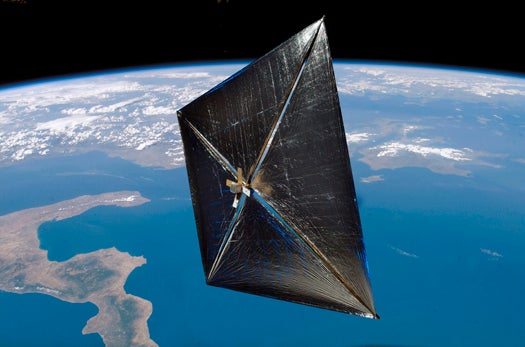
An Artist's Rendering of NanoSail-D NASA

Last week’s launch of NanoSail-D – NASA’s solar sailing nanosatellite that was reportedly launched from the Fast, Affordable, Science and Technology Satellite (FASTSAT) last week – may not have gone as well as initially thought. In fact, it may not have happened at all. Though publicized as the first launch of a nanosatellite from a microsatellite in orbit, NASA hasn’t heard from NanoSail-D since last week, leading some to suspect that it never launched at all.

Nanosail was set to launch at 1:30 a.m. EST last Monday, and according to reports from NASA at the time the launch was a success. That launch should have triggered a three-day timer aboard NanoSail-D, at the end of which it would have deployed a thin polymer solar sail (NanoSail’s further mission was to test compact solar sail technology). That should have happened on Thursday, but NanoSail-D has not confirmed that it ever deployed its sail, and thus far NASA has not been able to contact the craft.

That’s led some mission handlers to wonder if NanoSail-D launched in the first place. An update posted to NanoSail-D’s mission page on Friday states “at this time, it is not clear that NanoSail-D ejected from the Fast, Affordable, Science and Technology Satellite (FASTSAT) as originally stated on Monday.”

The statement continues: “At the time of ejection, spacecraft telemetry data showed a positive ejection as reflected by confirmation of several of the planned on orbit ejection sequence events. The FASTSAT spacecraft ejection system data was also indicative of an ejection event. NanoSail-D was scheduled to unfurl on Dec. 9 at 12:30 a.m., and deployment hasn't been confirmed.”

NASA mission handlers are still trying to contact their tiny satellite and troubleshoot possible issues that could have led to either a false positive on a launch that never happened, or the inability to make contact with an orbiting nanosat. Either way, NASA has confirmed that the other five onboard experiments on FASTSAT are operating as planned.

[NASA via Spaceflight Now]

13 Comments

This kind of sucks. Hopefully they can get in touch with it and confirm, or deny, that it actually did deploy. On the brighter side, at least the other experiments are going as planned.

I have 3 options:
01) VGER intercepted it.
10) It was captured by a large cylinder to verify the continued existance of whales.
PI) It's currently cloaked as part of the upcoming V attack.

I wonder if NASA has contacted NORAD about this yet. I mean, it might be a good idea to know if you have a rogue object in orbit or not.

United States: Can't tell if one of it's satellites is functioning properly or contact it at all.

Japan: Sent a probe to an asteroid and was able to retrieve it along with the desired samples with a myriad of issues that were solved along the way.

Hmm.

Neuenkir lets not forget the fact that this sat is tiny (size of a loaf of bread) with lots of parts. Its not something u figure out easy when it doesnt respond.

Neuenkir, did you completely miss where JAXA's Akatsuki probe totally missed venus and now needs to wait 6 years to *MAYBE* get another shot?

www.popsci.com/technology/article/2010-12/japanese-venus-probe-fails-find-orbit-might-get-second-chance-six-years

@neuenkir

That is one of the most stupid and pointless comments I have seen on here, and that is unfortunately saying something.

"Group A success story" vs "Group B unconfirmed blunder" Wow group B sucks!

You can't simply select a good, finished situation and one not going as planned, and think yourself witty to juxtapose the two.

And fyi, Japan's asteroid probe failed to work properly. It was all they could do to improvise the situation to complete the mission. (Yes, it was a geat success). There is no reason that the same outcome could not happen here. Errors are common in this line of technology. The reason that there are so many success stories about space is due in no small part to the number of problems that crop up, requiring people to stretch their imaginations to fix the problem. It’s like harvesting ingenuity.

United States: Managed to bring home 3 astronauts after their oxygen tanks ruptured, sending them on a random trajectory, with neither enough air nor propellant to make it home.

Japan: Can't get probe injected into Venusian atmosphere
Hmmm

See? I can do it too. Your opinion seems to be noting but superficial and pointlessly snarky comments. Please go away. Good day sir.

Agreee brian!

Manned space flight programs
1st Russia April 1961
2nd USA May 1961
3rd China OCTOBER 2003
4th USA PRIVATE SECTOR Scaled Composites October 2004

JAPAN........No manned space program yet even tho the usa has both comercial and private manned spaceflight WIN USA!

see i can do it also!

@ responses to me.

I would like you to reread my comment.

...

Okay. What was my opinion? Aside from 2 facts and a "Hmm." what opinion did I advertise? Ahh. Okay. So, from there, let's examine each of your comments.

Kickbush: Yes, I do realize it is a small probe, but I would image that would be simpler to resolve issues on compared to something larger for the sheer fact that you have less to go wrong. If you have a comparatively large communications satellite, it will likely have more parts and thus more that could go wrong with it. It is experimental technology, so I can see your point though.

Code Zero: I did. At least the satellite is still functioning and they are able to communicate with it.

Brian144: Your trolling attempt is unsuccessful and comparing two events that are decades apart in a field that is not a century old is sort of like comparing your lifestyle with that of an Etruscan. It doesn't work. I will not "go away" as you delicately put it. Your comment also seems to be snarky and pointless, so where does that put us?

Voodoo X: I do hope you know about Japanese manufacturing, economics, and scientific research a little bit concerning their post-WW II status as a defeated country. Should it surprise you that the first two countries into space were the two that most benefited from Allied victory?

Are we all good now?

I got my eye on Craigslist for any space-age looking toasters...

neuenkir, I think you misunderstood brian. He wasn't attacking Japan or aggrandizing the US. He was saying that shit happens no matter who you are, and the test is being able to roll with it. Certainly he could have been more politic about it, but brian's point is a very reasonable reaction to events like this. (That is, very nearly none at all, because we don't really know anything yet.)

VoodooX, on the other hand, is trolling. (Sorry, but it's kinda true.)

@neuenkir okay well I will add my 2 cents to your pointless comment too. One mission has been going on for 3 days. the other took 5 years!!!! maybe if you wait more than 1 cycle of wasted thought we may be able to salvage this mission as well!

Japanese also hopes to find NanoSail-D. There's so many Japanese followers on NanoSail-D Twitter. At this time, it's not sure that NanoSail-D ejected, deployed or not.

You confuse those 3 some.

Japan's IKAROS successfully deploy first solar sail in space, prepares for interplanetary Cruise on June 2010. And IKAROS flyby close to Venus on 8th Dec. Ikaros is still going continue interstellar deep space travel.

AKATUKI is failed to enter Venus Orbit on 7th Dec. Akatuki is Japan's Venus orbiter, but still have possibility retry after 6 years.

HAYABUSA asteroid mission(sample-return mission) was completely successful on June 2010, despite of a succession of technical problems.
On Nov, Jaxa is confirmed the capsule contain pieces of Itokawa. Hayabusa succeeded in completely the world's first asteroid sample-return. There is NASA Cooperation, thanks to NASA.

Has Nasa ever heard of live cameras? They are still stuck in the 1960's launching flying bathtubs.


140 years of Popular Science at your fingertips.

Innovation Challenges


Popular Science+ For iPad

Each issue has been completely reimagined for your iPad. See our amazing new vision for magazines that goes far beyond the printed page


Download Our App

Stay up to date on the latest news of the future of science and technology from your iPhone or Android phone with full articles, images and offline viewing


Follow Us On Twitter

Featuring every article from the magazine and website, plus links from around the Web. Also see our PopSci DIY feed


June 2012: Invent Your Own Anything

The 6th annual Invention Awards are here, from an inflatable tourniquet to a better lobster trap to spring-loaded hocket skates. This issue is all about the celebration of invention.

Plus: Making synthetic biology breakthroughs in a garage, building a constantly-moving ping-pong table, and a ridiculously overpowered barbecue.

circ-top-header.gif
circ-cover.gif