MIT’s Martian Genome Project Will Search for Alien DNA on the Red Planet
When hypothesizing about life that may exist elsewhere in the universe, the tendency is to visualize something far different from...
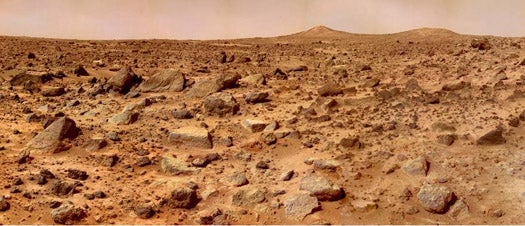
When hypothesizing about life that may exist elsewhere in the universe, the tendency is to visualize something far different from life here on earth. But here in our galactic neighborhood, a team of MIT researchers argues, life it just as likely related to us. Following that line of thought, the team is developing a prototype alien DNA decoder that it hopes to send to Mars aboard a NASA-ESA mission slated for launch in 2018.
The premise of their reasoning is this: It’s estimated that Mars and Earth have swapped a billion tons of rock over the course of their lifetimes. And some of the stowaway microbes aboard those rocks could be quite hardy, surviving the trip. DNA is pretty durable as well. On the surface of Mars it wouldn’t last too long, but shielded from UV radiation DNA could lie dormant on Mars for a million years or so.
So MIT’s DNA decoder will be designed to dig. If there ever was life on Mars, or if there are organics buried there from other origins – be they Earth or elsewhere – the Search for Extraterrestrial Genomes (SETG) should be able to isolate, amplify, and identify nucleic acids right there on the Mars, no return trip necessary.
The technology is still a couple of years away from field tests in Chile’s Atacama Desert or in Antarctica, two of Earth’s analogs for the arid, cold deserts of Mars. If it passes muster there, it could be hunting the building blocks of life on the Red Planet by the dawn of the next decade.