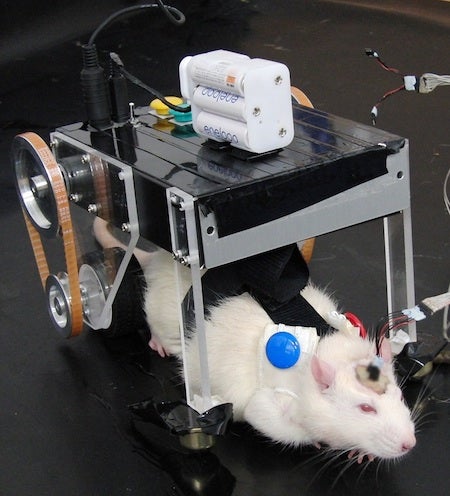
RatCar RatCar involves implanted neural electrodes that allow a rat's brain signals to control a motorized robot. IEEE Spectrum

Robots are a major part of the cultural fabric of Japan; they’re performing weddings, buying groceries and keeping people company. A team of researchers at the University of Tokyo is taking this robotic cultural immersion a step further — they’re making animal-robot hybrids. Sort of.

RatCar is a brain-machine interface that uses a rat’s brain signals to control a motorized robot. The rat hangs in the air, and the robot does what the rat’s limbs would do. It’s far from the only brain-robot locomotion contraption, but it’s arguably one of the strangest.

Osamu Fukayama and colleagues developed RatCar to study whether a small vehicle could be controlled by the brain signals that move rats’ limbs. Unlike less-invasive, EEG-based brain-machine interfaces, the system involves implanting tiny neural electrodes in a rat’s brain.

The rat is suspended from a small lightweight “neuro-robotic platform,” as IEEE Spectrum reports. The goal is to make the vehicle and the rat work together to move forward. Brain-control interfaces like this could be a boon for people with locked-in syndrome or various other disabilities.

The system also includes several models and algorithms that explain the correlation between recorded neural signals and the rat’s movement, as Fukayama explains.

Researchers trained the rats by making them tow the car, motors turned off, around an enclosed area. A camera tracked the rats’ movement and fed data into a modeling program, which pieced together signals from the motor cortex. Then, the rats were hung from the car so their limbs barely touched the floor. The researchers switched the motors on, and as they tried to move, their neural signals were used to drive the car. Six out of eight rats adapted well and were able to get around with the car, according to IEEE Spectrum.

It’s not clear how much the rats’ wriggling might have affected the car’s movement, however. Fukayama and colleagues Takafumi Suzuki and Kunihiko Mabuchi want to perform more experiments to address that question.

They have been working on RatCar for several years and presented their most recent work last month at the IEEE Engineering in Medicine and Biology Society annual conference in Buenos Aires.

[IEEE Spectrum ]

24 Comments

What a miserable life. Poor little one... You can see the apathy oozing from those wee eyes. All I can see is the face of my precious childhood rat, Curly, when I look at this and I...want to vomit.

It takes a "special" kind of person to be able to do that to a living being.

I appreciate the science, but I have a hard time...erm...stomaching it...

With a name like Fukayama, it has to be good.

Yeah, that's kind of sick, right there. This is the kind of science that makes people afraid of scientists. The last time I woke up paralyzed and strapped into an electric wheelchair with electrodes plugged into my brain, I didn't care for it so much.

Just wait until these Cyborg Rats try to take over the world...it won't be so funny, then.

This looks really cruel. Fortunately, there are no pain receptors in the brain. I appreciate that the rat is sacrificing a normal life to be a robot-rat hybrid. This tech can someday help those who can't walk. I hope they make this thing as comfortable as possible for the rat. I'd be miserable in that thing.

www.dotgeekblogs.blogspot.com

I'm surprised so many of you care about a stupid rodent. Primitive mammals like rats/mice are only useful for food and lab tests on our products/science experiments.

It's better than the alternative of letting them roam free, spreading diseases and such.

I would rather be friends with someone who cares about the welfare of rodents than not, but that's beside the point. I was working as a biomedical researcher in a lab in the US and was shocked when I first learned that I had to euthanize rats in order to study their brains. At least these rodents are not being decapitated in the name of science.

The only reason people do things like that is to watch the rats crash.

That is the sickest thing I've seen in my life, but it is one step closer to human testing...

Call me crazy but I sense a marketing treasure trove here, I mean what youngster these days wouldn't want their very own Rat Racer? Give them a little race track and some plastic sports cars and I smell the next Hot Wheels.

You're all missing the point here. First, it's a rat, likely unaware of what's going on. Whatever, it's A RAT. The point is, this technology, coupled with modern exoskeletons and neurally linked, high sensitivity prostheses could have para/quadriplegics up and walking inside of 10 years. This could give millions of people freedom they've never felt, or haven't felt in a long time.

You take your fully-functional body for granted while you white-knight for a f***ing lab rat, while some people can't even use a keyboard to tell you how stupid you are.

If rats mattered, they'd be the ones who evolved into sentience and a bipedal body.

@ EngineSkull

You're a douchebag. I hope you die painfully, slowly, and alone.

@confushawn I loved your comment; It was very well thought out and worded. The reasons for your thoughts were quite convincing to the point where I was compelled to side with you. Well done!

Hahahaha...the harshness of both sides.

Okay so this is harsh and unfortunate for the rats. What I'm wondering though...will the last war be between skynet and the rats?

@Confushawn - I'm afraid your the giant douche. What have rats done other than spread disease and get torn apart by cats? Next it'll be cows, pigs etc... then who knows. Pah!

@Engine Skull - Well said. This technology 'could' benefit real people in the very near future. The idea of harming an animal to further human technology is not old, and in my opinion is a noble endeavor. Unless you are 100% vegan and don't eat or use animals at all I don't think there is any argument here.

As far as the article goes, I thought we had the ability to map thoughts/brain patterns to a computer several years ago. So, why is this just now happening?

This little rat experiment is very light fare compared to some of the frankenstein rumours I've heard in neuroscience labs. Take a human brain connected to a monkey's body for example, kind of like the above experiment.

Those icky, nasty, filthy rats! I recall reading about how a few of these rats crossed the ocean on this wooden floating thing and when they reached land, they breathed on these nice people and killed tons of them with their diseases!! Oh, wait...crap...

Hey look its Algernon! I got your flowers around here somewhere....

Usually I just use mousetraps and d-con... glad someone found something useful to do with them.

I'd be much more convinced (and amazed) if the rat was controlling the vehicle from a remote location to, say, retrieve food/water for itself. The vehicle as pictured looks as if the rat could simply(if w/ great effort) be physically moved by the rats own foot power

I believe the idea is to let it move about on its own, record what brain activity corresponded to what direction, and then associate it with the proper motor controls on the car. I'm assuming the pictured stage isn’t the rat controlled stage, because if it is we’re either missing info or these scientist didn’t think out the mechanics of this very well.

Why do I suddenly imagine Pinky & The Brain riding those Tron motorcycles?

you guys think this is cruel? you should have seen the article where scientists literally separated the rats brain FROM its body, placed it in what can only be called a jar with some electrical and optical inputs attached to an antenna, and THAT controlled a blue tooth little car robot, the robots movements were very surreal, and the mouse brains only lasted AN ENTIRE MONTH before finally succumbing to the inevitable.

as for a lack of pain receptors in the brain, might I remind you of phantom pain? pain is processed in the brain and a lack of input such as missing limbs can be quite painful, as seen in many amputees who struggle with phantom limbs. when you attach electrical inputs into the brain, i don't have much confidence that some of that input isn't perceived as pain.

that being said, I'm not the kind of person who touts FEMA policies while avoiding milk like the plague, but common, there is a line somewhere(killing a rodent? i couldn't care less, but over-extended suffering?) and that experiment was cutting it like a paper ribbon through garbage disposal, it makes this little experiment look quite tame in comparison, at least the mice here still have functioning bodies and organs in working order.


June 2013: American Energy Independence

Five amazing, clean technologies that will set us free, in this month's energy-focused issue. Also: how to build a better bomb detector, the robotic toys that are raising your children, a human catapult, the world's smallest arcade, and much more.


Online Content Director: Suzanne LaBarre | Email
Senior Editor: Paul Adams | Email
Associate Editor: Dan Nosowitz | Email
Assistant Editor: Colin Lecher | Email
Assistant Editor: Rose Pastore | Email

Contributing Writers:
Rebecca Boyle | Email
Kelsey D. Atherton | Email
Francie Diep | Email
Shaunacy Ferro | Email

circ-top-header.gif
circ-cover.gif
bmxmag-ps