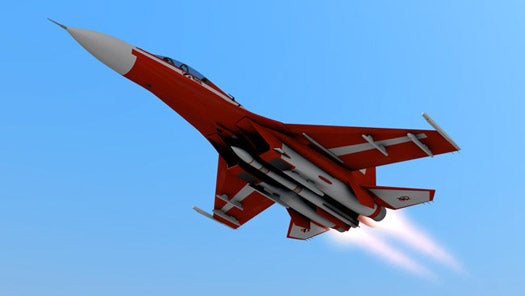
Building a satellite and launching it into space was once a multi-million dollar proposition. But even though miniaturization and easy-to-adapt technology formats like the CubeSat have brought down the costs of building satellites, the cost of getting those satellites into space is still sky high. So while new commercial space carriers perfect their various heavy lift rockets, one emerging space company aims to send smaller payloads into space on the backs – or rather the bellies – of existing vehicles: decommissioned military jets.
NanoLauncher, an upstart satellite launching company backed by one American company and three Japanese firms, plans to take a more Virginal approach to reaching the edge of space. Decommissioned military jets will carry small satellites (those weighing less than 330 pounds) and smaller so-called nanosatellites (those weighing less than 22 pounds) several miles up into the atmosphere aboard a rocket mounted on the jet’s belly. When the plane can safely climb no hire, it will fire the rocket, which will carry the payload the rest of the way into its orbit.
The service will be divided into two divisions: NanoLauncher Blue will carry payloads to suborbital altitudes, while NanoLauncher Black will send them even higher, up to 155 miles high where they can fall into orbit. NanoLauncher Black currently has a maximum payload of 44 pounds. The company is considering Lockheed’s F-104 Starfighter and the MD F-15D Eagle as possible launch vehicles, and will work from existing facilities like NASA’s Kennedy Space Center and Wallops Flight Facility, or perhaps Vandenberg Air Force Base.The idea is to make space launches affordable to commercial and academic ventures that can’t afford the high costs associated with piggybacking on a NASA mission or launching a single-use rocket. With small satellites constructed by universities or other institutions expected to increase dramatically over the next decade, the need exists for a service that can get them into space for less than $10,000 (the average cost associated with building and launching a CubeSat has ranged from $50,000 to $150,000 in the past).
Getting to that point means NASA can focus on NASA priorities while academia and private enterprise can find a reasonable means for ferrying scientific instruments and the like into orbits for less. That means more and better science at a lower cost, which in turn is good for everyone involved, even the space carriers doing all that heavy – and sometimes light – lifting. NanoLauncher Blue hopes to be launching suborbital satellites by 2014, with NanoLauncher Black following suit the following year.
[SPACE]
Five amazing, clean technologies that will set us free, in this month's energy-focused issue. Also: how to build a better bomb detector, the robotic toys that are raising your children, a human catapult, the world's smallest arcade, and much more.


Online Content Director: Suzanne LaBarre | Email
Senior Editor: Paul Adams | Email
Associate Editor: Dan Nosowitz | Email
Assistant Editor: Colin Lecher | Email
Assistant Editor: Rose Pastore | Email
Contributing Writers:
Kelsey D. Atherton | Email
Francie Diep | Email
Shaunacy Ferro | Email
Please stop relying on Spell Check and HIRE, not higher, real human editors and proofreaders, please: "When the plane can safely climb no hire,..." Really!
Really, when it can climb no hire.. I'm pretty sure that they meant to say hire. Like.... maybe they are hiring the plane...and ... the rocket can't climb it...so... it has to launch?? Spell cheek ease my fiend !
So sad what spell check has done to writing. . .
But anyways, THIS IS BRILLIANT!! Now imagine the possibilities if they combine this tech with swarm AI theory:
- two NanoSats bring the fuel
- one NanoSat brings the optics
- one NanoSat brings the encrypted communications module
- five NanoSats bring 1 nano-'Rods From God' each
- one NanoSat brings the Self-Destruct module (gotta watch out for China)
This will help us recycle and JETS ROCK!!!
The f-15 claims a 65,000 ft service ceiling. It can make a full vertical take off. If they were to remove all the weapons system equipment and battle related items maybe it could go higher. Anyway I am thinking since it has on-board secondary restart it could be launched brought to ceiling then increase to max speed in full vertical climb past the max ceiling that is claimed. Then launch the propellant rocket carrying the satellite. Keep in mind I am thinking with flame out in mind. The pilots would have to air start or JFS start once the craft returned to a proper altitude for restart. Unlike many jets it has a very large surface area that does allow for a sort of glide effect.
Just my thoughts. on which airframe I would pick.
After looking into it that may be the the highest altitude jet that is relatively common.
On the other nearly all military service aircraft are flown well past their service life. I do mean well past. That is why so many keep falling out of the sky, and falling apart. I am not real sure it is a good idea to give them another reason to stay airborne seeing as they are usually retired fully with good reason... cracks, failures, damage metal fatigue.
Yeah it would be great I just hope that the ACES-II is working better than the aircraft just in case. Seriously most of the active military jets are somewhere near 10+/- years past service life. The newer ones I worked on were a couple thousand hours over service life. That doesn't sound like much, but it refers to in flight life. If my memory serves me correctly they were to be retired originally at 6000 hours of flight time. Then extended to 9000. Now no more extensions, but they are into 12-15k or more.
Great idea. I think the jet could climb even higher if simple solid fuel rocket boosters attached underneath its wings (using its bomb attachment parts).
When the plane can safely climb no hire????? Thanks to Pop Sci for hiring an American educated reporter.
I don't think the service life will be an issue. The service life on military jets includes stress requirements that will allow a jet to remain in one piece throughout dog-fights with massive g-forces , jerks, twists, rapid acceleration and deceleration, speeds in excess of Mach 1, and lots of hardware straped to the bottom. This is far different from a nice leisurely cruise to maximum altitude where all is quiet and wind resistance is drastically reduced.
Also, the f-15 has a ceiling of 65,000 feet while the f-105 is only 51,000. I'm not sure why they would even bother with the 105s unless the supply of f-15's is just too limited.
SR-71?
what's with all these uptight dicks bitching about the spelling.
sigh. . .where's @ChuckLiddell when you need him
lnwolf41
@Guapo, my thought exactly, the black bird would be perfect since it only does science stuff any more.
plus it can add much more delta vee to the payload.
And for you spell check people, u can thk txting 4 how we spel now.
@lnwolf41
Indeed to your last statement.
Didn't Tom Clancy talk about some sort of rocket that was hung off the bottom of an F and used to take out a Sat? Was that Tom or another book I read back in the 90s.
You all are wrong...
The U-2 would be perfect for this type of mission. Especially when the payload is less than 500 lbs. The empty weight of the U-2 is around 14,000 lbs, while its max take off weight is close to 40,000. If we put in 20,000 lbs of fuel (2700 gallons, there's still an additional 26,000 lbs available for the satellites). Don't know if there's enough room to fit all that in there...but if not, at least it'll be really, really lighter than what it's normally designed to weigh during take off. That'll probably add even more altitude to the ceiling. Especially if there's aerial refueling involved.
Remove the cameras, counter-measures and everything else of military nature, and you could probably put 10-20 mini satellites into it.
The U-2 has a ceiling of 70,000+ (probably higher, since that info is still classified)...
@ Twobrain
The F-15 wouldn't be able to go much higher than what is already its stated ceiling. The air is too thin, so thrust is greatly reduced, meaning it can't go very fast at its ceiling. You would have to fly on full afterburners for any length of time at that altitude before maybe stalling and in 30 seconds' worth of time, you would be bingo fuel and ready to drop out of the sky. The airframe isn't designed just to go high, but to carry a lot of ordnance and withstand G forces so it's just probably too heavy even if you remove a lot of extraneous gear.
@rpenri: the point of using decommissioned jets is to decrease the cost of launching satellites into orbit. there have only been 86 U2's built, as opposed to 1,198 F-15's. that fact alone makes the cost of a U2 skyrocket. but i agree, it would be an ideal platform to launch from.
OK Since I am the crew chief let me correct you the f-15 gains speed at higher altitude. The issue it does have is that the oxygen is low enough that it stops burning... aka flame out. I mentioned that. The problem with the science vessels is they (at least the ones I put my hands on) didn't have bays to carry the payload. Another thing the payload of the f-15 is over 24,000lbs. (minus the weight required for fuel in the CFT's, and wing tanks.) Enough to carry a nuclear weapon if it were needed. As I said though it has a lower low altitude speed than high altitude speed. The high altitude speed is written as something like 2650MPH. Which at that altitude based on air density works out to almost mach 4. Just doing the math and hoping available information is correct. That is also based on the older motors mind you not the ancient vmax motors. that is based on the F100-PW220. The GE motor has been rumored to add a couple hundred more miles per hour. There is a reason the world was so amazed by the American version of the aircraft and even more amazed when another aircraft was created that could match it outside the US. Just to clarify the British think that their latest as of a few years ago is finally able to outmatch the F-15E. As always though we never show all of our cards. We only share rumors of maybe. Anyway long story short I think with the final stage of burn (before flame out condition) in the range of atmosphere that it can handle if the craft maxed it's speed and pulled into a vertical climb it may be able to go higher and then launch.
A side note the reason the SR71 can go higher is that it uses a RAMJET type engine. Another note is that it was originally the RS71 until a news agency typo'd the name and it stuck... Recon and surveillance 71. Note that neither of the naming words suggest payload other than a camera. No bays no external payload. At least to my knowledge.
The U2 was also a recon aircraft with no payload bays. Another limiting factor is that the design of the U2 made it difficult to fly.
So I say again the craft I would pick is still the F-15 specifically the E model if you could get your hands on one. If I were to try to negotiate I would seek after the love machine since she never has successfully fired at an enemy. That alone would make her suitable since she is a non combat proven vehicle. Also she was a decent flier if you aren't bothered by her typical break when a target is engaged thing. Another pain in the ass bird is 86-0187 that pig serves best as a static bird, but it would probably do great as a sat launch craft.
F-15 crew chief 2A373A (For the record this is my statement of citation. It may suggest with all that I have mentioned that I know what I am talking about. Maybe not as much as some, but certainly more than others.) The designation 2A373A tells you that I was a craftsman of the F-15E platform in case you were wondering. To clarify that is as close to a Masters as you can get in that field. 2A393A would be as close as you can get to a Doctorates.
I am mistaken the RS71 was not a RAMJET it was a "2× Pratt & Whitney J58-1 continuous-bleed afterburning turbojets, 32,500 lbf (145 kN) each" Wiki
As I said had my hands on not my particular aircraft. It is faster, it has a higher altitude max, but it has a slower to get there rate of speed... the F-15 climbs ate 50,000ft/min of climb compared to the 11000ft/min climb of the RS71. Also the RS71 is noted to have sensor payload not deployable payload. The U2 would also lack the speed for the lob that I am referring to. It may climb higher, but you will retire getting there compared to the F-15E, and again no deployable payload.
Please keep in mind the U2, and RS71 were not my craft so when I refer to them it is only as hearsay. Put hands on doesn't mean worked on. The F-15 though that is my beast and she is a a mean mother.
@twobrain
Cool.
In 1985 a F-15 was used to shoot down a satellite orbiting at 345 miles. The F-15 as at 80 feet when it launched it's missle. So it clearly would have no problem putting a micro sattellite in orbit.
oops 80 thousand feet...sorry.
The SR-71 is simply unsuitable for this type of mission. It was designed purely for altitude and speed. It has no provisions for payload mounting and could not be modified without destroying its aerodynamics. Also, it is probably the most expensive aircraft in the world on a cost/hour basis. While a modified U-2 might work, it takes hours to get to altitude with a pilot and satellite launch crew on-the-clock the whole time. You might as well use a stratospheric balloon. End-of-life calculations for aircraft are indeed based on expected combat mission stresses and not straight-up straight-down missions proposed. The aircraft would be individually evaluated and refurbished as required. Various models of the B-52 operated for more than fifty years.
BTW, nano-satellite is the dumbest term yet.