The 123,000 MPH Plasma Engine That Could Finally Take Astronauts To Mars
Veteran astronaut Franklin Chang Diaz has spent four decades developing his rocket fueled by nuclear reactors and liquid hydrogen. Now NASA just might let it fly
You might expect to find our brightest hope for sending astronauts to other planets in Houston, at NASA’s Johnson Space Center, inside a high-security multibillion-dollar facility. But it’s actually a few miles down the street, in a large warehouse behind a strip mall. This bland and uninviting building is the private aerospace start-up Ad Astra Rocket Company, and inside, founder Franklin Chang Díaz is building a rocket engine that’s faster and more powerful than anything NASA has ever flown before. Speed, Chang Díaz believes, is the key to getting to Mars alive. In fact, he tells me as we peer into a three-story test chamber, his engine will one day travel not just to the Red Planet, but to Jupiter and beyond.
I look skeptical, and Chang Díaz smiles politely. He’s used to this reaction. He has been developing the concept of a plasma rocket since 1973, when he become a doctoral student at the Massachusetts Institute of Technology. His idea was this: Rocket fuel is a heavy and inefficient propellant. So instead he imagined building a spaceship engine that uses nuclear reactors to heat plasma to two million degrees. Magnetic fields would eject the hot gas out of the back of the engine. His calculations showed that a spaceship using such an engine could reach 123,000 miles per hour—New York to Los Angeles in about a minute.

Franklin Chang Diaz
Chang Díaz has spent nearly his entire career laboring to convince anyone who would listen that his idea will work, but that career has also taken several turns in the process. One day in 1980, he was pitching the unlimited potential of plasma rockets to yet another MIT professor. The professor listened patiently. “It sounds like borderline science fiction, I know,” Chang Díaz was saying. Then the telephone rang. The professor held up a finger. “Why, yes, he’s right here,” the surprised engineer said into the receiver, then handed it over. “Franklin, it’s for you.” NASA was on the line. The standout student from Costa Rica had been selected to become an astronaut, the first naturalized American ever chosen for NASA’s most elite corps. “I was so excited, I was practically dancing,” Chang Díaz recalls. “I almost accidentally strangled my professor with the telephone cord.”
All astronauts have big dreams, but Franklin Chang Díaz’s dreams are huge. As a college student, as a 25-year astronaut and as an entrepreneur, his single animating intention has always been to build—and fly—a rocketship to Mars. “Of course I wanted to be an astronaut, and of course I want to be able to fly in this,” he says of his plasma-thrust rocket. “I mean, I just can’t imagine not flying in a rocket I would build.” And now he’s close. In four years Chang Díaz will deploy his technology for the first time in space, when his company, aided by up to $100 million in private funding, plans to test a small rocket on the International Space Station. If this rocket, most commonly known by its loose acronym, Vasimr, for Variable Specific Impulse Magnetoplasma Rocket, proves itself worthy, he has an aggressive timetable for constructing increasingly bigger plasma-thrust space vehicles.
Chang Díaz describes his dreams in relatively practical terms. He doesn’t intend to go straight to Mars. First he will develop rockets that perform the more quotidian aspects of space maintenance needed by private companies and by the government: fixing, repositioning, or reboosting wayward satellites; clearing out the ever-growing whirl of “space junk” up there; fetching the stuff that can be salvaged. “Absolutely, fine, I’m not too proud to say it. We’re basically running a trucking business here,” he says. “We’ll be sort of a Triple-A tow truck in space. We’re happy to be a local garbage collector in space. That’s a reliable, sustainable, affordable business, and that’s how you grow.”

Chang Diaz At Work In His Lab
Eventually, though, Chang Díaz intends to build more than an extraterrestrial trucking business, and his ambitions happen to coincide with Barack Obama’s call for a privatized space industry that supports exploration well beyond the moon. “We’ll start by sending astronauts to an asteroid for the first time in history,” Obama said in a major NASA-related address earlier this year at Kennedy Space Center. “By the mid-2030s, I believe we can send humans to orbit Mars and return them safely to Earth.”
Such a belief may seem overly ambitious, but the goals of aviation have always seemed that way. In October 1903, for instance, astronomer Simon Newcomb, the founding president of the American Astronomical Society, spelled out a series of reasons why the concept of powered flight was dubious. “May not our mechanicians,” he asked, “be ultimately forced to admit that aerial flight is one of the great class of problems with which man can never cope, and give up all attempts to grapple with it?” Less than two months later, the Wright brothers flew at Kitty Hawk. And in the 1920s a young man named Frank Whittle was coming up with drawings for a theoretical engine very different from the propeller-driven kind, one that might scoop in air through turbines and fire it through a series of “jet” nozzles. “Very interesting, Whittle, my boy,” said one of his professors of aeronautical engineering at the University of Cambridge. “But it will never work.”

Unearthly Glow
The Chase
Chang Díaz decided he wanted to be an astronaut at the age of seven, when his mother explained the U.S.-Soviet space race to him. He went out that night to stare at the stars and look for Sputnik. But he soon realized that he had a problem. He happened to be a citizen of Costa Rica, and Costa Rica had no space program. When he was a teenager, he sent a letter to NASA asking how to become an astronaut. He got a letter back saying that to fly with NASA, he must be an American citizen. Boldness runs in his family—his Chinese grandfather fought against the Qing dynasty and fled to Costa Rica during a crackdown on the Nationalist movement. So Chang Díaz was not about to let a thing like citizenship deter him.
After graduating high school, intent on joining NASA, Chang Díaz went to live with relatives in Connecticut. Despite his limited English, he won a University of Connecticut scholarship, one reserved for American citizens. Somebody somehow thought Costa Rica was Puerto Rico, he recalls with a laugh, and after the mistake was pointed out, he was told that the scholarship was being withdrawn. He appealed to university administrators, who agreed to take up his cause with the state, and part of the scholarship was restored, enough to make it possible for him to attend college.
His work was so outstanding there that he was accepted into MIT’s doctoral program for nuclear engineering. Then he applied to be an astronaut. NASA turned him down. (Chang Díaz says it was probably because his application for U.S. citizenship had yet to go through.) After he became naturalized—he now holds dual American–Costa Rican citizenship—he tried again, as one of nearly 4,000 applicants for 19 open positions. His plasma-physics doctorate, his singular focus on spaceship engines, his superb physical condition and his obvious drive combined to make him one of NASA’s select.
Being an astronaut, Chang Díaz says now, helped him to focus even more on his own vision, and it left him with a much stronger belief that speed was of the essence to get to Mars and beyond. “Believe me,” he says, “nobody will want to sit around in a spacecraft for six to eight months if you know you can get there faster.”

Power House
In many ways, Chang Díaz sees long-range space travel as the ultimate solution to the ultimate problem. The human race, he argues, will one day inevitably conclude that it has to live elsewhere in order to survive. It is also very possible, Chang Díaz concludes, that as resources dry up on Earth, other, potentially more profitable ones may be out there in the cosmos—something vastly more useful for batteries than lithium, perhaps, or for conductivity than copper.
“Whether we’ll find gold or riches or something we can’t even imagine,” he says, “we’ll never know until we arrive there to find out. I really don’t even see Mars as the end point; I see it as more of a waypoint. We’ll open up the entire solar system. Someday we’ll find life out there, and everything will change.”
Chang Díaz compares space exploration as it has been practiced thus far to exploration as it was practiced in the early years of the American frontier, when Lewis and Clark’s government-backed expedition brought back a trove of knowledge about the American West. The next phase, he believes, will be much more like the era of growth in the mid-1800s, when private railroads and mining outfits, helped along by land grants and other government aid, opened the West to epic expansion and settlement.
But, he says, space exploration isn’t simply a question of national achievement anymore. “We no longer have a big confrontation between the U.S. and the Soviets,” he says. “It’s totally different now. We all need each other to make this work.” He hopes U.S. citizens will be involved, but even that is by no means certain. “Countries like Brazil, India, China, some in Europe—there’s a lot of the same chemistry that the U.S. was feeling, say, 50 or 100 years ago. It’s a new club of developers.”
To hear Chang Díaz describe it, we’re on the verge of a shift from a nationalistic march toward dominance to a much more open and improvisational approach to innovation. If that’s true, it’s worth noting that he emerged from 25 years at NASA with his sense of improvisation intact.
Engine Simulator
In 2000, as part of a joint American-Russian survival-training program for crews visiting the ISS, Chang Díaz flew 60 miles west of Moscow for a round of practice drills. The instructors informed him and his two fellow crew members—Kalpana Chawla, killed in 2003 aboard the space shuttle Columbia, and a Russian cosmonaut that Chang Díaz describes as being physically much bigger than both of them—that they would need to simulate a mishap that had befallen an earlier mission in which the descent capsule had landed in the midst of a blizzard, and it took rescuers 48 hours to reach it. From now on, the Russians told him, all Soyuz crew must train for those conditions.
That’s a bit much, Chang Díaz remembers thinking. “Why wouldn’t I just delay the reentry by a moment and land in Fiji, or the Indian Ocean, or somewhere else warm and pleasant?” But that was the assignment, and so the trio sat in full flight gear inside a half-buried capsule as engineers heated up the exterior to reentry temperatures with a blowtorch. “It was a sauna,” he says.
The crew then had to remove their suits and don survival gear. The capsule was so tight that the process took the better part of a day, with each astronaut taking turns being helped out of one suit and into the other. Finally, they emerged into blinding snow and looked at their manual, which told them to build a shelter. Chang Díaz rolls his eyes at the memory.
Turning to his freezing teammates, he told them to gather up the capsule’s parachute silk. His father-in-law, during hunting trips in Montana, had taught him how to build a winter teepee. With the trunks of nearby birch trees and the silk, he improvised. Half an hour later, he had a fire burning inside, and the three were soon sitting in their socks, dry and comfortable.
Soon a face poked through the flap. The Russians, watching from a ridge through binoculars, wanted to know what was going on. A teepee was not in any manual. Was everyone all right? The crew smiled.
We’re fine, Chang Díaz told them. You look so cold. Come on in. So the observers joined them, sat down, doffed their jackets, and sipped tea.

Artistic Rendering of the Vasimr Engine
The Challenge
Chang Díaz, of all people, knows how hard it is to return safely to Earth. His career was bookended by death—death that could have been his own but for the routine tweaks of NASA’s scheduling log. The agency decided to pull him off his first scheduled mission on the space shuttle Challenger in 1986 and put him on the mission just before instead. Sixteen days later, newly returned to Earth, he watched his close friends and colleagues perish when Challenger exploded 73 seconds after takeoff. He went on to fly a total of seven missions between 1986 and 2002—he’s tied for the all-time record among astronauts—and logged 1,601 hours beyond Earth’s atmosphere. Then, a few months after his final mission, Columbia broke apart during reentry, killing all seven people aboard.
Chang Díaz’s invention will do little to reduce the dangers of liftoff. Plasma engines depend on the vacuum of space and still require “venerable chemical rockets,” as Chang Díaz calls them, to reach Earth orbit. But outer space is where his work stands to vastly improve the safety of a crew. As he points out, a lot can go wrong en route to another planet. The limitation of space travel with a conventional rocket is that the rocket must use its entire fuel supply at once in a single, controlled explosion to reach Earth orbit. It then coasts along at a mostly uniform speed until it enters Mars’s gravity. NASA estimates that such a trip would take about seven months. During that time, Chang Díaz explains, there is no abort procedure. The ship cannot change course. If an accident occurs, Earth would be watching, in a 10-minute communications delay, the slow death of the crew. “Chemical rockets are not going to get us to Mars,” he says flatly. “It’s just too long a trip.”
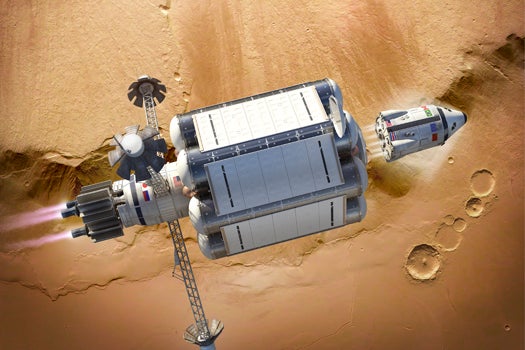
A plasma rocket like Vasimr, on the other hand, sustains propulsion over the entire journey. It accelerates gradually, reaching a maximum speed of 34 miles per second over 23 days. That’s at least four times as fast as any chemical rocket could travel, shaving at least six months off a trip to Mars and minimize the risk of mechanical dangers, exposure to solar radiation (Chang Díaz’s design shields the crew behind hydrogen
tanks), bone loss, muscle atrophy or any of a thousand other liabilities along the way. And because propulsion is available throughout the trip, the ship could change course at any time.
But human spaceflight programs are currently built around old-fashioned rocketry. NASA has invested mostly in propulsion systems powered by chemical fuel, and for sensible reasons. Chang Díaz’s rocket presents many challenges. For one thing, a Vasimr-powered Mars craft would need several nuclear reactors on board to generate the large amount of electricity required to heat the plasma. NASA set to work on a nuclear reactor for space travel in 2003 but scrapped the project after only two years—the risk of radiation from an explosion or crash was likely too great— and redirected its resources to more conventional propulsion programs. For another, no one has yet determined how to make certain that plasma gas can be safely channeled through a magnetic field. Or just how the human body might respond to traveling at speeds of up to 34 miles per second. “The reality is, rockets don’t always work,” says Elon Musk, the driving force behind the rocket company SpaceX, one of the key players in the emerging private space industry. For Musk, who struggled for years to get his Falcon 1 rocket into orbit, the stakes seem particularly high in the case of rockets carrying nuclear material. “If something goes wrong, you have radioactive debris falling to Earth—you have a disaster,” he says.
It’s true that conventional rockets would be required to put a Mars-bound plasma ship into orbit, but Chang Díaz disputes the notion that launching Vasimr would pose extra risks. The reactors would remain inactivate until the ship was out of the danger zone for spreading radiation back to Earth, he notes. And NASA has already successfully launched several nuclear-electric probes. Nothing is impossible. “We can do this safely,” he says. “Our understanding is evolving all the time, but we know that in order to go far, we have to go fast. That’s what Vasimr is all about.”