When most people think “trade show,” what comes to mind are harsh fluorescent lights and hollow convention halls, all filled with corporate drones (of the human variety) idly wandering through booths hyping the latest in office paper technology, stopping only to hover over bowls of stale candy and cheap swag.
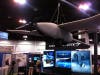
The annual Association for Unmanned Vehicle Systems International (AUVSI) event in Denver, Co. is also a trade show, down to the expansive halls and harsh lights. But instead of the latest in corporate nothingness, its booths are filled with something far more interesting: the state-of-the-art in flying robots.
Click to launch the photo gallery
We were recently on hand to find out what this sort of trade show looks like. Launch the gallery above for our photo tour.
UAV Fuel Cell
Jogjaman Jap of Singapore’s Horizon Energy Systems shows off his company’s new plug-and-play hydrogen fuel cell for small UAVs. Its proprietary chemical hydride hydrogen generator means you just add water. It produces 200W of continuous power for six to seven hours.
Integrator’s “Ikea Fasteners”
The “Ikea Fasteners” on Insitu’s new modular Integrator UAV require just a quarter turn to secure the wings. The Navy plans to buy at least 200 of the small-tactical class aircraft. The gas-powered plane has a 16 foot wingspan, weighs 75 pounds, and can fly 24 hours on its gas-powered engine.
Integrator’s Creative Landing Gear
Clips on both wingtips of the Integrator serve as landing gear: They snag the line of Insitu’s SkyHook crane and snare the plane, whose engine immediately cuts when inertial sensors detect the sudden shift. Then the operators haul the plane down like laundry.
Instead of Booth Babes…
Drone trade shows have their own brand of superfluous booth porn: Wichita, Kansas–based McCauley shows off a carbon-fiber prop used on a… manned Cessna. They make props for unmanned systems, too.
Griffin Guided Missile
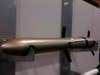
Raytheon’s new 33-pound Griffin guided missile fits the trend toward smaller and more accurate munitions, according to a spokesman for the weapon systems manufacturer. It can be directed to explode above a target, on impact, or on a fuse delay.
All-Weather Autonomous Bomb
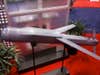
Raytheon’s new GBU-53/B small diameter bomb is touted as an all-weather seeker, allowing UAV pilots to track and destroy targets regardless of weather conditions. It’s 69 inches long and weighs 204 pounds.
Flexible Circuitry
A web of flexible circuits germinated in the MIT engineering lab of professor Mary Boyce could allow electronics to be built into a wide variety of shapes, squeezing circuitry into tighter and more aerodynamic spaces.
Nano Drones Under Glass
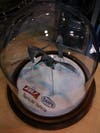
AeroVironment showed off prototypes of its nano air vehicle, a hummingbird–sized flapping-wing UAV that one day could be used as a surveillance tool that blends into the natural environment.
SAMARAI Monocopter
A Lockheed Martin engineer holds the latest prototype of the SAMARAI monocopter drone, a unique vertical take off and landing (VTOL) configuration whose one wing whirls around a central hub like maple tree spinners
This Stalker’s Always Listening
Lockheed Martin’s Stalker UAV gets a new feature that takes advantage of its whisper-quiet “hush drive” propulsion: The shot-stalker, which can identify and locate gunfire and explosives within its surveillance domain.
Skeldar Copter Drone
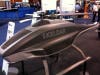
Saab and Swiss UAV teamed up to produce a line of small UAVs including the fully automated Skeldar, which has a 15-foot rotor and a five-hour flight time.
Global Hawk
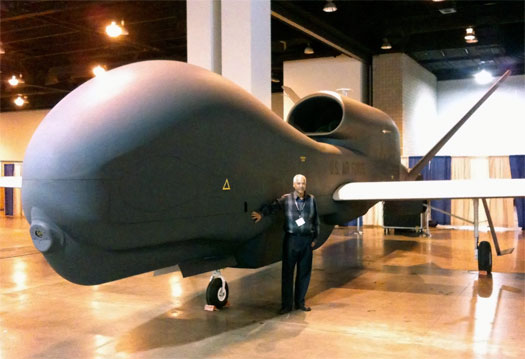
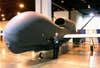
Northrop Grumman’s Global Hawk is the highest-flying of the military’s current fleet of UAVs. With its 116-foot wingspan, it can climb to 60,000 feet and has a range of 9,500 nautical miles. Another show-goer gives a sense of scale.
X-47B
Nose-to-nose with Northrop Grumman’s X-47B unmanned combat air vehicle, which is being developed for the Navy as a carrier-based bird.
Lightweight Eyes in the Sky
Rob Gilchrist, a mechanical engineer with Goodrich, shows off a new lightweight surveillance gimbal fitted with an electro optical camera and an incredibly compact infrared camera. The seven-pound T3 illustrates the effort to pack ever more functionality into smaller payloads, thus extending flight time.