Typhoons threaten the western Pacific relentlessly year-round, dogging coastal cities along the eastern coast of Asia and sometimes unleashing devastating power that can cost human lives. But even as Taiwan and China clean up after Typhoon Fanapi flooded streets and claimed a handful of lives earlier this month, a Japanese company has patented a scheme that uses submarines to downgrade the force of typhoons as they threaten to make landfall.
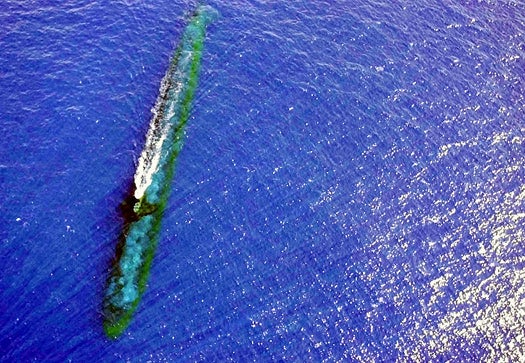
Under the plan, a fleet of about 20 subs would dive some 100 feet below the surface just in front of an approaching storm. Each submarine would be fitted with eight pumps capable of quickly dumping more than 500 tons of chilled water per minute into the water above. According to Ise Kogyo, the company behind the idea, 20 submarines could quickly lower the temperature of more than 600,000 square feet of water to the point that a storm’s strength would be diminished.
A typhoon needs water temperatures of between about 77 to around 82 degrees to form and gather steam. Cooling the water in the path of a storm could slow its rotation or even stop a gathering storm in its tracks. In theory, anyhow. A patent application is pending and the scheme may soon be approved in the U.S., though cooling the water may be the least of the problems associated with the idea. For it to work, you first have to predict the path of a storm, then get the submarines in place before the storm can change course.That’s a lot of variables, but it might be easier than setting off a series of sonic booms in the eye of the storm. As weather manipulation schemes are concerned, it might be one of the more reasonable ones we’ve seen.
Five amazing, clean technologies that will set us free, in this month's energy-focused issue. Also: how to build a better bomb detector, the robotic toys that are raising your children, a human catapult, the world's smallest arcade, and much more.


Online Content Director: Suzanne LaBarre | Email
Senior Editor: Paul Adams | Email
Associate Editor: Dan Nosowitz | Email
Assistant Editor: Colin Lecher | Email
Assistant Editor: Rose Pastore | Email
Contributing Writers:
Kelsey D. Atherton | Email
Francie Diep | Email
Shaunacy Ferro | Email
Why use submarines? Why not determine the most likely areas to be effected by typhoons and build permanent offshore pumps to do the work when needed?
There's just too much area to cover for something like that Setarip.
http://scijinks.nasa.gov/_media/en/site/hurricane/cyclone_map_large.gif
Check out the map and you'll see that a mobile operation is really the only viable option
So how is that too much area to cover for stationary pumps but not for subs? I dont think it is at all. For one, the advantage of stationary pumps is they can be powered by renewable energy such as solar/wind/waves, and when we can determine the path of a typhoon we can quickly switch the needed pumps on well ahead of time to accomplish our goal. If we built a platform(sort fo like a oil rig in size) that housed the massive pumps and storage tanks, we can run the pipes along the proper areas coming from that one station. I think if we set up a few dozen stations along a coast line this would be a much more managable way of handling these storms.
Not to mention the fact that these would be essentially unmanned, and much more reliable.
What temp would the water be chilled to?
What would the chilling of the water do to the sealife in the immediate area?
@caradoc01
I imagine they're pumping water up from deeper below the surface where it is cooler.
Why would we want to mess with nature?
To prevent disasters. And because we can-thats my favorite answer :D
Hurricanes are a natural part of Earth's processes...that's kinda like clogging up all the volcanoes on the Earth...
You forgot to mention that we as humans are a natural part of Earth's processes.
I agree with Setarip. People keep forgetting that we humans are part of this earth too, we are part of mother natures plans, we do what we do because that's what nature inteded us to do.
Plus I don't think we would plug valcanoes, they are easier to predict and provide more good than bad.
@Setarip:
So 20 subs for a mobile solution....
OR
2,500 miles of off-shore permanent pumps...
Just guessing (my estimated costs are probably very low on the permanent pump stations):
>> Pumps need to be 1000 feet apart or closer to be effective....
>> Submarine equivalent permanent pump stations cost $500,000 vs each sub costing $10,000,000.
>> Operating costs for either system running about $15,000,000 per year
Gives an estimate of:
$200 million to build the subs
vs.
$6.6 billion to build the permanent pumps
Hmm.... 'Wonder why they propose subs instead of permanent off shore pumps? 'Seems about the same to me...
I can agree, the subs will probably be cheaper to start off with, but each system would have advantages and disadvantages. Even if the cost of the permanent offshore pumps was 7 billion(which in reality is not that much nowadays compared to what we spend on bogus government bailouts), the amount of money saved each year would be in the billions. Worth it in my opinion.
lnwolf41 The reason for the subs is you can put them much farther out to sea. so the storm cell would decrease in strength. You would still want it to land fall so you can renew the fresh water table. just reduce the storm surge.
Two points:
First, mobile is better because, essentially, this will be combat against an opposing force, namely a mobile storm system. Now I might be wrong, but I think that there are very few battle plans that involve sitting in one spot and shooting artillery these days. Everyone is mobile, so why should this plan not be?
Secondly, I would suggest thinking about what hurricanes actually DO. They disperse energy that is building up in the oceans in the form of heat. If hurricanes are not allowed to form as completely as they will do naturally, then this heat energy remains in the ocean. What would the impact of that be? Consider this; the last several hurricane seasons in the USA alone have been some of the worst on record. We've seen a hurricane in the Southern Hemisphere, a first in the written record. We can also measure that average global surface temperatures of the oceans have been growing over the past 80-100 years.
Coincidence? You decide. But I think that before we stop a natural process, we should first understand the full ramifications of what a world without that process would be like.
All that said, this plan is probably much more realistic than flying jets counter-clockwise to an already-formed hurricane. I mean, seriously.
"So how is that too much area to cover for stationary pumps but not for subs? I dont think it is at all. For one, the advantage of stationary pumps is they can be powered by renewable energy such as solar/wind/waves, and when we can determine the path of a typhoon we can quickly switch the needed pumps on well ahead of time to accomplish our goal."
Seek professional help.
When wind speed is too high, wind turbines shut down to protect themselves. Offshore wind is very expensive and very unreliable on a 50 m deep continental shelf such as around Britain. The oceans around Japan are VERY deep; kilometers deep; you're going to have to build floating wind mills capable of surviving and producing energy inside a ****ing typhoon.
Wave power must be moored to the bottom of the ocean and oceans around Japan are VERY deep. Wavepower doesn't deal well with unusually strong waves; hell they barely survive in normal waves(see the numerous failed projects; e.g. pelamis).
Solar power, in a freaking typhoon? There are clouds as far as the eye can see and there are winds that will rip your panels apart and smash the remains of them into panels down-wind; not to mention that you'd need a freaking square kilometer sized barge paved with the damn things to produce any meaningful amount of power even when the sun shines.
All of these power sources are hideously expensive, terribly unreliable, completely impractical and incompatible with typhoons.
With a submarine you just need a small reactor. You get controlable output, portability and enormous power to weight ratio.
@neuenkir
Not sure where you live but the last few hurricane seasons have not been that bad. The season after Katrina and Rita was actually very mild. The average for a season we expect four named systems hurricanes, two of which are category 3 or greater in strength at 1st landfall.
Katrina and Rita fell within the range of normal weather. It's just that they hit a part of the U.S. that doesn't usually get hit by the bigger ones.
For every action there is an opposite, yet equal reaction. I imagine that though this may help control typhoons or whatever, it will change something else in a different part of the globe. It probably won't be good either.
PopSci should be embarrassed to publish this story. Build 92,928 of these subs so you could cool a 10 mile by 10 mile area and they might stand a chance of slowing it just a little. But I doubt that would be enough to slow it down much. Come on 600,000 sq ft? I thought Japs were smart? An eye alone can be 30 miles and they want to cool a a 775x775ft square? Would probably realistically need to cool the whole eye so realistically close to 1 million of these 10 million dollar subs. So what is that $1,000,000,000,000. Sounds like a great investment. That doesn't include operating costs by the way =P Hope they have well over a quadrillion dollars to throw at this!
This seems to be one of those "pull yourself up by your bootstraps" solutions. Chilled water doesn't just happen. It takes a lot of energy to either chill water or move it from lower depths. Pumping from lower depths messes with the evolved stratification of sea life. Either way, additional heat is generated. You can't keep it on the submarine, so it has to go into the water. As with other weather control techniques, the unexpected consequences can be severe. If storms increase in adjacent areas, international lawsuits could be forthcoming.
Dear World, Please use twelve A-6D/E Intruder Aircraft with Modified Sargeant Fletcher Fuel Tanks that carry liquid Nitrogen to fly in the eye and dump/spray said Nitrogen in a large quantity(see Aircraft before mentioned capabilities) to "seed" the TYPHOON quickley and multiple times anywhere in the world within a few hours. FYI...Subs are really slow. In the future putting the cart before the horse is not recommended. Please feel free to contact me for more information.
There is an obvious problem: Cold salty ocean water sinks. It doesn't spread over a large surface area.
What you really want to do is prevent concentrated heat dissipation at the water surface in front of a hurricane.
The best way to do that is to change the surface tension of water - either by air-spraying a bio-degradable surfactant to decrease the surface tension - thereby releasing water vapor earlier over a really large geographical area - and keeping the water vapor energy from being concentrated by wind currents and sucked into a hurricane - or by increasing the surface tension by spreading a blocking liquid - like oil.
Surfactants spread on the BP Deepwater Horizon oil spill proved effective this Summer of 2010 by preventing US hurricanes from finding a ready source of concentrated warm water vapor in the loop current off the Gulf Coast. The heat was spread over a much wider area - resulting in a warm temperature high pressure system which brought an extended drought to the Southeastern US states - but also prevented hurricane incursions into Gulf Coast states.
This of course does mean that BP will probably be tested in US law courts for being responsible for causing crop damage losses in the Southeastern US states -- and BP's $20 billion dollar liability reserve fund will look like peanuts.
One side effect of the unintended BP weather experiment? Hurricanes and tropical storms were routed directly into Mexico and other Central American countries because of the warm temperature high pressure system over the Southeastern US.
This also created late summer monsoonal flows over the Southwestern US states like Texas, Arizona, New Mexico, and Colorado. When those moist warm air masses collided with cold air masses over the US Midwest, we got the flooding in Minnesota, Nebraska, Wisconsin, and Iowa. And more crop damage.
The real to-do is to increase the complexity of the weather patterns to encourage more moderate intermix of high latitude cold air masses with tropical warm air masses. This will decrease the average energy available for each tropical depression - but will increase the frequency of less intense tropical storms.
Luckily, the Icelandic volcanoes are doing a pretty good job this year of reducing insolation rates in the Northern latitudes and creating more intense cold air masses earlier this Fall.
Remember that the real investment action will be in crop futures this year and next: Winter wheat failures are expected for Russia, Canada, Northern Europe, and the US Pacific Northwest because of the Icelandic volcanoes.
In any case, the cost of a fleet of surfactant spraying planes has got to be cheaper than the cost of a fleet of 20 nuclear submarine based deep-water sump pumps. Planes would be faster and easier to deploy over a wider area while allowing each spraying pattern to be quickly adapted to changing weather conditions. There is no reason why these couldn't be UAVs for crew safety. There should be enough retired Air Force KC135's and Lockheed Tristar L1011 tankers out in the Mojave Desert to make this mission plan easy to test.
BTW: The submarine fleet is similar to a post-Katrina idea that Bill Gates was kicking around - except that he planned on using modified oil tankers to host the pumping operations - which also provided an option for spreading oil over the ocean surface.
Of course,the crews on a submarine have a greater chance of survival in the event the pumping operation is overrun by a hurricane or typhoon. But then again, Bill Gates is more anxious about over-population than most normal people.
so... it looks like a lot of discussion on cost and methods but, when you take the heat out of the water (by chilling it) where do you put the heat?
500 tons of chilled water / minute x 20 submarines.
stay with me...
100,000 tons x 20 = 2,000,000 tons / 8 (lbs/ gallon) = 250,000 gal/ minute!
250,000gal x 3.6kg = 900,000 kg = 900,000,000 grams
So this would require the collection of 900,000,000 calories per minute for... oh lets assume they're unionized sub-mariners on the day shift (8 hours x 60) 480 minutes.
432,000,000,000 calories.
I'll admit i don't have a frame of reference for this volume of energy, in the form of heat, And I dont know I may be down a rabbit trail but...
What Do They Do With The Heat?
Hey....brain trust....stop trying to act like this is going to work..OR picking it apart. It may have mild success if they can have all the ideal conditions line up and can make subs travel at untold speeds. GO BACK TO MY PREVIOUS COMMENT and you will see a viable solution that will work...wrapping yourself into a lengthy physics discussion may be somewhat entertaining but this has never been hard to solve..just no one really wants to solve it for a number of hideous reasons. Dispersal of heat can be accomplished many ways..so look at all 3 sides of the coin please. So why would you waste time cooling massive amounts of sea water....when cooling the Typhoon directly is easier and quicker. It is the equivlent of using scissors to cutting your lawn...when you have a lawnmower in your garage.
Suppose an airplane would drop electrically-charged glitter into a hurricane. The glitter would electrically charge the wind. The wind would make the electrical charge move fast, which would create a magnetic field, which would slow the glitter and slow the wind.
I already thought of this idea long ago to place scoops on a fleet of nuclear subs that would thrust cold water upward in front of the storms. However, they didn't produce electrical power to reduce GHGs and the fuel they burn would also warm the oceans thus causing more global warming. The "Underwater Suspension Tunnels" are a better option according to the National Hurricane Center and HRD!!
http://www.youtube.com/watch?v=0fh_RXiEinU
http://www.youtube.com/watch?v=Z6O6UHpKT_E