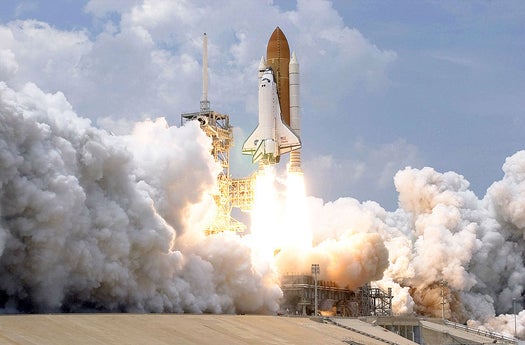
As Congress adjourns there’s still plenty left for them to argue about, but NASA’s mission going forward isn’t one of them. The House of Representatives passed a NASA authorization bill late last night, outlining the budget – $19 billion in 2011 and $58 billion through 2013 – and goals for the space agency going forward. On deck: increased commercial space investment, a new heavy-lift rocket, and a focus on future deep space missions to an asteroid or even Mars.
The bill was also the final nail in the coffin of the Constellation program, which was already effectively dead anyhow. But remnants of the program will live on as NASA retools its mission to tackle the challenges of the new century, most essentially an extension of manned exploration to regions of space beyond the moon.
Perhaps the most important philosophical shift represented in the bill is the eventual transition of low-earth-orbit activities to the hands of private space enterprises. The bill sets aside $1.3 billion over the next three years for investment in commercial spacecraft that will eventually become the workhorses for transporting personnel and materials into LEO.The bill also officially extends NASA’s role at the International Space station through at least 2020 and adds one more Space Shuttle flight to the two already scheduled before the program is retired next year. The new final mission will likely fly around June of next year aboard the shuttle Atlantis. It’s not yet clear exactly when commercial space carriers will be able to take over cargo and personnel flights to the ISS, and in the meantime the U.S. will pay the Russian space agency to ferry goods and people to the space station and back.
The bill embraces many aspects of the space plan President Obama unveiled in February – enhanced commercial spaceflight investment and a goal to put a man on an asteroid by 2025 – but in some respects it attacks the plan more aggressively, a welcome signal from Congress that it is serious about maintaining NASA’s status as the global leader in space travel. Under the bill, NASA will begin work on a new heavy-lift rocket next year, four years ahead of the President’s proposed schedule.
[Space]
Five amazing, clean technologies that will set us free, in this month's energy-focused issue. Also: how to build a better bomb detector, the robotic toys that are raising your children, a human catapult, the world's smallest arcade, and much more.


Online Content Director: Suzanne LaBarre | Email
Senior Editor: Paul Adams | Email
Associate Editor: Dan Nosowitz | Email
Assistant Editor: Colin Lecher | Email
Assistant Editor: Rose Pastore | Email
Contributing Writers:
Rebecca Boyle | Email
Kelsey D. Atherton | Email
Francie Diep | Email
Shaunacy Ferro | Email
I am happy about this. I say moon base first though. Going to an asteroid seems senseless to me.
I agree, going to an asteroid is too much like the marginal movie "Armageddon". In the sense of full disclosure, I am not an Obama support in the slightest, but if Bush would have come up with that I would have slammed him just as hard.
I moon base is the first logical step to a settlement on Mars. It is not "going" to the Moon, it is learning how to live on the Moon that is the hard part. I am astounded how few people get that. It is fine if you think that we do not need to go to either, but if we ever plan to settle Mars, we must go to the Moon first.
exactly John.
The moon is the only logical place to study the long term effects of being out of the Earths safety net.
Parking a manned vehicle on an asteroid will do nothing to prepare humans for deeper space travel. What would happen if we accidentally shifted the trajectory of the asteroid when landing on it and it became earth threatening? Leave the moving stuff be until we can get on solid ground.
Next Chinese heavy lift booster
Since the Chinese with a top down political system could care less about greenies, a modification of Freeman Dyson's Orion scheme would give them all the lift capacity for which you ever envision a need.
Drill a 2 mile hole in a salt formation. Put a small nuke at the bottom in a water tank, put a thick steel plate on top of the tank with a automated payload capsule on top. Light the nuke and let er rip. When the projectile exits slam the door shut and redirect the radioactive steam back underground. Radiation leaks - a lot less than the daily radioactive output of one of their coal plants.
3000 tons at $10 a lb straight to the moon. Seal the hole and drill a new one for the next load.
Great for compressable are ice, steel,frozen food,fuel tanks, rocket fuel, circuit boards, nuclear fuel, copper wire and a thousand other commodities needed in space.
Humans and flower petals will have to be launched another way.
Google 150-kiloton-nuclear-verne-gun for more
With the cargo capacity available, a simple very efficient spacebased transport could use the nuclear engines from stolen NASA Nerva designs since we aren't allowed to use them.
We can actually learn a great deal of usable science from a trip to an asteroid-
First, the proposed trip will extend about 7 million miles away from Earth, much farther than a trip to the moon, and a better scenario for the hazards of a trip to Mars(instant communication becomes impossible, solar flares during the much longer journey, the isolation that will be experienced since the earth will be a very small dot at that distance, and, of course, the even greater self-reliance required to handle any problems that might occur).
Another thing we can learn in great detail will be the sapling and analysis during the stay on the asteroid-much more detailed and spontanious than robot alone could manage.
Finally, the obvious thrill of a civilization making its first mission well beyond the Earth-Moon system!
I didn't mean that it would be a useless venture. Sure a lot of things could be learned from going to an asteroid.
What I am saying is that is a dream to be realized after we can safely and effectively live for long periods of time off of earth. It is much easier to study things from a low-gravity situation without any atmospheric distortion, like, say, from the moon.
Also much easier to move back and forth from the moon since you need relatively little thrust to break the pull of lunar gravity as compared to Earth gravity.
Weigh the pros and cons of going to the moon or an asteroid first. Easily a lunar winner.
This bill being approved is a great win for humanity. It is expected to be signed into law on Friday.
Political battles will continue, but the law will establish commercial space as a key part of US space policy.
It also provides for a balanced space program with a less ridiculous approach to a heavy lifter.
A robust, global commercial space industry will be the engine that enables humanity to expand off planet!
What a great decade to be a space enthusiast!
[
People often ask, "What is commercial space?":
Commercial Space = space missions where companies develop spacecraft to their own specs and get paid only when/if those spacecraft deliver on a contracted goal. Example: $100 million for delivering 5 MT of cargo to the ISS.
-- The key point is that the financial incentive is to maximize profits by completing the mission quickly, safely, reliably and economically.
Old Space = space missions where companies develop spacecraft and run missions to their customers' specs and get paid for every dollar they spend plus a contractually determined profit margin. Example: $200 million to try to deliver cargo to the ISS - oops it didn't work - $300 million more to clean up and try again....
-- The key point is that the financial incentive is to maximize profits by dragging out the mission as long as possible using overly complex and expensive mission solutions.
Under the new law:
>> Transport of cargo and crew to LEO and the ISS will be via Commercial Space.
>> The new heavy lifter development will be mostly Old Space (cost-plus).
]
Moon - been there, done that, and unsuitable to long term habitation (insufficient gravity for long term human life). Useful when exploitable, but we are nowhere near that.
Asteroid - useful. Undone. Further out. Possibly metallic (and thus more useable). Landing on a smaller target (good if we ever do need to move/destroy one).
Mars - honestly, less interesting than Venus.
@SpaceSamurai
Exactly why this is a good idea.
@GTO
Actually pioneer10 is right. Missions to asteroids beyond the Earth-Moon system will better prepare us for the rigors of getting to Mars. However you are right about how our moon will serve as a platform for colonial development on a terrestrial body. Although the same could be done with asteroids, the moon is a lot closer.
If we're to get to Mars, we will have to tackle the difficult first and make greater leaps forward. We've already been to the moon. We can and will go there again (even if it's other nations that are leading the endeavor to do it for the first time; from their perspective). We have to continue to go further.
@JohnR
I'm sure your statement is born of the desire to see a human colony on another world, but trust me when I say that time will come. Your political preferences aside, you have to accept the fact that the proposal that President Obama put forward was truly revolutionary (simply because very few to no one else is doing this; save Russia). This is why congress passed a more aggressive version of this proposal into Bill format. Even though politicians from the right were combating the idea because of the same idealistic back-and-forth nonsense that holds much of human progress back, they eventually had to sit down and think about the proposal. When they were done playing there Washington gang war of Bloods versus Crips (Blue vs Red; color play on the political parties. But if you don't like that, how about Triads vs. Yakuza, or Italian vs. Russian mafia. Same level of ridiculousness that defines American politics today) they too had to admit that it was a very good idea in the end that would allow our economy to flourish with a new and popular market that would break the commercial aerospace monopoly held by Russia, allow humanity greater access to space, and spawn competition that would increase the growth of technological advancement in the U.S. eventually allowing not only NASA but private industry to go further (in terms of space). You don't have to like someone to admit when they have a good idea. If people like Adm. Mahan, Gen. Mitchell, Gen. Lemay, Albert Einstein, or Isaac Newton were alive today, you'd probably not like any of these individuals personally, but because of what they've accomplished in they're own right makes them worthy of the recognition they deserve regardless of what kind of person you think they are.
"Welcome! to the Federation Starship SS Buttcrack!!!"
@Oakspar77777
The moon is exploitable. Going there is necessary, but I do agree with your "Been there, done that," sentiment. Other nations are shooting for the moon. I say BRAVO! Humanity wins in the end. Meanwhile the world's elite aerospace center can push out further.
As far as Mars is concerned, Venus is arguably more interesting (not to mention closer), but I don't see us making endeavors to land there in the near future on account of the fact that that planet is immensely hot. I don't believe there are environmental suits capable of withstand the harsh environment to allow a manned crew to survive entry into the atmosphere let alone dwelling on the surface.
"Welcome! to the Federation Starship SS Buttcrack!!!"
How long is an asteroid orbit? Could we spend a few months sending modules to an asteroid as it approaches for a close fly by then ride the asteroid to another location [Mars]. If the whole orbit is way too long to wait through then have a return stage. I'd imagine fuel for only 1 way would be much easier to bring than fuel for a round trip.
If we built it to handle space for half a decade or so unmanned we could maybe reuse it, assuming it passes nearby again and hasn’t been hit by other space debris.
Just a thought. Landing on an asteroid opens plenty of possibilities.
@pheonix1012
Your response begs a question from me. You said "but trust me when I say that time will come". What credentials (engineer, scientist, physicist, etc.) or crystal ball do you have that guarantees that? An asteroid hitting the Earth (and we are overdue for a strike, statistically speaking) can change that in a blink of the eye. Oh, and just in case you are wondering, I am an engineer and I have friends that are actual rocket scientist...and they did not stay at a Holiday Inn Express last night.
I never once said anything negative about commercial space flight but since you bring it up I am huge advocate. The private sector will do better, the only issue is all of the numb-skulls out there who really have no idea just how hard it is to go into space (let alone go to another planet) harp on and on about how the private companies would already have flown to Uranus given the budget of NASA (sorry for the pun, I could not help myself).
Lastly, I do not think I gave you enough information in my post to discern who I do and do not like. By choosing to disclose I am not a supporter of Obama in the slightest, the best you can imply is that I am one of the 50-65% of the people who do not support him (depending upon which poll you believe). My purpose in disclosing that was to say that going to and asteroid just because it has not been done makes no sense regardless of who's idea it was. That is a perfect job for robotic probes. There is a purpose to going to the Moon/Mars and that is to expand the footprint of humanity so if that overdue asteroid does hit us, all of us will not die. I do not care how many exoplanets we find, at this point, we are the only (marginally) intelligent life in the universe, as far as we know, and therefore unique.
I feel that a moon base is not only good for us in that we can learn how to live on a different celestial body, but also for other deep space missions. The moons gravity is 1/6th of ours, and once we establish a base there sending astronauts to other bodies will be easier and cheaper.
I am all for space exploration, and think that at this time robotic/instrumental exploration is the best way to do it. Sending a man to these remote locations is a great feat, but accomplishes nothing. The idea of colonizing the Moon or Mars is, I think, irrational and near impossible.
The primary problem is the low gravity. People who live in the space station have to exercise rigorously to maintain muscle. This will be to a slightly lesser extent on the Moon or Mars, but difficult to keep up for long periods of time. Anybody that lived on Mars for a long period of time may find that they cannot come back to earth and cope with the higher gravity.
I support the concept of a large wheel like rotating space station with earth normal gravity for the occupants. They could be large enough to be a city. If you want to move off the earth's surface then this is a much more practical approach.
Does anyone else notice that this no extra money to nasa... 19.3 billion a year is no extra money for nasa. It does give some direction but more funding is needed. When it comes to something throwing money at would help its nasa.
@thisguyhere
the problem is that most taxpayers and lawmakers have ZERO clue as to the ROI that NASA provides.
I would be more than fine if they rolled the NASA budget into the DOD budget as long as it was not wasted.
If you can not see the money trail, no one cares.
I wonder if some major corporations and the government are seeing dollar signs in the idea of focusing on asteriods? If they gain the knowledge and expertise of that kind of mission, it could eventually lead to mining the resources from asteroids, and using them as vehicles to travel, and ship goods and resources through space. They might be able to mine moons and planets in our solar system, and use these asteriods as mules, if they dont mine the asteriod itself. I am sure the govt has pretty big think tanks within NASA laying out the scenarios. Then the govt puts a political spin on it and comes up with ideas that may not be obvious to the general public. Maybe they need a lunar base on the moon, but sometimes its better to let someone else do the dirty work, like the Chinese.
. . . . like the Chinese
The ROI on going to the moon is not obvious. That's the problem. There are thousands of items which exist today because of the moon landing. We had to create "things" that would work on the moon and yes, that's great but we could have created them anyway. Does that make going to the moon worth it?
Not really - it just means that tax dollars forced/incentivized a really smart group of people to solve problems that they ordinarily would not have been so interested in solving without that funding. War is the same way. You can't justify war by saying but look...we got long range planes (aka bombers) out of it.
This is really no different than any sort of government funded project.
Where things get really exciting through is when you get commercial enterprises interested in expansion to the Moon/Mars/Asteroids.
If the moon was made of gold/diamonds/nickel - we'd be all over it. It isn't though. It's a big disappointment. If Mars had cool stuff great but it doesn't, it's just further away. Yet it is that further away part which motivates really smart people to make inventions to get us there. And that is where there's hope.
Anyway - NASA is great but commercial operations need to get us into space and unfortunately until someone says "Hey if you make this in space, it works better" or someone says "Hey you can only make this cure for 'x' in space"...we are in trouble. Tourism works for Jamaica but not for the moon.
Don't get me started on colonization. There's no reason to colonize unless we can use a mineral there that doesn't exist here. Otherwise there's no business reason to go there. Governments funded expansion to the Americas but it was business which kept the ships coming back again and again. Shame there aren't any beavers or trees on Mars. This would be a no brainer.
so what ur sayin is, we shot let loose the scientists and be happy with what ever scraps they leave us?
This Bill is basically useless for advancing commercial space for this reason... The Government has strings attached to the 1.3 Billion over three years... they basically say how it should be spent and for what purpose. These kinds of "funds" look good on paper but is entirely wasteful. The smart space companies will avoid the money if too many strings are attached, and I hope NASA get's canned or starts to get reimbursed financially on the discoveries they make that trickle down to the consumer industry, where they make billions collectively off of NASA tech and NASA gets buttkiss. THis Bill is horrible. The better approach would be to have a kind of X-Prize, No strings attached reward for the first company to get a rocket ship 9 meters a second instead of the 4-6 we currently have. Or just say the first company to have the capability to get astronauts to the ISS get's X amount, no strings attached.