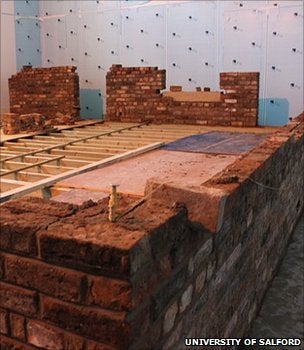
Older homes have a certain charm, but they’re notoriously inefficient — they’re drafty, under-insulated, and equipped with old, energy-guzzling appliances. In an effort to study potential improvements, British researchers are building an “energy house” inside a special three-story shell that can generate rain, snow, wind and varying humidity levels.

By studying the different ways the house consumes energy, researchers hope to come up with ways to improve efficiency and reduce carbon dioxide emissions, BBC reports. The terrace-style home, designed by researchers at the University of Salford in Manchester, is thought to be the first of its kind in Europe.


Construction is only a few weeks in, but a virtual tour of the house shows a sharp-looking brick building with nice bay windows, stylish bathroom sinks and energy-efficient appliances. It is designed to resemble the two-up, two-down terrace-style homes that make up about 15 percent of UK dwellings, the researchers say. About 2 million Britons live in homes like that, which were mostly built prior to 1920.

The home’s snow globe shell can generate whatever conditions the researchers want, unlike other test properties that depend on Mother Nature.

In addition to creating the weather, the researchers will work with psychologists, health experts and sociologists to come up with sustainable solutions. They hope to study whether the use of certain colors and wall coverings affect how we perceive temperature; whether smart meters showing real-time energy use will affect behavior; and if game consoles like the Wii could be used to convert residents’ physical energy into a home power source, for instance.

The house is expected to be completed in February.

[BBC]

8 Comments

I like how it's only "thought" to be the first of it's kind in Europe. Little did they know, Evil McSpankensmire had built his own home in a snow globe many years before this!

The real problem with all these great ideas is that they are not for the masses.

Like I saw a show where a woman built a very efficient home for about just about it would cost for a conventional home. But the problem is how many people really live in a "custom" built house? The rest of us buy what the builder makes for the most part (with cosmetic changes), or buy existing houses. Until you can convince the builders to change their ways the point is mute.

@tcolguin Every idea has to start somewhere, if anything you should be angry at the builders who probably wouldnt adopt any new ideas because they would have to go back to learn all the new techniques and such.

Actually I'm not angry at anyone, and no I don't want these people to stop looking for good ideas. I think what they are doing is great. I was just pointing out, that if their ideas are going to amount to anything it has to be picked up by the masses. And the reason it currently isn't is certain partly the builders fault, and also the consumers, for not demanding better, or wanting to get the cheapest priced house at the cost showing up in the future.

I trust they are using energy efficient snowmakers and recycled water for this boondoggle.

And why are there no windows in the structure for solar effects? What kind of energy efficiency is that!? Are they going to use artificial solar lamps to generate the heating cycles?

And who gets to live there? Al Gore and Bjorn Lomborg?

Kermudjin, it helps if you read the article; or at least skim the first paragraph or two. This isn't an energy efficient house, it was never intended to be an energy efficient house; it is a fairly typical british house in an controlled, artificial environment where its performance can be studied.

This isn't about building an energy efficient house. It's about building a common 1920s style house inside a controlled environment. Scientists will study the house's energy consumption under different weather conditions to try and discover cheap and efficient ways to make *regular* houses more energy efficient.

Reading is a great way to get information, folks.

Interesting project, many things can be studied with that. Traditional houses were built in specific times and conditions, with limited technology and common materials to what can be built today. People are using new tools and technology for adaptation, since it's getting harder to get old materials, but problems are the same, weather, water, ground movement and biological organisms causes various problems and energy losses. Perhaps those solutions shouldn't be so simple and compact but classical materials interconnected with new composites and biology, similar to clothes, like natural shell and skin interface with nature. House could be a home to various plants that would support structure by strengthening foundations, protecting walls and driving moisture away, allowing clean air to flow trough it, resist fire or even connect buildings in the area to be more earthquake proof. Today we have knowledge, technology and materials, that can be tested in time capsules instead trough centuries of adaptation to natural environment, energy house could simulate some changes in living environment that is also rapidly responding and influence structure efficiency. Instead of constantly fighting those problems, adaptation to living environment would help adapting to weather, seasons and steer those physical forces away to harness their energy, like entropy speed reduction shell and energy collector for house residents.


June 2013: American Energy Independence

Five amazing, clean technologies that will set us free, in this month's energy-focused issue. Also: how to build a better bomb detector, the robotic toys that are raising your children, a human catapult, the world's smallest arcade, and much more.


Online Content Director: Suzanne LaBarre | Email
Senior Editor: Paul Adams | Email
Associate Editor: Dan Nosowitz | Email
Assistant Editor: Colin Lecher | Email
Assistant Editor: Rose Pastore | Email

Contributing Writers:
Rebecca Boyle | Email
Kelsey D. Atherton | Email
Francie Diep | Email
Shaunacy Ferro | Email

circ-top-header.gif
circ-cover.gif
bmxmag-ps