Boeing Will Launch Space Tourism Business, Lifting Off in 2015
American space ambitions have, for the most part, maintained a well-defined line between space exploration and space tourism, But that...
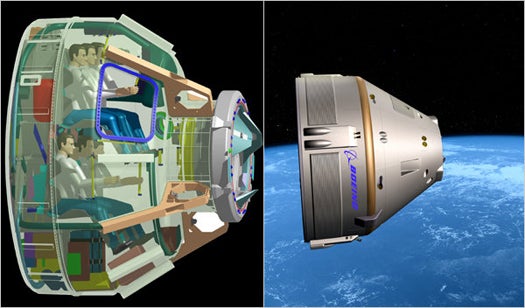
American space ambitions have, for the most part, maintained a well-defined line between space exploration and space tourism, But that line has now blurred considerably as Boeing announced that it is entering the space tourism business, selling leftover seats in its Crew Space Transportation (CST) spacecraft after the initial four are filled by embarking and returning crews bound for the International Space Station.
Boeing and Las Vegas-based Bigelow Aerospace won an $18 million contract from Boeing earlier this year for development and testing of a space capsule capable of carrying astronauts to the space station and back. Boeing’s planned capsule would seat up to seven passengers, and since space station crew rotation missions generally require four NASA astronauts, three seats would be available for commercial sale.
Boeing stopped short of naming a price, but it did indicate that flights could begin as soon as 2015 and that it’s already prepared to speak to interested customers. However, Boeing and Space Adventures (the company that will handle the bookings) did say prices would be competitive with previous Soyuz flights, which most recently charged $40 million for an eight-day round-trip to the ISS.
Russia, of course, has been selling seats aboard its Soyuz spacecraft for years, allowing wealthy tourists the opportunity to launch alongside Russian cosmonauts, accompanying them on their missions. But NASA has thus far refrained from entering the space tourism game, though it has lent support – monetary and otherwise – to private ventures that eventually aim to enter the private space tourism business.
In a larger context, the blurring of the line between NASA and its commercial counterparts could signal an embracing of the Obama administration’s vision for future American spaceflight, a vision that calls for increased reliance on commercial ventures for orbital trips to space and a shifting of NASA’s focus to deep space exploration. Some members of Congress, specifically those on the House Science and Technology Committee, feel that such a shift strips NASA and America of their space dominance.
But considering we’re supposed to find a habitable exoplanet by Memorial Day of next year, perhaps a transition toward deep space technologies is in order after all.