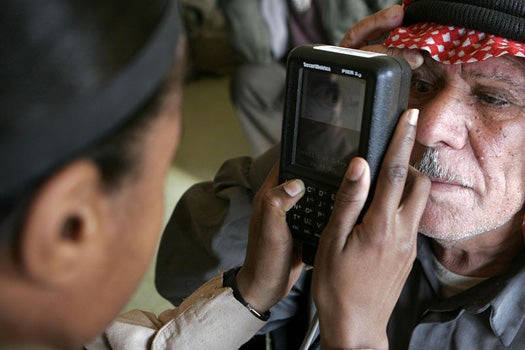
Biometrics in Baghdad A U.S. marine uses an iris scanner to identify a city council member in Baghdad.

Biometric systems – those that identify individuals based on unique biological characteristics like fingerprints, retinal patterns, voice, or facial features – have long been considered the future of security protocols. Technological advances over the past decade in particular have made them much more widespread in practical application, but a new report form the National Research Council says that could be a mistake, as the systems are “inherently fallible.”

The report – commissioned by security-inclined bodies including DARPA, the CIA, and the Department of Homeland Security – found that while biometric systems are effective at certain specific tasks, the promise of biometrics has surpassed the actual technological delivery, and that could lead to serious problems as the systems are rolled out more and more widely.

The systems, the report argues, rely on probabilistic results, which by definition are imbued with a certain degree of uncertainty. Further, biometrics aren’t static; the characteristics largely perceived as positive identifiers actually can change over a person’s lifetime due to age, disease, or other factors. This can lead to false-positives or an inability for a system to make an ID at all. Further, the systems’ effectiveness is as reliant on human competence as it is on the technology itself.

This kind of inconsistency is obviously not ideal in situations where making a positive ID is critical to security of both information and personnel. But, the report says, that doesn’t mean biometric systems should be scrapped. What it does mean is that careful systems-level considerations need to be made when integrating biometrics into a security portfolio – and that security schemes need to be exactly that: portfolios.

Biometrics, uncertain though they may be, are still effective if employed in the proper ways, but there need to be secondary measures in place to back them up, and operators should employ them with the expectation that they will make errors, in some cases frequently. Because nobody is perfect, not even security tech’s next big thing.

6 Comments

Yeah, let's follow the argument. Iris scans are no longer going to be reliable... Let's scrap that for direct computer to computer communication. It is the only thing that doesnt change... I know let's put a unique computer chip in your right hand or in your forehead that can be scanned.... Just sayin'

so, your saying replace biometrics which is your own body and might be off a bit with a chip that can be scanned, and if it can be scanned what is to stop someone from scanning it with a hidden scanner, a sensitive reader can pick up the signal intended to only travel a few inches from several feet away allowing someone to scan a chip with a device in a pocket, then take the info and encode it into another chip and walk right into the secure zones.

This fact is why I keep my remote scanable credit cards in card sleeves that block the signal.

I think the problem is that, while all security systems are fallible, biometrics are currently being marketed as infallible, as they rely on your "unique" bodily identifiers. I'm sure the report's purpose is just to make people aware of that shortcoming so that they can address it.

All this stand off ,instant ID technology is a terrible invasion of privacy Implanted chips, biometrics, unified and central banking cards, tracking passports,web pages that unwillingly share information across pages. All Sold under the catch all "Well if your not doing anything wrong why should you mind?" Look how inaccurate polygraphs are and in some circles are treated as gospel.People have come to expect urine and blood tests by employers when they haven't ever done drugs. Its always sold as protecting the public good. The governments and banks or anyone else thats not involved in criminal investigations has no zero nada right to this massive data collecting.To be under constant and continual surveillance or have huge data banks filled with cyber and real tracking shopping and logistics information that at a flick of a program that can be turned to evil purposes it is Un-American.
First its going to be sold as convenience, then its going to be pushed as law,then cash ,then guns, and welcome Big Brother and Orwell. Stop it now!Republican always say they want less government not when it comes to this kind of over control snooping.On top of that the people who develop this always have the counter measures to defeat it playing both sides to the middle.Already this type of crap has gone to far.

Instant DNA scans will be the norm in a few decades I bet. just a skin cell, a 1000cell 5 terahertz (each) pda will be able to decode your dna in a few minutes.

DNA isn't 100% accurate either...

Cancer, is damage to DNA which can cause the individual cell to replicate uncontrollably.

There's also gene therapy which is in its infancy right now, but can advance in the future to where DNA is as readily modified as computer code.


138 years of Popular Science at your fingertips.

Innovation Challenges


Popular Science+ For iPad

Each issue has been completely reimagined for your iPad. See our amazing new vision for magazines that goes far beyond the printed page


Download Our App

Stay up to date on the latest news of the future of science and technology from your iPhone or Android phone with full articles, images and offline viewing


Follow Us On Twitter

Featuring every article from the magazine and website, plus links from around the Web. Also see our PopSci DIY feed


March 2012: The Future of Medicine

A 10,000-rpm, no-pulse heart is completely revolutionizing how we think about transplants. Plus: rapid-response virus hunters, a shocking cure for migraines, the world's youngest person to have achieved nuclear fusion (in his parents' garage!), and much more.


circ-top-header.gif
circ-cover.gif