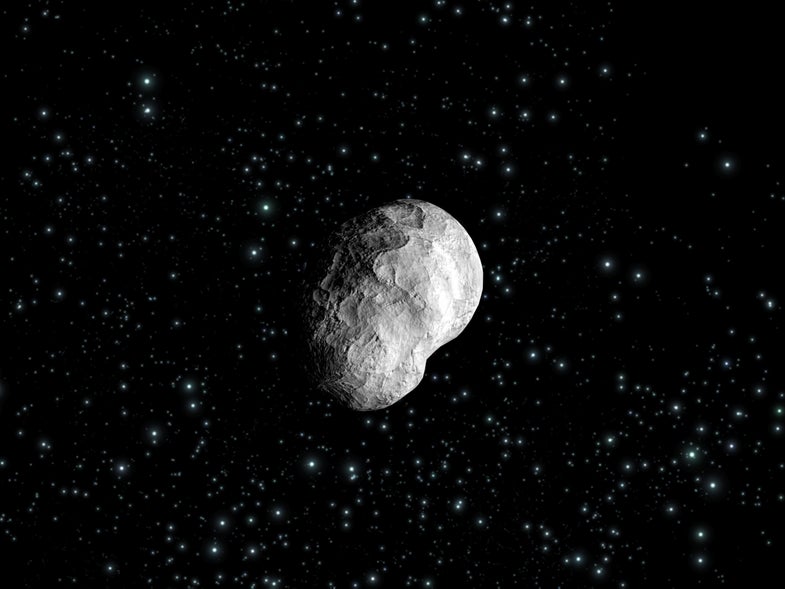
Asteroid 21 Lutetia ESA

The European Space Agency's Rosetta mission is poised for a flyby of asteroid 21 Lutetia, the largest asteroid to ever be visited by a spacecraft. On Saturday, July 10, Rosetta will skim past Lutetia at a speed of about 33,000 miles per hour, coming to within 1,965 miles of the asteroid.

Researchers and engineers at ESA and about two dozen European and U.S. institutes and universities have been preparing for the flyby for several months, working on a series of commands that will enable onboard instruments to autonomously conduct observations as the spacecraft passes the asteroid. The OSIRIS (Optical, Spectroscopic, and Infrared Remote Imaging System) camera, operated by Germany's Max Planck Institute, will capture visible-spectrum images at Rosetta's closest approach. About four hours before the approach, mission controllers at ESA's European Space Operations Centre will flip Rosetta over into its Asteroid Fly-by Mode, which keeps the spacecraft oriented in the imaging instruments' field of view.

The flyby will be the second of two close asteroid encounters scheduled for Rosetta, which began its journey in 2004. The first was a flyby of 2867 Steins, a much smaller asteroid than 21 Lutetia, on August 4, 2008. In 2014, Rosetta will undertake its primary mission of orbiting and exploring Comet 67P/Churyumov-Gerasimenko. The spacecraft's small lander Philae will touch down on Comet 67P's surface to conduct the first-ever exploration of a comet at close range.

A live webcast of tomorrow's 21 Lutetia flyby will be available on ESA's website beginning at 6:00pm Central European Time (12:00 noon US/Eastern).

[ESA]

10 Comments

How fun ^.^ Checking out big rocks in space! Why not? So what exactly are we looking for with this "comet rover"?

First, I think they are making sure of having the skills to at least approximate to an asteroid, not a small task. The comet comes next, which is going to be much more difficult.

Second, the data can come handy, for many different reasons, knowing what composes asteroids may be useful for researches on how the solar system was formed, for geology studies, can be useful even for future mining industries, and, why not? the data may save our asses if an eventual asteroid is head our way.

I got that part. What I meant was what is the probe designed to look for.

Great report - this is really going to be an exciting flyby! As a kid, I used to read Popular Science magazine and spend hours imaging what it was like to travel in space. Now, working on the ESA website, I get to report on some of the coolest spacecraft and missions - and see our news shared in good 'ol PopSci!

Waste of money, time, and effort.

@Cetus93

Are you one of those people that think exploring space is a waste of money and effort? If so you do not belong on this site. Here we believe in the advancement of technology, science, and exploration.

Now why don't you try to explain your thoughts instead of just saying something that doesn't make sense at all?

Yeah Cetus! WTF mate? How is any attempt to further knowledge a waste? I can think of hundreds of government programs that should be cut before this one. Not to judge but... Why are you here commenting if you don't have an interest in these things being done? You should be excited not pissed. I admit that this mission doesn't get my heart pumping but knowledge for the sake of knowledge is never (ok rarely) a bad thing lol

I gotta tell you, people; I had really high opinions of the work coming out of Max Planck, but this Rosetta thing, the operator was supposed to start shooting when they got this close. They will never earn shields this way. Let someone else play now.

I gotta tell you, people; I had really high opinions of the work coming out of Max Planck, but this Rosetta thing, the operator was supposed to start shooting when they got this close. They will never earn shields this way. Let someone else play now.


June 2013: American Energy Independence

Five amazing, clean technologies that will set us free, in this month's energy-focused issue. Also: how to build a better bomb detector, the robotic toys that are raising your children, a human catapult, the world's smallest arcade, and much more.


Online Content Director: Suzanne LaBarre | Email
Senior Editor: Paul Adams | Email
Associate Editor: Dan Nosowitz | Email
Assistant Editor: Colin Lecher | Email
Assistant Editor: Rose Pastore | Email

Contributing Writers:

Kelsey D. Atherton | Email
Francie Diep | Email
Shaunacy Ferro | Email

circ-top-header.gif
circ-cover.gif
bmxmag-ps