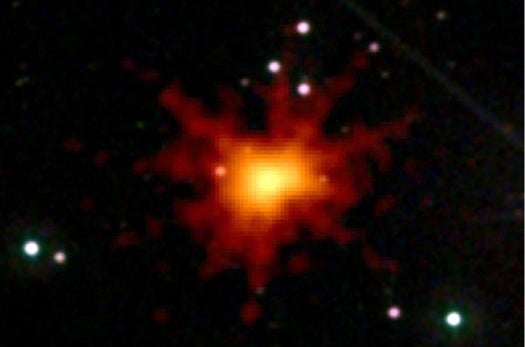
NASA scientists have figured out what temporarily knocked out the X-ray detector on the agency's Swift space observatory earlier this summer: the strongest blast of X-rays ever recorded from beyond the Milky Way slammed into Swift unexpectedly, overwhelming the detector and puzzling mission handlers for a moment. But good luck sending a bill to the culprit for time lost; the X-rays were spawned 5 billion years ago during the violent explosion of a massive star as it turned into a black hole.
The gamma ray burst that struck on June 21 was the brightest light source ever recorded in X-ray wavelengths at that kind of distance, though in optical and ultraviolet wavelengths it was more or less ordinary. It was bright enough that the software that NASA uses to analyze the data from Swift simply shut down, as it was unable to keep up with the overwhelming number of photons bombarding the sensor. One researcher who helped write the software likened the burst to trying to measure the flow rate of a tsunami with a rain gauge and a bucket.
The software did resume capturing data shortly thereafter, recording the evolution of the burst and recovering the data that Swift detected during the software shutdown. From that, they were able to piece together a numerical picture of the intergalactic attack: 143,000 X-ray photons per second during peak brightness. By comparison, the brightest ongoing X-ray source in the sky is 500,000 times closer to us yet only sends 10,000 photons per second our way.Dubbed GRB 100621A for those keeping score at home, the gamma ray burst was 5 times larger than the brightest one previously seen, and until it happened many thought such a bright burst wasn't likely or even possible.
[PhysOrg]
138 years of Popular Science at your fingertips.
Each issue has been completely reimagined for your iPad. See our amazing new vision for magazines that goes far beyond the printed page
Stay up to date on the latest news of the future of science and technology from your iPhone or Android phone with full articles, images and offline viewing
Featuring every article from the magazine and website, plus links from around the Web. Also see our PopSci DIY feed
Science is reinventing play, from extreme sports to gamification to ridiculous roller coasters to the playgrounds of tomorrow, and this issue is chock full of fun. Also, on a less fun note: Did global warming destroy my hometown?
It would make sense that these bursts would come from billions of light-years away, since thats the time when the universe was alot more chaotic, and these collisions more common.
It also makes sense since a burst of that magnitude too close to the earth would wipe us all out, and then no one would ever hear about it.. too bad too, event horizon would be fun to see ;D
I'm now even more curious about what effect GRB 100621A had on other equipment, it obviously wasnt very concentrated in one spot or we would have heard about it much differently... Ive always thought that a burst "5 times larger" than previous would have had drastic consequences here on the surface...our atmosphere is indeed our friend :)
from Douglasville, GA
I am not a scientist so I'm not saying that I'm exactly correct here, but I would assume that the burst didn't cause any bigger problems because it was only the brightest recorded in X-ray wavelengths. The article says "in optical and ultraviolet wavelengths it was more or less ordinary." So it didn't really send any more energy than a light bulb or UV rays from the Sun. It only caused problems for NASA's instrument because it was only detecting X-rays and wasn't built for that kind of magnitude blast. "Until it happened many thought such a bright burst wasn't likely or even possible."
It's still amazing to me to see things like this, but to also realize how truly fragile and vulverable we all are in the cosmic heavens. We've been incredibly lucky these past few hundred million years or so.
Would have been a GREAT day to lay down some X-Ray paper and take a full body x-ray photo for free!!
rogue;
Uh, X-rays are far more energetic than UV and visible light. The shorter the wavelength, the more energy. Wave your hand up and down 5" once per second. Now do it 10X/second. Now do it 100X/second.
The only reason it didn't affect the ground is that short waves like that (or even shorter ones in the gamma ray band) readily smash into atmospheric molecules and get stopped, heating up the molecules or causing secondary events (look up Cherenkov effect.)