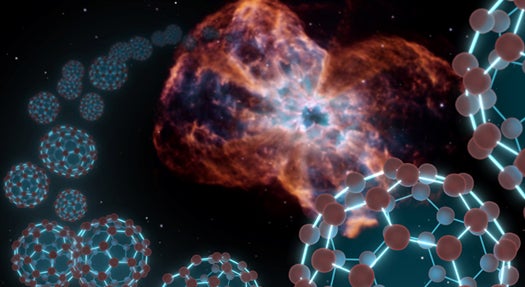
The space discoveries are piling up this week. Next up: Astronomers working with NASA’s Spitzer Space Telescope have discovered buckyballs in space for the very first time, putting an end to a decades-long search for the largest molecules now known to exist in space.
Buckyballs are so named because they resemble the geodesic domes associated with architect Buckminster Fuller (the little magnetic balls that some people keep around as a desk ornament are also a tribute to this structure). The 60-carbon-atom molecules were first created in the lab a quarter century ago and have been long since thought to exist in space, but for years they eluded researchers.
The carbon atoms in buckyballs are arranged in a three-dimensional spherical structure that gives them a soccer ball-like appearance, with the atomic bonds creating an alternating pattern of hexagons and pentagons. The structure is more than just elegant; it’s unique strength and properties have made it a sought after molecule for a range of applications including armor and superconductors.Perhaps as impressive as the buckyballs themselves is the fact that Spitzer found them at all. They were detected in a planetary nebula called Tc 1, where an aging star had likely shed a layer of carbon rich material into a cloud. Light passing through the cloud gave off the unique spectral signatures of the buckyballs, which only made their presence known because they were at the right temperature to be seen. It’s impressive enough that Spitzer can peer out into the universe and analyze its contents down to the molecule. Looking at the right place at the right time, that’s just cosmic good fortune.
[NASA]
138 years of Popular Science at your fingertips.
Each issue has been completely reimagined for your iPad. See our amazing new vision for magazines that goes far beyond the printed page
Stay up to date on the latest news of the future of science and technology from your iPhone or Android phone with full articles, images and offline viewing
Featuring every article from the magazine and website, plus links from around the Web. Also see our PopSci DIY feed
Science is reinventing play, from extreme sports to gamification to ridiculous roller coasters to the playgrounds of tomorrow, and this issue is chock full of fun. Also, on a less fun note: Did global warming destroy my hometown?
I'm by far no scientist, but I have issue with the whole, detecting molecules from lightyears away deal (my guess is there are a whole crap load of them in one dense location). What is the margin of error on something like this? Can it even be independantly confirmed? So when they tested this sensor, did they point it at Earth and detect the molecules made in the lab or something?
It's great that science can come up with tools like this. Maybe it's me, but it seems dificult for me to fathom that something so small can be seen from so far away and the results NOT be influenced by things around it. I guess I'd need to see the results for myself and how they came to that conclusion.
Buckyballs in SPAAAACE!!!!!
Igot1forya: they use a technique called spectroscopy. They do not physically see the molecules; you are correct in saying that would be very difficult. Instead, they look at the light coming from this nebula. Before it goes through the nebula, it is assumed to have a certain, continuous spectrum (nearly a black body spectrum if you want to look that up). After it gets through, there are a series of dips in the spectrum called absorption lines. These lines appear at very specific wavelengths in the spectrum. The location of the absorption lines act like a fingerprint for a given element/molecule. So by looking at the spectrum, and particularly the location of the absorption lines, the astronomers can determine what elements/molecules the light passed through.
You are right that the spectrum will be influenced by stuff nearby. However, the main contribution to this will be the Earth's atmosphere, and we know what is in there so it can be accounted for.
kgullikson:
Thanks for the explanation. You are very kind to take the trouble.
from neverland
I thought, buckyballs are made inside a special configuration tubes, forcing carbon with EM fields to form in that way.
Perhaps we're looking in some process of crystallization of carbon, leaving similar fingerprints. It would be interesting to know, if and how pattern change trough time, because in labs it doesn't ;)
I believe a certain fraction of common candle soot is composed of buckminsterfullerenes.