The Fengyun satellite that China blew up in 2007 is space enemy number one
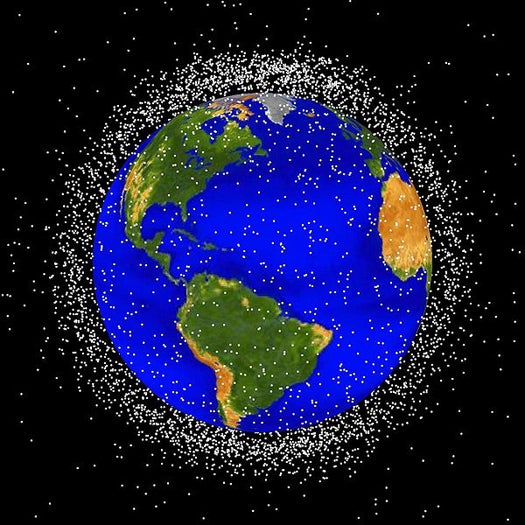
Orbital Debris The dots on this NASA-generated chart represent known pieces of large orbital debris. NASA

NASA has been tracking a piece of space junk on course for a near collision with the International Space Station this week, but while the agency continues to monitor the debris -- a leftover from China's brilliant shooting down of the Fengyun 1C weather satellite during a missile test in 2007 -- Russian Flight Control authorities have issued an all-clear, saying an avoidance maneuver will not be necessary.

This month, NASA's Orbital Debris Program Office released data naming the top ten incidents contributing to the space junk problem. The Fengyun fiasco is hands down the largest single contributor to the growing space junk crisis. NASA has identified some 19,000 objects larger than four inches that are running loose in orbit at extremely high rates of speed just waiting for a functioning satellite, a spacecraft, or the ISS to get in their paths. Of those, 2,841 are thought to have come from the destruction of Fengyun 1C.

Most of the garbage hurtling through space belongs to China and the Soviet Union, the report says, though Western commercial interests and space agencies also shoulder their shares of the blame. Some of the blame can even be divvied up; last year an operational Iridium communications satellite collided with a spent Russian Cosmos spacecraft, spawning nearly 2,000 pieces of smaller debris.

But Europe could soon take the top spot on the space junk tally. When the European Space Agency's Envisat Earth observation satellite goes defunct in three years, the ESA will be the proud owner of the largest and most dangerous piece of junk out there: a nearly 9-ton, $2.9 billion piece of orbiting detritus that won't be pulled into Earth's atmosphere for 150 years. The danger isn't that the massive satellite might slam into the ISS -- the chances of that are quite slim. But if it collides with another large piece of junk at high speed -- say, a rocket stage or another retired satellite -- the impact could release 10 times as much junk as the Iridium-Cosmos smash up.

With so much junk up there, the DoD has even warned of a scenario in which such a massive collision could trigger a cataclysmic chain reaction in which one impact begets another and then another until entire orbits are unusable. Unlikely, sure, but some insist it's possible. The good news is we're working on the problem. Northrop Grumman is working with DARPA to develop a ground-based radar system to help track space debris from the ground, and the U.S. Air Force is planning to launch a Space-Based Space Surveillance satellite in the near future that will help direct traffic in space. Assuming, of course, a piece of orbiting junk doesn't knock it clean out of the sky.

[Space, Network World, Voice of Russia]

11 Comments

so they're planning ground based tracking and a satellite dedicated to traffic direction?

i would think, and I'm sure most would be with me on this, but more monies should be spent on ways to rid the debris?

China should be sued if it's pieces end up colliding with another country's satellite(s). What they did was so retarded and typical of communist societies which don't give a hoot about other countries.

they could put a gel or light foam that expands which would catch the loose debris in orbit after time it would fall into the gravity and burn up in the atmosphere non toxic of course.

@giz
sued? really? thats your answer...

Certainly work should be done to reduce the rate of increasing junk. But we can't let the debris stay up there for 150+ years (some may never come down on their own). We have to get a clean-up strategy on paper and then do it.

You would think as many people that talk about recycling metals. Someone would go up with a spaceship, pulling a strong electro-magnet and collect all of the metal from around the area. Drop it down to earth. It might not be enough scrap to pay for the mission but they wouldn't need to worry about collision anymore. I'm sure it wouldn't be that easy, but if I can think of a simple solution like this. A rocket scientist should be able to make it a reality.

@blaxeed

That's an enormous area for one vehicle to cover, or even for many vehicles to cover. More than 200 million to 300 million square miles to search for these objects. Nonetheless, I agree that something should be done about them. I just don't see how to do it effectively at all.

Oh no!! this debris is a big threat to the ISS. Isn't there any solution to this problem.
http://procleansegoldwarning.com

What ever happened to the talk of a ground based laser system for zapping small debris and breaking up or nudging large ones into less than survivable orbits? Even though that would be one very powerful laser.

Good old china and soviet union for leaving their garbage around lol

http://procleansegoldreview.net

Is this the scientists equivalent to the carbon foot print?


June 2013: American Energy Independence

Five amazing, clean technologies that will set us free, in this month's energy-focused issue. Also: how to build a better bomb detector, the robotic toys that are raising your children, a human catapult, the world's smallest arcade, and much more.


Online Content Director: Suzanne LaBarre | Email
Senior Editor: Paul Adams | Email
Associate Editor: Dan Nosowitz | Email
Assistant Editor: Colin Lecher | Email
Assistant Editor: Rose Pastore | Email

Contributing Writers:
Rebecca Boyle | Email
Kelsey D. Atherton | Email
Francie Diep | Email
Shaunacy Ferro | Email

circ-top-header.gif
circ-cover.gif