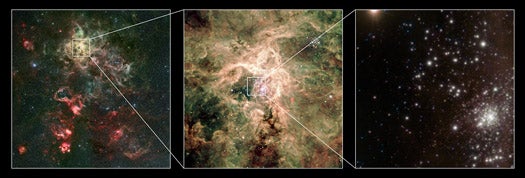
When speaking of the cosmos, we like to attach really amazing modifiers to the phenomena we find there, prefixes like “super-” and “extra-“ or adjectives like “massive” and “giant.” So, having used up most of the good ones, we’re not really sure how to describe the gargantuan (oh, that’s a good one) star that European researchers just discovered with the ESO’s Very Large Telescope; at 265 times the mass of our own sun, it is the largest star ever discovered, by more than 100 solar masses. That is to say: it’s really, really big.
Named R136a1, the star is about 165,000 light years away from Earth in the Large Magellanic Cloud – not so very far by super-massive galactic standards. It is easily the brightest star in the neighborhood (millions of times brighter than our own), but while it’s still putting up nice statistics ESO researchers say it used to be a whole lot bigger. In its early days it was probably 320 times the mass of the sun, more than double what some contemporary astronomers thought was more or less the upper limit for star mass (around 150 solar masses).
But the bigger they are the harder they fall, and R136a1 could be a further boon for researchers should it begin to burn out, as it is a candidate for an exotic kind of star death called pair-instability supernova. As expected from a star that is so big it defies description, such a demise would be particularly violent and extremely bright. But it could also teach researchers a lot about star death.Such monster stars are extremely rare and one researcher on the ESO team says it’s probably as big of a star as will be discovered with our current telescope tech (beyond a certain point we can no longer pick out individual stars in a cluster). But next-gen telescopes that will go online in the coming decade will let us see even farther, hopefully helping us to discover even more extra-super-gigantuous stellar bodies – and words to describe them – in the not-too-distant future.
Check out The Guardian's mind-blowing visualization of R136a1 compared with our own solar system here.
The incredible innovations, like drone swarms and perpetual flight, bringing aviation into the world of tomorrow. Plus: today's greatest sci-fi writers predict the future, the science behind the summer's biggest blockbusters, a Doctor Who-themed DIY 'bot, the organs you can do without, and much more.


Online Content Director: Suzanne LaBarre | Email
Senior Editor: Paul Adams | Email
Associate Editor: Dan Nosowitz | Email
Assistant Editor: Colin Lecher | Email
Assistant Editor: Rose Pastore | Email
Contributing Writers:
Kelsey D. Atherton | Email
Francie Diep | Email
Shaunacy Ferro | Email
256 would have been a much more elegant number (>_<)
I like the way this article is written ^.^ Very fun :D That being said there is not much to it. OOOOoooOOh! Scientists were wrong about the maximum size of stars. Saw that coming.
Question.
What happens when two moderately sized stars collide? Do they make a bigger star or blow up?
I assume most of us know that Mass is just relative to the amount of Matter the object consists off, but Mass is not representative of the amount of Volume it takes up. However, there are some that do not, so let's not be misleading and clarify a few things. For example, some of the most Massive Objects in the Universe are Black Holes, which have theoretically 0 volume. R136a1 impresses with 265 Solar Masses? The Supermassive Black Hole OJ 287 is 18,000,000,000 Solar Masses. R136a1, for Mass of a Star sets a new standard. As for Volume though, even though it's 1,000,000 times brighter than our Sun, it's Volume is shadowed by that of VY Canis Majoris, STILL.
R136a1 is 265 Solar Masses and 35 times the diameter of our Sun. In terms of Mass vs. VY Canis Majoris, R136a1 wins. However, in terms of Volume, R136a1 is ONLY 35 times the Diameter of our Sun. Our Sun is approximately 865,000 Miles in Diameter. Being 35 times the Diameter, R136a1 is approximately 30,275,000 miles in Diameter, pretty large. If it were to replace our Sun, it would be touching the boundaries of Mercury's Orbit, which is approximately 35,000,000 miles. Earth is approximately 93,000,000 miles away from the Sun. To give you an idea of our Voluminous VY Canis Majoris is, it is 1,800,000,000 miles across. 1,800,000,000 miles (VY Canis Majoris) > 30,275,000 miles (R136a1) by a long shot. To give you an idea of how much space that would take up, Saturn's Orbit is 1,350,000,000 away from the Sun. So, if R136a1's outer edges would singe Mercury if it were in the place of our sun, VY Canis Majoris in it's place would be hiding Mercury, Venus, Earth, Mars, The Asteroid Belt, Jupiter and Saturn within itself, with room to spare. Hoever, R136a1 is just starting it's main sequence, whereas VY Canis Majoris is near the end of it's life. R136a1 may become even larger later on in it's life.
[ insert "yo mamma's so fat joke" here ]
"What happens when two moderately sized stars collide?"
Not much...usually just a lawsuit or two, but most likely a lot of PR and one of the stars gets a decent Hollywood movie out if it.
Posted by aiquoy: "R136a1 is 265 Solar Masses and 35 times the diameter of our Sun. In terms of Mass vs. VY Canis Majoris, R136a1 wins. However, in terms of Volume, R136a1 is ONLY 35 times the Diameter of our Sun."
Your science is much better than mine, friend, but your math sucks. A star with 35 times the diameter has 22,438 times the volume. I don't know where you got the 35, but I believe it's wildly inaccurate. A sun with 265 times the *volume* of the ours would only be around 8 times the girth. Gravity means this star would be compressed more, ne? So it's less than eight times the size (a difference calculable by some factor you would know and I wouldn't.)
That start isn't just fatty-fatty-pho-fatty it is
fatty-boobalaty!
@Dirk Mcbratney: I think you misunderstood what he was implying, this star is 265 times the MASS of our sun, mass is not related to what its volume is. A star could be a gazillion times larger than the sun but still only be say 3 times "heavier" than our sun.