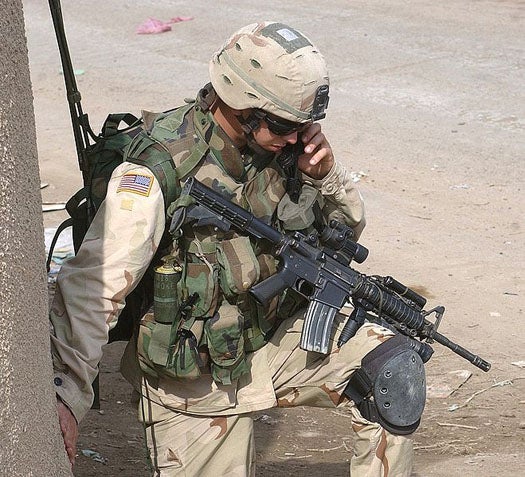
Like renewing your driver's license at the DMV or getting someone from the cable company out to your place, calling in close air support can be a real process for troops on the ground. A request for an air strike from a commander on the ground goes through various higher-ups, analysts, lawyers, and other commanders, slowing the response time to a crawl. That's why DARPA is launching the Persistent Close Air Support Program (PCAS), under which the scheme is simplified: ground troops ask for a strike, and a robotic warplane brings the ruckus, no middlemen necessary.
The weapon of choice would be an optionally manned/unmanned A-10 Warthog, those destructive and somewhat ugly slow-flying aircraft that can deploy a battery of weapons against enemies below. Fast-acting A-10s would give Joint Terminal Attack Controllers (JTAC) -- the soldiers within units that call in air strikes -- the ability to "to visualize, select and employ weapons at the time of their choosing." DARPA thinks this will "revolutionize how a JTAC is able to request and control near-instantaneous airborne fire support."
But wait; doesn't this kind of air-strike-on-demand go against the military's current strategy of limited air power and reduced civilian casualties as dictated in Af/Pak by the recently ousted General Stanley McChrystal? It absolutely does. But keep in mind this is DARPA, and it's innovating for battles a decade down the road. The goal of PCAS is to create tools that will reduce the time lag between request for support and an actual air strike from half an hour or more to a matter of minutes.So don't read this as a change in policy, but rather as an initiative to remedy what DARPA sees as inefficiencies in the close air support chain. Right now, a radio communication (which may not come in completely clear) sets in motion a machine with a lot of moving parts, any one of which might make a mistake -- commanders deciding the necessity and consequences of a strike, intelligence analysts examining footage of the battlefield, legal brass ensuring the strike is in line with the rules of engagement, etc.
DARPA wants to automate this process where possible and condense or remove parts of the process that slow down the close air support process. After all, we (hopefully) won't be in Afghanistan forever, and on the battlefields of the future the ability to call in instantaneous robotic close air support could be a powerful and potentially devastating tool in America's arsenal.
[FedBizOpps via Danger Room]
138 years of Popular Science at your fingertips.
Each issue has been completely reimagined for your iPad. See our amazing new vision for magazines that goes far beyond the printed page
Stay up to date on the latest news of the future of science and technology from your iPhone or Android phone with full articles, images and offline viewing
Featuring every article from the magazine and website, plus links from around the Web. Also see our PopSci DIY feed
Science is reinventing play, from extreme sports to gamification to ridiculous roller coasters to the playgrounds of tomorrow, and this issue is chock full of fun. Also, on a less fun note: Did global warming destroy my hometown?
This tool will be very handy when the aliens attack.
this will be very handy when politicians stop running wars, until then, it will probably cause more delay then the old style
Strong arguments can be made on both sides of this debate. I compromise solution would be a field commander above a certain rank...
So basically, DARPA wants to imitate the bombing system used in Call of Duty: Modern Warfare 2.
@nikhilkunapuli - exactly.
This isn't very different than having a very powerful set of "mortars" and "machine guns" at your disposal. Just means you have more power behind your disposal.
Those "inefficiencies" are in place to insure that an untrained soldier can't bring the full force of US firepower down without clearing it with a commanding officer first. I think the technology is useful, don't get me wrong, but it should be implemented such that an experienced field officer can order a strike on demand. Let's get rid of communication lag, sure, but international conventions can't be treated as mere "inconveniences," if only to avoid the public relations fiascoes that can result when they are treated as such.
I'm sure everyone who has posted so far would agree that we'd be far more comfortable with our push into mechanized warfare if our safety features were keeping pace with our destructive potential. I, for one, challenge the military to take on the idea that the robot, whether on the ground, in the air, or whatever, IS a U.S. soldier, needing a logic matrix designed to protect the innocent at machine speed. We kill more innocents now than before; and while it may be true that our enemies there are hiding in the base population, the only way we can ever hope to get their cooperation is if they SEE we are there to help them AND live to TELL about it.
I think that there will always be some command/legal element involved. The current situation may involve more issues with possible civilian causalties, but there are always issues.
One that is common in all conflicts is priority. There never seem to be enough resources, so someone has to parcel them out. 'Someone' would presumably be some level of command staff. Also, there may be other friendly forces nearby that have to be taken into account.
That being said, I'm all for simplification. I just doubt that we can realistically have a ground troop whistle up a UAV with no approvals required.
Interesting that the A10 is referenced. One of my favorite aircraft, but it has many enemies. It was destined to be shut down in the early 2000s, but it must have survived once again.
@ford2go: Yeah, I noticed that too, I'm gonna check it after here. I think the A-10 II has been on the chop block twice, officially, but they always find a need for brute force and a fairly sustained time on target. I'm surprised more aren't purchased by other countries. It will still be some time before these are no longer relevant. Even then, the mere threat of the A-10 will require opponents to designate substantial resources to counter the threat.
The core issue lies in designing the company structure and how much organic support it has.
The traditional old studies concluded the captain could only fight x systems.
I think it's time to relook all these concepts and start seeing the battlefield as a series of venn diagrams. The company has organic RPV and sensor assets and organic towed Slammers (ganged smart 70mm rockets) or Metal Storm mortars. There might be more staff to manage the fight.
Lawyers? ABSURD! If you are afraid of being sued, DON'T GO TO WAR!!!