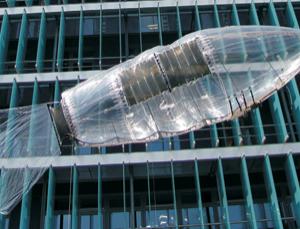
A new blimp built in Switzerland uses artificial muscles to glide through air as a fish moves through water, and it doesn't require engines or noisy propellers to do it.
The Airfish is about 26 feet long and looks like a giant flying trout. Airfish is filled with helium and made of special polymers that make it move.
The designers, led by Christa Jordi and colleagues from EMPA, the Swiss federal laboratories for materials testing and research in Dübendorf, replaced traditional motors with swaths of acrylic polymers on each side of the Airfish. The polymers connect to carbon electrodes, and when a voltage moves across them, the electrodes are attracted to each other, compressing the polymers. The Airfish is forced to flex like a contracting muscle. By alternating the voltages applied to each side of the vehicle, the team can make the ship shimmy like a fish. Membranes on the tail move it back and forth, too.The team modeled the Airfish after rainbow trout because they're versatile swimmers, but aren't especially quick or agile. They programmed software to mimic the rhythm of the trout's motion, and ran it on a computer attached to lithium-polymer batteries in the airship's gondola, New Scientist reports.
The combined motion of the tail and the body make the Airfish move forward at roughly 1.5 feet per second, akin to a slow walking speed. Airfish studies are reported in the journal Bioinspiration & Biomimetics.
More work needs to be done to determine how the Airfish will act in certain windy conditions. But it's so graceful and quiet that the researchers hope TV broadcasters might favor it for capturing footage of sporting events. Here's to the Goodyear Airfish.
Five amazing, clean technologies that will set us free, in this month's energy-focused issue. Also: how to build a better bomb detector, the robotic toys that are raising your children, a human catapult, the world's smallest arcade, and much more.


Online Content Director: Suzanne LaBarre | Email
Senior Editor: Paul Adams | Email
Associate Editor: Dan Nosowitz | Email
Assistant Editor: Colin Lecher | Email
Assistant Editor: Rose Pastore | Email
Contributing Writers:
Kelsey D. Atherton | Email
Francie Diep | Email
Shaunacy Ferro | Email
Hi folks,
Good to see some basic research on blimp aerodynamics. The scaling factors for boundary flow around blimps and the few design programs that apply to blimps don't work too well at present so this type of experiment is useful.
If you want to see more on modern operational blimps see airshipblimp.com or if you just want a helium sniffing laugh try airship.me the worlds only lighter than air comedy site.
Hope the new baby blimp works out well.
Regards JB (Skyship driver in A View to a Kill)
According to MW - an engine is a machine for converting any of various forms of energy into mechanical force and motion. The human body is an engine. So...it does have an engine.
If you want to see more about larger modern airships try www.airshipblimp.com which has a lot or rare airship pictures both past an present.
Regards JB
we use normal blimps for sporting events because theyre far enough away not to make any noise and audiences usually make a racket anyway that it wouldnt matter unless it was a checkers tournament or golf and cmon, who cares about golf. i dont see the point of these things. i dont see how itd overcome/stick around in windy conditions. they could be really cool nightlights
Seriously, a CLEAR & SILENT aircraft, and you can't see any use for it at all? It could be 5,000+ feet in the air with a camera and you would never know it. I agree football games and races are pointless, but put one in a war zone.
So, would the same principle work for a submarine?