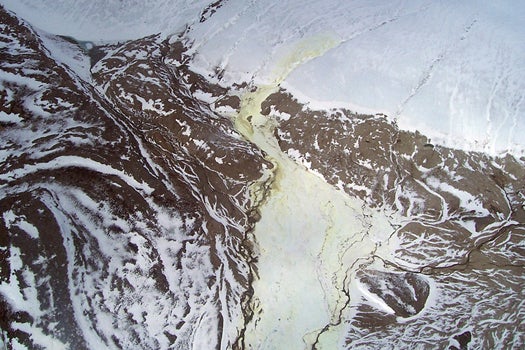
The Sulfur Stain, from a Helicopter NASA Earth Observatory

Among NASA’s top priorities is the goal of locating life in the universe and it has – on Earth. But in doing so, NASA may have found a new tool to help it seek out life elsewhere in our solar system. An imaging satellite has located microbial life on the ground from space for the first time. And if it can do that here, it stands to reason that the technology might be able to do so on other planets as well.

NASA’s Advanced Land Imager (ALI) riding on the EO-1 satellite spotted a small patch of yellow ice in the Canadian Arctic that is the only known place on Earth where sulfur is pumped to the surface by natural processes, much like a spring. Looking down form a helicopter the stain is visible but from space it is very hard to spot.

So NASA engineers went looking for it in the invisible part of the spectrum using a hyperspectral sensor on ALI called Hyperion. From that data, researchers were able to identify the discolored ice by the chemical signature of sulfur, which was strong enough to be visible (strong enough, in fact, that researchers can actually measure the amount of sulfur from the Hyperion data alone).

But none of that has anything to do with life. The underlying processes, however, are the key to this discovery. This particular sulfur starts out in the seawater beneath the Arctic as hydrogen sulfide. It’s only after microbes in the water strip the hydrogen away that the sulfur alone rises up to stain the ice, which acts as a big yellow arrow pointing to the microbial life below.

As Discovery News astutely points out, this Canadian Arctic scenario is like a microcosm of other rocky, icy bodies in the universe, specifically one in our solar system: Jupiter’s moon Europa. We know Europa is icy and we suspect there may be liquid oceans beneath that ice that could theoretically harbor life. While sending a Europa rover to the planet to drill through the surface sounds fun and all, it would be a lot easier to send an orbiter, sporting Hyperion-like sensors, to go search for the telltale signs of life beneath the ice.

It’s clearly an idea in its infancy, but it’s a pretty cool one.

[Discovery News]

16 Comments

Whoa! Life on earth! They've really out done themselves this time!

lol I thought the same thing!!

Still, if there is life on Europa in any kind of abundance the constantly shifting surface will have pushed some organic molecules through the cracks in it's crust. There is a lot of unknowns as to what specific chemicals will give us the "life here!!" signal. Add the fact that, we don't know (i'm assuming) what radiation and space exposure would do to the evidence. Regardless, with better imaging we should be able to see SOMETHING out of the ordinary on the surface indicating life is below. If in fact there is life down there.
I for one am optimistic, with a healthy dose of understanding if there isn't any life.

I wonder if they'll ever find intelligent life on Earth...

hey... i just found out that planet earth is dominated by one main species. theyre like everywhere and in the billions.

i wonder what else is here... hmm... whats that blue stuff over yonder?

I used to think it self-evident that there is intelligent life on earth. Now I am not so sure. We may need more evidence.

So this only works on/in ice? If this is only going to be used on icy planets and moons, then what about all the planets where water doesn't exist as a solid?

This story is fascinating; however, all I could think about after seeing the picture is the warning: "Never eat yellow snow!"

handydave you stold my thunder,, that isn't sulfur that is
dinosaur pee

Life remote sensing is necessary but so is robotic and human accurate assay of solar system soil/ice firma.

-Space is all about destination, destination, destination for humans. (nuclearspace.com)

@redpat2061, @morphex: brings back childhood memories of an ancient t-shirt which had a caricature of Spock talking into a communicator with the caption: 'beam me up Scotty, there is no intelligent life on this planet'

This is encouraging news since unless you look very closely at the planet surface you really can't see (at least during the day) civilization. Obviously you can see liquid bodies of fluids and plant growth but that is it. I can only hope Hawking is wrong about alien life and if it were to come here and see what we do to our only home that they don't wipe us out, but help get us on track, hmmm maybe Obama is an extraterrestrial LOL figured I throw that one out to the T bag people.

I really think we all have missed something here....with an over populated planet and rising shouldnt we be trying to spread life on other planets instead of being rediculous about finding it right now...lol...send some fn mirco orbs to mars would ya lol

The headline reads "Nasa finds life on earth"... hahaha.. You had to see the jokes coming on that one.

"Heckava job fellas!"

What's next, discovering that the sky is blue?

Wow. Nasa...FAIL! lololol

This is not news. A probe did this exact think years ago.


June 2013: American Energy Independence

Five amazing, clean technologies that will set us free, in this month's energy-focused issue. Also: how to build a better bomb detector, the robotic toys that are raising your children, a human catapult, the world's smallest arcade, and much more.


Online Content Director: Suzanne LaBarre | Email
Senior Editor: Paul Adams | Email
Associate Editor: Dan Nosowitz | Email
Assistant Editor: Colin Lecher | Email
Assistant Editor: Rose Pastore | Email

Contributing Writers:
Rebecca Boyle | Email
Kelsey D. Atherton | Email
Francie Diep | Email
Shaunacy Ferro | Email

circ-top-header.gif
circ-cover.gif