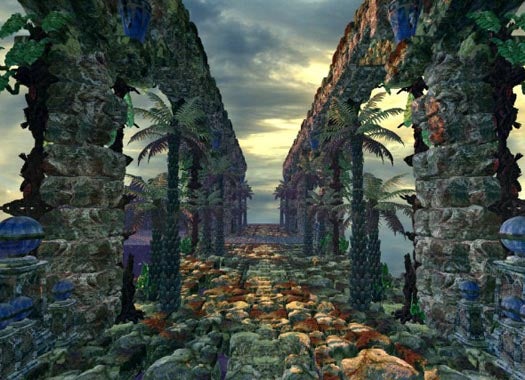
Bruce Dell doesn’t have a college degree or work for a major video game producer, but he might just change video game animation forever. The Australian hobbyist claims his new technology, Unlimited Detail, can turn out computer-generated graphics sans graphics chips or massive processing power. Rather, he claims his system offers unlimited graphics power that is software- rather than hardware-based, meaning there is no end to the amount of detail one can render.
Dell explains how all this works in fairly rich detail in the video below, but to summarize, Unlimited Detail sheds the usual polygon construction of virtual worlds in favor of a kind of point-cloud construction. Imagine the 3-D equivalent of pixels (like “little 3-D atoms” as Dell says), making up the entire virtual world from little points of color, much as the real world is constructed of tiny building blocks.
This kind of construction isn’t completely new, but it is limited by the fact that each point requires a little bit of processing power. Rendering huge 3-D worlds like the ones in modern video games would require trillions of points, and rendering that many points per frame is impossible by modern computing standards; the real time demands of games make the idea completely unfeasible.Dell’s software, he claims, gets away with this by acting as a search engine rather than a graphics engine. Build a world out of points, and Unlimited Detail’s software searches, in real time, for only the points in the cloud needed to render a view from a certain perspective. Detailed algorithms search through point-cloud data to find the right “atoms” to build only the scene you need at that moment, which equates roughly to one point for every pixel on the screen. Suddenly, you don’t need to process billions or trillions of points anymore; the underlying points go unprocessed and only the visible ones are rendered.
At least, so says Bruce Dell. Very few people have seen the software in action (he's still collecting his IP protections), and according to Wired companies like Nvidia are skeptical that his concept will work. You can hear it from Dell below and decide for yourself, but if he can deliver on what he promises in this video, gaming will never be the same.
Five amazing, clean technologies that will set us free, in this month's energy-focused issue. Also: how to build a better bomb detector, the robotic toys that are raising your children, a human catapult, the world's smallest arcade, and much more.


Online Content Director: Suzanne LaBarre | Email
Senior Editor: Paul Adams | Email
Associate Editor: Dan Nosowitz | Email
Assistant Editor: Colin Lecher | Email
Assistant Editor: Rose Pastore | Email
Contributing Writers:
Rebecca Boyle | Email
Kelsey D. Atherton | Email
Francie Diep | Email
Shaunacy Ferro | Email
Very good explanation in the video. It's still up in the "we'll believe it when we see it" area, but it looks very, very promising.
This must be part of that technological singularity that's coming around the bend.
Good work, Unlimited Detail. Looking forward to what's in store for us on the Xbox 720 or whatever's coming out in a couple years.
it seems, if this was so great, everyone would be all over it already, and we would have heard more.
well, it would seem youre hearing about it now, anyway..
he does explain in the video that they did try to ptich it, but no one would bite.. sometimes it takes a minute for people to jump onboard something that goes against whats considrered the norm (polygons).
guess we will see soon enough
This could be Huge. It's awesome to hear that there are still some innovation out there.
Along with this and the memresistors, I must say, the exponential march of technology continues!
Assuming it works like he says (big assumption), I can see why intel and nvidia wouldn't want to back it- it would mean an enormous drop in graphics card sales. However, any other company should have jumped onto it like it was a bacon-wrapped Benjamin sandwich, stuffed with cocaine.
Kinda up there with ultra-capacitors: unbelievably awesome if true, but I want to see it in action before I get my hopes up.
I think there is a problem with memory, how will these trillions and trillions of points be addressed in memory??
I you look careful at these environments, the shapes are repeated many many times.
The "search" algorithm is nothing more than "for every pixel in the screen, look away from the perspective of the camera in a growing radius and stop when the radius is filled with points, or radius is big enough, then do some sort of average with the color of the found points"
add this with quantum computing and you got yourself one hell of a graphics power house
Intradevar "Unlimited detail" la 480p. 720p s-ar vedea mai bine. Oricum nu cred pana nu vad. Si ce vrea omul asta sa ne spuna?: ca nu avem nevoie de mult hardware ci doar de cipurile pe care le avem acum? Cam saraca propunerea. Niste programe pe care le-am scris acum 10 ani beneficiaza enorm de toate avansurile hardware.
16 months is a long time... Looks like it'll be worth it though...
*Jaw Drops*
8o 8| 8) 8D
I have been wondering for a while when we were actually going to see a breakthrough somewhere. I'm not talking somewhere where the technology can slowly evolve to be better. I'm talking a sudden release that is like a nuke in the business that wipes out all competition in the area instantly... Like this...
ngon methods are fairly nice, I must say. I'm going into computer sciences, so I am well aware of the methods involved. They aren't even that hard... How exactly you arrange the dots in 3D space has yet to be seen (the little one second glance wasn't enough for me to figure out how they are doing it).
What's funny is that this is so blindingly simple. It is not even that hard to write a program that does that! The trick is in its creativity.
I do understand why NVidia and ATI wouldn't want any part in it. It kills the need for that next GPU upgrade, and thus their business. That said, if they took it into the software market, they would kill their business rival, but would also drastically reduce their own size as well. It takes far less equipment to write software than it does to print hardware.
Of course, while I am optimistic, I am cautiously so. This is certainly beyond the EMdrive and Ultracapacitors, but it is still not absolutely and totally guaranteed. That said, it is incredibly likely and I would not be surprised in any way, shape, or form if this innovation blew up the market for GPU's overnight.
This is a brilliant but simple innovation that yields the result of being able to revolutionize modeling.
There is one hiccup. Where are all the other points located? This is the problem. How is it quickly accessing the point locations it needs? Apparently it has been solved, but I would love to know how they are doing it. I guess I'll just have to wait for the SDK. Regardless, Dell is going to make a fortune off this. My hat goes off to him accordingly.
It was confirmed as a fake months ago.
This is an old technology using voxels. It was used in few games both old ones (Delta force) and new (Crysis uses voxels for its terrain system). The main problem is you can't animate it.
Those guys got their hands on one of free sparse voxel octree engines and made a showcase.
P.S. Wonder how Pop Science editors don't verify things they publish?!
I'm not very impressed. Lighting a scene properly IMO is more important than throwing garbage (what they call detail) everywhere in the scene.
Makes sense so far. That would be a nice capability to have on a tablet PC - unlimited 3D capability. Why render, texture and trace pixels that will never make it to your small screen. Imagine doing full 3D CAD on your tablet PC or smart phone. Let's do it!
It doesent matter much if you cant animate it or run a physics engine with it. Physics systems and animation take a boat load more memory than simply making a beautiful world. And besides that image didnt look that good. As someone pointed out before it is alot of repeats.
I wonder if this is something that could be applied to High Def TV's? To make them even more High Def.
Looks like some of you are unaware of the perm "proof of concept". And so what if the unlimited detail model isn't animated - doesn't mean it can't become animated as the technology matures. What I imagine will be the genius moment (am I having that moment now) is to combine the technologies. Use unlimited detail for the city, for example, and use tried-and-true polygons for the character animation. That way, you spend the processing power making the focus of the game more realistic and the environment more nuanced.
Yeah, there's no reason you can't have two systems in place. Most games already have a much lower polygon count for physics interaction than for the graphics, you could do the exact same thing if this replaced the graphics.
so im not to fluent on this area of technology but wouldnt this meen that there would be no reason to have a graphics card at all or would that just be icing on the cake? and i think i do understand most of what the guys above me are saying to agree that why cant they just use both i meen if you look at the sky in most games now it looks more like a picture that never moves anyway so what the point of animation and and what about buildings they never move i meen there is so many stationary things in gaming that whats the point of using the old polygon system if this can do better?
finally this tech sees some light. iv been talking about this now for months trying to inform people about what im talking about when i say that 3d graphics are about to go through a drastic change!
new it was posted in february damnit!
anyway he needs to show a realistic video before he convinces anyone
Also wanted to add that there's ablolutely no problem rendering SVO data in real time. Just go to Youtube and type "voxel", or "sparse voxel octree".
YEah...I don't buy this technology either.
First of all, the computer models of these environments...how are they stored? They say it's some sort of point cloud...
how much memory does it take to hold all the data needed to create (or hold) a typical model? The data needs to be available to the CPU so that it can access it when required...
I have a feeling a typical level of a game would require substantially more RAM than even a level of Crysis.
If everything is modeled out and detail is exceptional, that means that everything needs to load before you can play...I have a feeling loading times would probably take a long, long time. Unless they decide to only load the data that the camera sees...but for fast moving scenes with lots of stuff happening, the hard drive / RAM might not be able to load everything as fast as needed and you'll get stuttering or possibly even slide show the action....
Don't know enough about this technology and how it works to make any more speculations...
No demonstration of movement, much less animation.
Everything is made from a small scene that is placed in a tiled or fractal arrangement; I suspect that this arrangement has a particularly simple form for determining the first possible occluding object.
Obnoxious memory requirements; hence a million repitions of the same leaf, the same branch the same 5 blades of grass.
Not impressive at all.
Like other people, I'm wondering what the hardware requirements are for this. Do I need to have a couple of terabytes to hold my game? Do I need to get a server board with room for 8 cpus? Is this run on consumer grade hardware, or is everything run on supercomputers? I don't exactly have the money for a CRAY supercomputer right now.
The second video I think really helps to fill in the information, he says that it can run on a nintendo wii, and cell phones. You need to think outside the box on this one, google, per individual seach query, does not take that much power, they need alot of power due to usage rates, all the points can be stored in a DB, or a table, where every entry represets the enviroment.
If you had an enviroment that was say 640*480 the total enviroment in a 3d enviromental space is 640*480 cubed, (I believe, math is not my best point.) the software does not require that the entire cubed area be rendered but only the visible flat side that the user sees. The DB of the point cloud would need to cover all the points in full dimension, but what is actually processed visually is a flat image, that simply apears to have 3d perspective.
Please correct me if I'm wrong.
someone needs to put this software on the i pad....so games like razors edge can be played with full quality!!!!!!!!!!!!1!!!!!!!!!!!!!!!!!!!!!!!!!!!!!!!!!!!1
Damn. This was scaring the shit out of me. I realized recentally that I want to do 3D animation. What would have happened if I paid mad money to go to college to learn the wrong way to model graphics? Wait till I get in the video game industry to do something like this. Geeez.
www.freebord.com/ride <-- Snowboard the Streets!
Wouldn't this pose massive problems for things like simple physics and movement and shaders? Think about it, even if it can efficiently render all those points, the system they're using doesn't seem like it would work well if you wanted to move an object. Wouldn't moving all those points be quite the burden? Now imagine something like even rigid body physics...it'd be hell. Also, what about things like blood splatters and scorch marks, everyone's favorites! All those points would have to be altered on the actual model because there are no textures/surfaces to use. I love the idea of looking outside the box and am all for revolutionizing, so if there is a way to get around the problems I mentioned then w00t, nice games here we come, otherwise, it may need a lot more R&D.
zayıflama kilo Verme Yağ yakıcı wwww.devabitkiselurun.com
zayıflama kilo Verme Yağ yakıcı www.devabitkiselurun.com
Yeah, this doesn't seem at all realistic. even barring the possibility that it's an actual hoax - if there really are more points in one tree than there are in a complete environment in another game, well, there you go....
And yeah, manipulating those points within a game engine, with a polygonal physics engine running things underneath and updating that "search index" every cycle, well ... yeah, that's not really going to work.
Really cool potential and great video explanation, but will it work? I found a user contributed news survey about this story that is interesting at a new website that is also interesting. It can be found at: alpha.survcast.com
When prompted you have to enter the promo code - firstcast
Then search the key word: gaming
Cast your opinion
It's really cool ,hope it will be true
If this turns out to be real and not vaporware, it would be a big step forward. Re-render Crysis on a single-core 1ghz cpu, and he'll have a gaming audience.
Beecher Bowers
www.gamingbee.com
anyone who says they cant be animated hasnt watched the video
hey popsci, any new info on this yet?
If anyone is interested in this awesome new Unlimited Detail technology, you can check the latest news/developments at the semi-official
Facebook page at: www.facebook.com/group.php?gid=105528666147262 ;)Those that say 'no' well remember this is running on CPU only and not mixed as of yet with GPU power of ATI or NVIDIA. I find it shameful that NVIDIA finds this skeptical, probably due to it was not them that thought of it but Mr. Dell the "hobbyist". good luck with the SDK development.