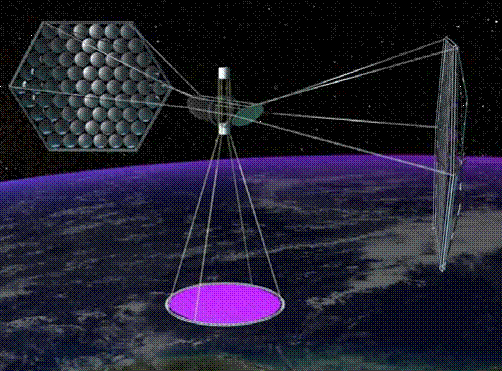
A laser-obsessed entrepreneur whose mosquito-zapping project demoed at the TED 2010 conference has bigger plans for energy beams. Tom Nugent envisions using lasers to deliver energy over long distances -- whether that means juicing up an aerial drone's batteries or beaming solar space power down from orbital satellites, according to Xconomy.
Nugent's skeeter-killing project came from his past work for Intellectual Ventures, the invention company which enlisted Microsoft-founder Bill Gates to file a patent on a geoengineering scheme to limit the destructive power of hurricanes. But Nugent has since moved on to found a power beaming company called LaserMotive, along with physicist Jordin Kare.
The idea of harnessing lasers to deliver power to a receiving solar cell has slowly gained traction over the years. A U.S. company called Solaren signed an agreement with California-based Pacific Gas & Electric to supply space-based solar power by 2016.
Japan also plans to launch its own solar power satellite by 2015, as a precursor to a larger model that would provide power to 300,000 homes. Europe's biggest aerospace company, EADS Astrium, would put its own solar-collecting demo satellite into orbit by the end of the decade. Such projects have also drawn plenty of skepticism.
But LaserMotive has taken smaller, concrete steps to build up its business. The company claimed NASA's top space elevator prize of $900,000 by having fielding the only robot to climb to the top of a cable at a speed of more than 4.5 mph -- all based on beamed laser power. Nugent and Kare also hope to dominate the Level 2 space elevator competition in the fall, which requires teams to go about 11 mph up the same cable.
The company's first business opportunity might come from beaming power to small drones that run on electric batteries, so that they could remain aloft for longer. Nugent also hopes to perhaps beam power to disaster relief efforts down the line.LaserMotive's best existing lasers can deliver a kilowatt of power over a quarter of a mile, as long as clouds or fog don't interrupt the beam. They won't slice people in half like lightsabers, Nugent notes -- but they can still pose a hazard to unwary eyes.
[via Xconomy]
Five amazing, clean technologies that will set us free, in this month's energy-focused issue. Also: how to build a better bomb detector, the robotic toys that are raising your children, a human catapult, the world's smallest arcade, and much more.


Online Content Director: Suzanne LaBarre | Email
Senior Editor: Paul Adams | Email
Associate Editor: Dan Nosowitz | Email
Assistant Editor: Colin Lecher | Email
Assistant Editor: Rose Pastore | Email
Contributing Writers:
Kelsey D. Atherton | Email
Francie Diep | Email
Shaunacy Ferro | Email
Sweet. Can't wait for this to come.
still contributing to global warming though...?
Sounds like something out of Star Wars :) but it is a good idea... although, what would happen to a bird or a plane flying trough the laser beam?
Ivan Malagurski
Should not contribute to global warming when the satelite is between the Earth and sun. It will merely concentrate a large area of light on a small target - good for the solar cell aimed at, with minimal dimming to the surrounding area (think of how a magnifying glass can take an area of light, intensify it to ant-frying power, and only cast a small degree of shade to the surrounding area).
In other words, it will just be taking solar radiation headed to us already, and concentrate where it lands - thus creating greater solar power potential in one area while actually cooling other areas (for a break even on total energy absorbed globally).
Now, if the satelites were not between us and the sun, then they would be effectively increasing the surface area of the Earth in relation to it's solar absorption. That would warm the Earth, if only in a minor way. Of course, if that was an issue, you could always balance the heat by launching solar shades equal to your solar collectors.
The size of the Earth, however, and the potential energy herein contained, dwarfs any short term risks of increase solar absorption from orbiting lasers, much like trying to burn the state of Flordia with that magnifying glass.
We need a giant white sheet hovering above our planet. multiples of them spanning miles, to block the sun enough that light still gets through but not as much so that we don't get so hot. then close them up and when it starts getting cold, and maybe that can give us time to work on the real problem. There we go, problem stalled. I wish childish ideas like these could work flawlessly rather than some other problem arising. Does it really hurt to consider it though. Maybe I'll make billions and spend it all doing this without considering consequences.
30bcf4e2
"can deliver a kilowatt of power over a quarter of a mile"
That's more than a little hazardous. Class 3a lasers can damage eyes in a few seconds -- their output is less than 5 milliwatts.
I'm guessing that if you get in the way of these guys, you could easily get some severe skin burns -- if not something worse.
The beam would be focused on a panel of collecting cells not to people at all. Planes could pass the beam in fractions of a second and that would not interrupt anything.
I wouldn't suggest flying planes through these beams, regardless of how quick. Do it too many times, might cause longterm damage. People staring out the windows, could have reactions. I would rather expend the little extra fuel to make sure not to fly through the beams, just in case.
30bcf4e2