National Institute of Standards and Technology Tests Spray-On Transistors, Finds Them Promising
We may earn revenue from the products available on this page and participate in affiliate programs. Learn more › In...
We may earn revenue from the products available on this page and participate in affiliate programs. Learn more ›
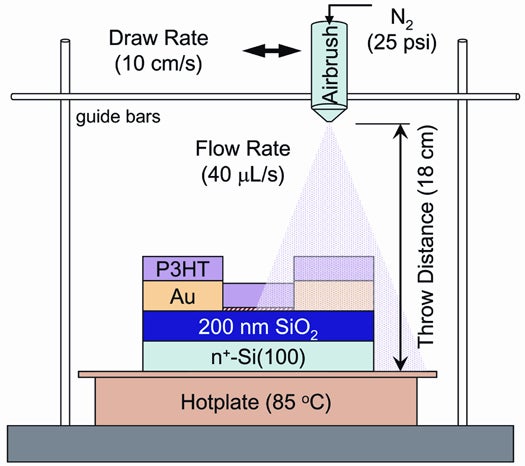
In a discovery sure to help the development of solar panel and display technology, scientists at the National Institute of Standards and Technology (NIST) have engineered transistors that they can airbrush onto a surface like spray paint.
Unlike most computer chips, which use transistors made of silicon, the NIST spray-on computer chip utilizes an organic semiconductor, called poly(3-hexylthiophene), or P3HT. By spraying the P3HT over a deposited circuit architecture of gold and silicon, the NIST team can lay down vast swaths of electronics quickly and cheaply.
The NIST scientists admit that translating this breakthrough into a concrete new technology will prove challenging. However, once the technique is perfected, it can result in very significant price drops for both solar panels and large display screens.