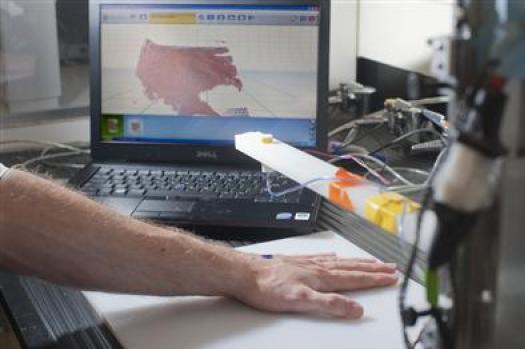
As if fabricating a new heart from scratch wasn't impressive enough, the doctors at the Wake Forest Institute of Regenerative Medicine have come up with another astounding breakthrough. This time, they've designed an inkjet printer-like device that sprays new skin cells onto damaged burn tissue like it was a cheap tan. This device provides a fast alternative to delicate skin grafts, and could eventually be used to close other kinds of wounds as well.

The device itself consists of a tank holding a mixture of harvested skin cells, stem cells, and nutrients, and a computer-controlled nozzle that places the cells exactly where they need to go. The spray works similar to a color printer, first spraying down a layer of fibroblast skin cells as a substrate, and then blasting on a layer of protective keratinocyte cells. Both sprays also contain a slurry of some undeveloped skin cells.

In initial tests on wounded lab mice, burns treated with the cell printer healed in two weeks, compared with the usual five weeks skin grafts take to heal. Additionally, the mice with the printed-on skin showed less scarring and more hair regeneration, as the sprayed-on stem cells better incorporated themselves into all the various cell types of the burned flesh.

Successful mouse tests have driven the Wake Forest scientists onward to tests with pigs, whose skin more closely resembles that of humans. After the tests with pigs conclude, the doctors can finally move on to human trials, and eventual FDA approval. Additionally, the Wake Forest team is working with the U.S. Armed Forces Institute of Regenerative Medicine to utilize this technology on the battlefield, to print shut bullet wounds and blast damage.

[Reuters]

12 Comments

If you showed this technology to scientists no less than three decades ago they would have thought you a witch.

Amazing how long predicted future tech such as human space flight and flying cars never seem to materialize but crazy things like this which no one would have ever imagined just pop up out of nowhere.

the thing I like about htis is that there is no accelerated regeneration. Chances of the printed skin becoming cancerous shoukd be less.

My thought was, who sits there and wounds the mice? I don't think I could do that.

This is the single most incredible thing I've heard of.

This is straight out of Starship Troopers.

We're taking such even strides toward maximizing our human potential and each new discovery, however small, leaves less room for the big discoveries to hide...

@kfreels

That was exactly the way I felt. This stuff is amazing, pure amazing.

Now going to the hospital or the doctor's office is going to start looking like the car shop or something

In recent stories we've seen a portable x-ray machine, sound that can pulverize cancer, a $3 negative pressure pump, a cure for diabetes, and a swab test for oral cancer.

With the help of this and other coming innovations (i.e. nanotechnology) we could put the devices of a modern hospital into a cargo truck.

Just get the robotic surgical arms w/ a satellite link to a surgeon, several nurses, and some basic supplies and you've got it!

Outstanding. That is all.

Hey...

Reminds me of the scene in Fifth Element where they reconstruct Leeloo.

Could I get one naked Milla Jovovich to go, please?

How long did "Dub" delay this technology with his dark ages attitude towards stem cells? This is one thing that Obama cannot be criticized on. Hopefully, other tissue repairs like this (Discs in the back, Joint degeneration, bone issues) will follow soon!

Great for humans though less than wonderful for the test mice.

That's cool! Looks like the first step toasted the dermal regenerater.


June 2013: American Energy Independence

Five amazing, clean technologies that will set us free, in this month's energy-focused issue. Also: how to build a better bomb detector, the robotic toys that are raising your children, a human catapult, the world's smallest arcade, and much more.


Online Content Director: Suzanne LaBarre | Email
Senior Editor: Paul Adams | Email
Associate Editor: Dan Nosowitz | Email
Assistant Editor: Colin Lecher | Email
Assistant Editor: Rose Pastore | Email

Contributing Writers:
Rebecca Boyle | Email
Kelsey D. Atherton | Email
Francie Diep | Email
Shaunacy Ferro | Email

circ-top-header.gif
circ-cover.gif