The Macondo oil well is leaking almost 1,000 barrels per day into the Gulf of Mexico, and represents an environmental disaster in the making
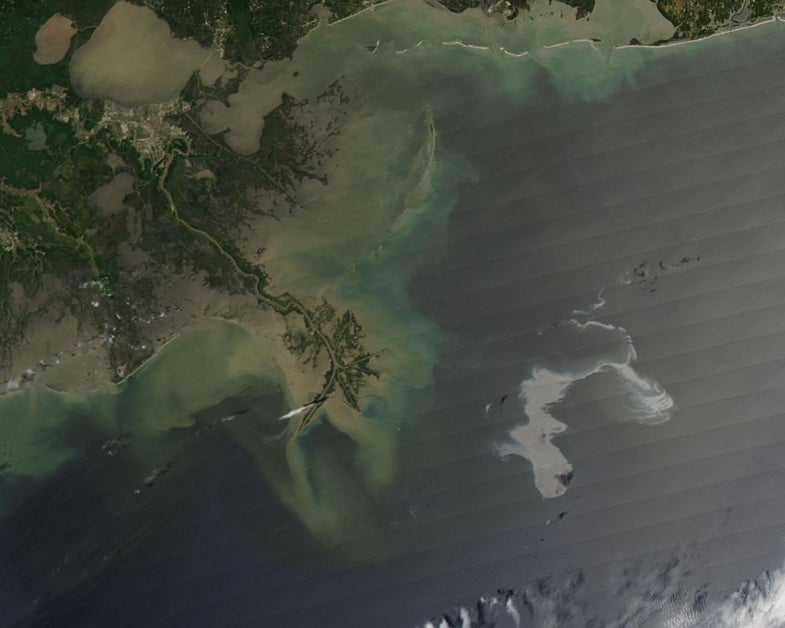
Deepwater Horizon Leak An oil slick (lower right) in the Gulf of Mexico threatens wildlife refuges around the Mississippi Delta. NASA

Robotic submersibles could help energy giant BP contain a leaking oil well following an oil rig explosion last week. The mission: use robotic arms to activate a large valve designed to seal off a well from the surface, according to The Chemical Engineer.

About 1,000 barrels (42,000 gallons) per day has been leaking from the Macondo well almost a mile below the surface of the Gulf of Mexico, since the Deepwater Horizon rig exploded last Tuesday and likely killed 11 workers. The destroyed rig was operated by Transocean under a BP license.

That has set the scene for potentially huge environmental disaster in the making, with the U.S. Coast Guard describing the spill as "very serious." The urgency has compelled BP to deploy the underwater robots in the complex, first-of-its-kind operation which could take between 24 and 36 hours -- and there's no guarantee that it will work, according to the company.

Underwater robots certainly exist, and many future designs call for them to scout for new oil wells or operate as search-and-rescue helpers. But this latest incident may prove the biggest challenge yet for robotic submersibles.

BP has also prepared to drill relief wells to permanently secure the leaking well. A drilling rig is set to drill a second well that would intercept the Macondo well and inject a heavy fluid to prevent the flow of oil or gas, and allow for more permanent sealing. The company has also prepped almost 106,000 gallons of dispersant -- one third of the world's supply -- to help break up any crude slick before it reaches the coast.

Still, the drilling project could take months, which means the best hope for averting catastrophe in the meantime could lie in some cold but steady robotic arms.

[via The Chemical Engineer]

10 Comments

I just keep saving all these headlines, So when my son gets older and asks, What happened? I can let him see for himself

Good Grief no sub-surface safety valve that is hydraulically actuated and if the hydraulic pressure is not maintained the valve automatically closes. BP knows better. Shame on them.

soccerdad - I heard they were between drilling and production concreting the well so they did not have the BOP hooked up.

two things I'd like to mention. First, i think evenyone can lay off farms and biofuels for creating a dead zone in the gulf for a while. And two, Whoever is still chanting "drill baby drill" should be required to go down and clean up the coastline first hand.

Hah This makes me laugh the government cant cover this Fukk-Up, this should be a sign and one hell of a wake up call for these money drunk bigwigs who cry when green peace tell them to clean up their act. Time for these oil freaks to pay up because this spill has and will destroy the beaches and underwater ecosystems for years to come! When my son asks me Daddy whats the black stuff on the Beach? i'll say Son that is what happens when Greedy people Screw up.... Get it together people and open your eyes your coveted gas just doomed multiple species of animals.sick!

Before you try to reply to my harsh words hear this. this is the very planet that we live on we breathe its air and use its soil to create food. people need to understand that if we keep being nasty to our only planet we will absolutely regret it later you here that hubub of 2012?? well it could become a reality

Think about that

The oil dispersant that is now being used on the on the oil only worsens the problem spreading it out all over the gulf area and beyond. Oil being lighter than water it will be spread into far more areas to harm wildlife and shorelines. They need to stop the oil flow not spread it farther!
It's hard for me to believe that scientists today cannot come up with a feasible way to contain the oil flow. It has to happen fast so it's time to kick the government off the project and employ the private sector to come up with the solution.

How about poking a tube,sort of like a industrial sized Foley catheter with an inflatable tip into the discharge pipe? Once the inflatable tip inflated and sealed the discharge pipe,it could be more easily sealed with cement,etc.

Thank you!!! Somebody who is actually using their brain HOORRAAYY!!!

Solution to stop leaking from well bore:
Connect underwater robot arm (use remotely operated vehicle ROV) and ship with strong plastic tube. Inner diameter of tube is about half inch. Then put inside in order 2 or 3 plastic balls and after that strongest Neodymium( NdFeB) or other kind magnet and again and again... Fill tube all way from robot to ship.
Use ROV to close end of tube (robot arm) to well bore installation on seabed. Cover outside installation about two or three meters from the leaking hole with lot of magnets (in many layers - about 20 cm thickness). Then put inside robot arm in leaking hole about three meters and shot magnets from tube. NdFeB magnets will stick for pipe installation inside and stick for each other with strong forces. And make some kind of magnetic mass shutter. Then cover it with iron dust to fill gaps between magnets. And leaking will be 100% stopped. This process will close up leaking pipe slowly and it is important to prevent so called hidro(oil) dynamic shock which probably can blow up installation from seabed. Well bore installation is very heavy and magnets are, too. If it not enough weight to keep well bore installation on seabed, it is easy to cover it with more magnets and iron parts (junk).
Plastic balls are imported to keep distance between magnets on way from ship down to robot and end of tube. They will flow away with oil when they go out from tube.
Magnets not needed to be ball shape; important is to easy go down through tube. Few tones of magnets is needed to fill pipe inside and outside and make flange.

If somebody likes my idea and want more details for technology, please ask!


June 2013: American Energy Independence

Five amazing, clean technologies that will set us free, in this month's energy-focused issue. Also: how to build a better bomb detector, the robotic toys that are raising your children, a human catapult, the world's smallest arcade, and much more.


Online Content Director: Suzanne LaBarre | Email
Senior Editor: Paul Adams | Email
Associate Editor: Dan Nosowitz | Email
Assistant Editor: Colin Lecher | Email
Assistant Editor: Rose Pastore | Email

Contributing Writers:
Rebecca Boyle | Email
Kelsey D. Atherton | Email
Francie Diep | Email
Shaunacy Ferro | Email

circ-top-header.gif
circ-cover.gif
bmxmag-ps