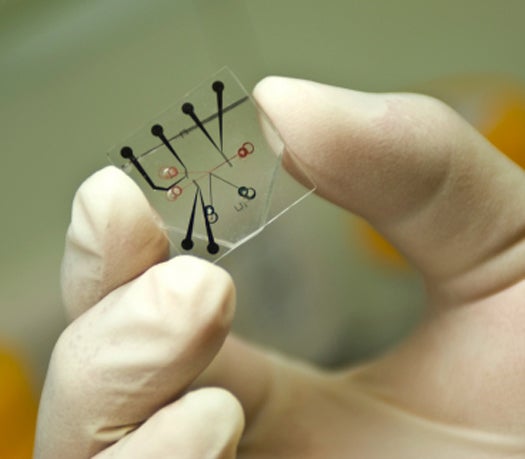
Water Desalination Chip via Technology Review]

High costs, in money and energy, limit the usefulness of desalination as a way to provide drinkable water in disaster areas. However, a new method could lead to portable desalination devices simple enough to run off solar power or a battery, but powerful enough to supply a family, or even a small village, with clean water. Additionally, the new desalination device also cleanses water of biological contaminants.

Developed by scientists at MIT, the desalination device is about the size of a postage stamp, and can be fit together into larger daisy chains. An eight-inch-wide array of the desalination chips can produce four gallons of clean water every hour, while only using as much electricity as a light bulb. Plus, when tested with water mixed with plastic bits, human blood, and miscellaneous proteins in addition to salt, the unit pumped out 99-percent-pure water.

The desalination chips separate water from contaminants by repelling the foreign particles electrically. Since this method does not use filter, the system can operate without high pressures. Simply pour the contaminated or sea water in the top, and wait for the pure water to come out of the bottom.

According to the developers, it will take about two years to develop a commercial product containing 10,000 desalination chips. Whether this technique can expand beyond portable low-energy systems, and into the sort of large-scale desalination that provides many Middle Eastern countries with potable water, remains to be seen.

[Technology Review]

36 Comments

If an 8 inch wide array of chips will produce 4 gallons of water an hour at the energy usage of a light bulb, why build the huge 10,000 chip array?

I never understand the logic of one system for a whole community, like we do with power.

Statements like "Whether this technique can expand beyond portable low-energy systems, and into the sort of large-scale desalination that provides many Middle Eastern countries with potable water, remains to be seen."

Doesn't make since. Put these in the homes and pump the salt water to the houses. What family uses more than 4 gallons of water an hour?

Sure purify the water and then pump it through dirty pipes. I would rather get the 99% pure water right out of this device.

Why are smart people so dumb?

Yeah, you try pumping salt water around a country and see what happens to all the pumps, pipes and everything else. Try to think through your comments before you get on and start calling people dumb.

Every single home and business would have to install their own desalinization. Unless of course you want to install an entire new system of pipes for only your salt water.

Also - things are always cheaper when done on a large scale.

Why are people who call people dumb so dumb?

Thank you SLNuke87

ajohnson1986

from Sioux Falls, South Dakota

exactly SLNuke87. by Voices1776 logic we should all have oil pumped directly to our homes so we can refine it ourselves into our gas and oil and everythig! Economies of scale always makes things cheaper when produced in large volume. Plus if its at your house that means it your problem. So unless you'd like to do your daily checks to check your water purity i'd much rather put a large one together and let a professional deal with it.

this tech does look awesome though. could really help alleviate some of the troubles they are having out west with the water shortages. Maybe we'll get to see the colorado river run like its supposed to instead of turing into colorado creek as everyone pulls water out of it.

Granted, home or community use would bennefit from larger arrays, but there's still a market for portable & personal devices.

Imagine having these in life boats. Or water bottles for beach bums. That'd at least give them a commercial product right now.

Is 99% clean enough for American's digestive system to handle? When I hear about water purity I swear I always hear 99.(something). Would we still get Montezuma's Revenge if we drank 99%?

It amazes me that nearly a billion people around the world still don't have access to clean water.

And I complain that my water looks blue coming from my tap when I fill a bath. It's bad, but nowhere near as bad as the bacteria infected water in many countries.

I'm so glad that there are scientists out there trying to figure this stuff out. It's been going on for far too long.

With this and the Lifesaver bottle/jerrycan, as well as Dean Kamen's Slingshot water purifier (among others), they should get it resolved within this decade.

yeah, this seems like a good idea, how could this possibly go wrong? (yeah i said it XP)

I think a small scheme or simple drawing of thing thing in action would be nice.. anywone?

Um... the energy to power a light bulb is actually quite a lot of energy.

And 99% pure means that 1% of the water is gunk. That is NOT drinkable water.

dontbother um...what light bulbs are you using in your house? flood lights? new light bulbs use about 15W...whereas the computer you were reading this article was probably using around 150W. In a very poor country it may be a lot of power, but the power required is the least of most appliance we use. Any society with electricity would probably have light bulbs 1st on their list of priorities anyway.

And 99% isn't good enough? would it be better if it were 99.5%? because you know 0.5% makes such a BIG difference. 99% clean water is great for people in developing or poor countries. If you live in the city, I'm pretty sure the air you breathe is less than 99% pure. Do you carry an air tank with you?

oops looked up wrong thing...ill adjust computer to about 80W

Average trinking water has a TDS of 50-800 ppm depending on the source (bottled water usually has higher TDS, go figure). This works out at 99.995% to 99.902% water...

The stated "99% pure water" sounds like it's being used as a generalised marketing term.

But potable water is never "100% pure" in fact drinking ultrapure water will kill you faster than any bacteria could.

Better to be a little dirty than too clean, and drinking water with a bit of dirt in it won't make you sick, it's the microbes & bacteria that are the problem.

Wondering if this device can be used to clean rain water? Combine this device with a rain water collection tank and a solar cell. You now have a portable solution for millions of families spread around non-coastal tropical/sub-tropical terrains.
Understand that rain water collection tank might not be dependable for a year long supply.. but it is a start! Thoughts?

Desalination for poor third world and developed countries like Israel is all good and fine at a low cost and energy use, but what happens to all the contamination of heavy metals, other pollutants and the salt. Can the salt be separated from the rest and at what cost. Or is it that like everything else plies and piles of these contaminants will require uncontrolled dump sites and such pollution spreading like wold fire leaving the blight as seen in some of these third world countries and and other toxic polluted site in the west.

remember, that 99 % is based on really nasty water as well probably worse than what you'd get straight from the ocean. It can still be filtered and chlorinated cheaply. The important thing is that we have a much less energy intensive way to get the salt out.

Course, with the possibility of greater widescale desalinization, I would hope that they work on a dispersal method to get rid of the higher content of salt water that won't damage the local aquatic environment.

This is a great improvement in water desalinization science. What i dont understand is the dumb comments made by dumb people like Voices1776, who dont realize the cause and effect of the process. Thank you SlNuke for bringing clarity to the changes required and not to forget about the by products i.e the output of the filtration process, one is pure water the other is impurities. As per Voices1776 the govt has to go from home to home collecting the toxic on daily basis and not to mention on the containment of the toxic as well...I mean just think before you say something.

There are masterminds who are working on some ground breaking technologies as such. Have some respect for them rather than reading something about it and assume that you are the most intelligent person in the world and they are dumb people. Ignorance at its best.

Houses in remote VILLAGES do not have pipes coming to their houses, they have to fetch the water from the village stream or from a hand pump well. The only system that will work in these villages is a household system.

Even many large cities in developing countries, like Nigeria (largest population in Africa) where I lived for a year do not have piped in water supplied by the community; if that infrastructure existed it would already have a treatment system. The apartments I lived in had their own electric wells and water storage tanks in the roof. Neigbors who do not have their own wells buy water from those who do.

This well water is not treated and is not sanitary, because just as the communites do not provide water they also do not provide a sewage system, which means it will stay in the ground on the same plot of land where the well is. I was very careful to boil or treat all the water I drank. When I didn't I got TYPHOID!

If the focus is villages and developing countires a large scale system is completly USELESS! Sell the people something they can use and have ownership of. Or they can keep buying bottled Eva water from Coca-Cola, which they can't really afford anyway.

The biggest problem with desalination currently is where so you put the pollutants that are removed. The high concentrations of pollutants are the real problem.

It's not like you have only one shot at purifying the water before you have to use it. Many filtration systems are multi-stage. It would take only a few additional such devices working in series to make safe potable water.

Bob.Law.Law said:

"And 99% isn't good enough? would it be better if it were 99.5%? because you know 0.5% makes such a BIG difference"

This is why we shouldn't let people have diplomas if they don't pay attention in math class.

99.5% pure water is twice as clean as 99% pure water.

Every 9 you add after the decimal place of 99% is a factor of 10 difference. Marketing has taught people that 99% is "close to 100%". It's not. Each 1% is a part per 100. Water purity is typically measured in parts per million. That's 99.9999% for one part per million.

Or to put it another way, 99% blood free water would be visibly red.

OK PLEASE...

99%=1% impurities or 10000ppm
10000 ppm is toxic. That is assuming its only impurities like salt and not toxic metals, biologicals or other toxic compounds.

Minimum drinkable water for humans is 500 ppm (99.5%)

Worst water for cattle is 7000 ppm and may be toxic if consumed over long periods.

So this technology is a start, but its no way near where it needs to be to be good enough to use.

The technology may not cascade. That means 2 in series wont give 1% of 1%. (like filtering filtered water wont make it any cleaner). Altho it implies in the article that it may cascade (daisy chain somewhat) the effectiveness and energy consumption may increase.

and " electricity like a lightbulb" is not specific enough to be able to set an energy usage.

Here is a link to the article abstract:
www.nature.com/nnano/journal/vaop/ncurrent/abs/nnano.2010.34.html

It actually says the technology is capable of a 99% salt rejection rate. If you consider seawater to be about 35,000 parts per million, 350 ppm would be about 28 times better than 99% pure water.

The authors also foresee small- or medium-scale systems rather than large scale desalinization plants.

Hello

On top of no pipes for the fresh water even in the cities, their are one billion people without any electricity of any kind at all. They use kerosene very sparingly for lighting and heating.

So first you have to get them electricity before you can purify the rainwater run off system you going to install at each person's house. What is the cost of the gadget? Anyone know?

When you call someone else stupid its generally just your conceit and blindness to your own shortcomings showing through in your writing.

MrChaos

Also, man does not live by water alone. He needs calories and protein. That means that desalination must be sufficient to generate not just drinking water, but the massive amounts of irragation water needed to grow crops and raise animals.

On the other hand, 99% is likely more than sufficient to turn ocean water in irrigation water. Dig freashwater wells for the drinking water, use this to water the crops.

Of course, 4 gallons an hour (100 per day, more or less) is not going to irragate much.

@Voices1776: I see your point. If the chip can actually process 4 gallons an hour, it seems a bit pointless to build a centralized water-treatment plant.

But there is a catch. If you start pumping saline or briny water into the grid, there will be huge problems of electrolytic corrosion in the pipes which will drive up maintenance costs beyond the point of profitability. Also, with corrosion you will have the inevitable consequence of metals dissolving into the water, which you don't want to happen either.

Hence, in an urban setting it might make sense to take out the salts out from the water before pumping it into the grid rather than afterwards.

There are lots of rural families in the US who use well water which may be contaminated by fertilizers, insecticides, antibiotics, mercury, etc.

Millions of folks with city water put additional filters on the kitchen sink water pipe due to concerns about bacteria, chlorine, dissolved aluminum salts, tastes, and odors. Some cities are still using hundred year old wooden pipes. My "city water" comes from wells whose pipes run through septic fields so I get letters from the city about bacterial contamination.

So it seems reasonable to have a mix of scaled technologies to meet various using environments.

Afterall, the aquifers are being depleted far faster than they're being refilled. If you look at the Milwaukee disaster they were pulling drinking water from the same lakes they were dumping their sewage in. Sewage treatment doesn't kill everything.

I don't want to sound dumb or anything but if you have ever played the original Fallout game, the term "water chip" should have significance for you. Water chips, now good for 3rd world countries AND nuclear wastelands! Also, I think this would be a great opportunity to improve the United State's aging water treatment systems. BTW does anyone know the water purity standard for tap water?

@Neal2010
Countries with enough rain to warrant a rain collection device atached to one of these wouldnt need to desalinate in the first place, and rainwater in general is safe to drink unless it is contaminated by the container.

Amazing!

Ivan Malagurski

This technology could be ajusted to clean the fumes from cars or from power plants Or make a planet with toxic gas habitable or make the space shutles air supply last longer.
Why just think about water when there are so many other posiblitys to clean our world and explor.

As quoted by the developers in the MIT Technology Review article: "While the amount of electricity required by this method is actually slightly more than for present large-scale methods such as reverse osmosis, THERE IS NO OTHER METHOD that can produce small-scale desalination with anywhere near this level of efficiency, the researchers say."

To be fair, the developers may not be aware of capacitive deionization (CDI) that is already in commercial release by AquaEWP (www.aquaewp.com)...the only company with a commercially successfull CDI system that addresses all of the issues brought forth in this article. Power consumption is lower than 1/4 of that for RO systems making it viable for low-power, solar operated water purification and disinfection. Blogging about it at ggammonewp.wordpress.com

I think it is wonderful to be making whatever attempts possible to help create a clean water supply for ANYONE who needs it. Shoot, before we know it, even our precious water that we think is SO outstanding in the industrialized nations is going to be contaminated, if we are not careful!!!!!!
Desalinization is an effort that has been a controversial subject for years; there are many pros and cons. The pros are quite obvious.....clean, fresh water. The cons are sometimes more subtle than we might realize, ranging from what many have brought to light here in regards to future contamination, to the fact that desalination causes a serious in-balance in the oceanic ecosystem. Over time, this in-balance can cause certain wild life to be unable to thrive, become extinct, thus the ocean's circle of life becomes non-existent......at which point....so does the earth. This is NOT a dooms-day prophecy, because there IS a way to do this AND to continue to HELP our oceans THRIVE. We must simply replenish what we are taking away. Give back to the earth.

I am as ignorant as the next, though, so maybe I don't knwo all that much!!! ;)

Take Care,
Audrey

Hello

On top of no pipes for the fresh water even in the cities, their are one billion people without any electricity of any kind at all. They use kerosene very sparingly for lighting and heating.
www.promdresspicture.com
So first you have to get them electricity before you can purify the rainwater run off system you going to install at each person's house. What is the cost of the gadget? Anyone know?

When you call someone else stupid its generally just your conceit and blindness to your own shortcomings showing through in your writing.

Cette technologie pourrait être ajusté pour nettoyer les fumées des voitures ou des centrales électriques ou en faire une planète avec des gaz toxiques habitable ou faire de l'espace shutles alimentation en air durer plus longtemps.
Pourquoi se contenter de penser à l'eau quand il ya tant de posiblitys pour nettoyer notre monde et Explor.

www.autonewstoday.net

Suurin ongelma suolan tällä hetkellä on, jos niin laitat epäpuhtauksia, jotka poistetaan. Suuria pitoisuuksia epäpuhtauksia todellinen ongelma.

www.hotcarz.net
www.PARKCARZ.COM
www.thaicarnews.com


138 years of Popular Science at your fingertips.

Innovation Challenges


Popular Science+ For iPad

Each issue has been completely reimagined for your iPad. See our amazing new vision for magazines that goes far beyond the printed page


Download Our App

Stay up to date on the latest news of the future of science and technology from your iPhone or Android phone with full articles, images and offline viewing


Follow Us On Twitter

Featuring every article from the magazine and website, plus links from around the Web. Also see our PopSci DIY feed


February 2012: The Future of Fun

Science is reinventing play, from extreme sports to gamification to ridiculous roller coasters to the playgrounds of tomorrow, and this issue is chock full of fun. Also, on a less fun note: Did global warming destroy my hometown?


circ-top-header.gif
circ-cover.gif
bmxmag-ps