"Thermopower waves" could be a brand-new way to produce electricity
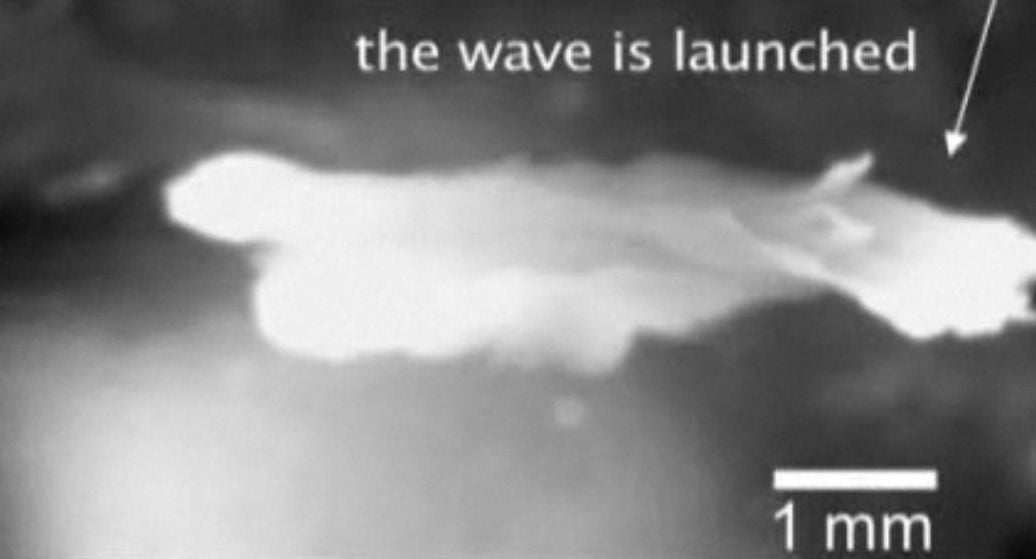
Nanotube Heat Wave And it burns, burns, burns ... MIT

Johnny Cash can't have known about carbon nanotubes when he sang about that burning ring of fire, but MIT scientists have shown how the tiny tubes can channel a ring of heat that creates electrical current -- about 100 times as much energy per unit of weight when compared with a lithium-ion (Li-ion) battery.

The new experiments involved nanotubes, or submicroscopic structures just a few billionths of a meter in diameter, that can conduct both electricity and heat. Engineers coated the nanotubes with reactive fuel that produces heat by decomposing, and then ignited it with laser beams or high-voltage sparks.

That set off a fast-moving heat wave that traveled through the nanotube's hollow cylinder 10,000 times faster than in the reactive fuel itself, and reached a temperature of 4,940 degrees F (3,000 Kelvin). The fast-moving heat also pushed electrons along the tube and created a noticeable electrical current.

Such combustion waves were studied mathematically for a century, according to Michael Strano, a chemical engineer at MIT. Strano first predicted that a nanotube or nanowire could channel the heat pulse and create electrical current, but now his group has realized that prediction.

Some semiconductor materials can also produce an electric current when heated, but the carbon nanotube experiments defy predictions by thermoelectric calculations. Strano noted that the heat wave seemed to carry along electrons or other electrical charge carriers, not unlike how an ocean wave can pick up debris.

The possibility of creating substantial energy on such a tiny scale could lead to new ultra-small electronic devices the size of rice grains, whether for implantable medical chips or other tiny sensor applications.

Strano's MIT group plans to continue improving the efficiency and cut back on wasted energy given off as heat and light. Strano also suggested that a different reactive fuel coating for the nanotubes might produce alternating current -- an intriguing contrast to current energy-storage systems that all produce direct current.

[MIT]

13 Comments

Would it recharge or not, that's the question.

I don't think the process looks reversible from a charge/discharge standpoint. It does apear you could "refuel" the system for another go. This isn't so much an advance in electrical to electical but creates a new frontier for nano particle fuel options. I mean controlling a molecular level combustion is pretty impressive. We have already seen articles on combustable fuel as replacements for batteries this is just another step in that direction.

The other concern would be heat mitigation 3k kelvin is nothing to sneeze at

To me this looks like a potential replacement for the mechanical ic engine in a hybrid, and a pit stop on the way to pure electrics.

Ain't micro batteries thinking small,why not use it to design a new fusion reactor & let's get space travel possible

Could this thing be used to power a VASIMR plasma thruster instead of using a nuclear reactor?

Could it be used to power tactical laser weapons?

Could it be used to power an EMP weapon?

everyday brings somthing new but were still stuck in the 60s, but with cell phones and slow internet =/

This is cool, but I'm struggling with the tiny/implantable device application. 5000 degrees in the non metric Farenheit would seem to require some sort of larger packaging to manage the heat.

New energy for Planet Earth. Wow.

Let me visualize this. I have a medical device implanted in my body, that when it is activated burns at nearly 5,000 degrees. O.K.

And then, how do I refuel it? Oh, we do more surgery and implant another one.

Or maybe we have an electrical generating plant, burning jillions of carbon nanotubes, and shoveling in new ones to replace the burnt ones, and lining them up properly to get them going.

Sounds like a winner to me!

This is amazing. Think about the medical implications. If we ever invent robotic organs we can power them with this technology. Also we can extend our life span if we can somehow make our body use less of our own energy.
| Written by Dimitri from Eat Healthier Foods |

This is cool, but I'm struggling with the tiny/implantable device application. 5000 degrees in the non metric Farenheit would seem to require some sort of larger packaging to manage the heat.

jeff
http://burnwiigames.org/

Ain't micro batteries thinking small,why not use it to design a new fusion reactor & let's get space travel possible
www.tran33m.com/vb/


June 2013: American Energy Independence

Five amazing, clean technologies that will set us free, in this month's energy-focused issue. Also: how to build a better bomb detector, the robotic toys that are raising your children, a human catapult, the world's smallest arcade, and much more.


Online Content Director: Suzanne LaBarre | Email
Senior Editor: Paul Adams | Email
Associate Editor: Dan Nosowitz | Email
Assistant Editor: Colin Lecher | Email
Assistant Editor: Rose Pastore | Email

Contributing Writers:
Rebecca Boyle | Email
Kelsey D. Atherton | Email
Francie Diep | Email
Shaunacy Ferro | Email

circ-top-header.gif
circ-cover.gif