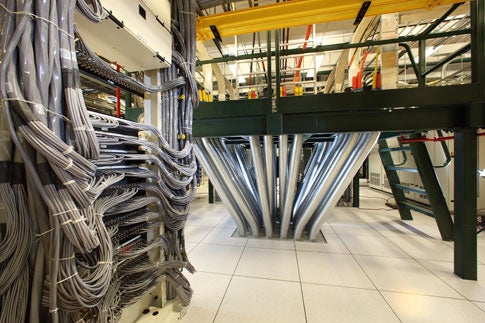
A Series of Tubes At Terremark's Miami headquarters, undersea Internet cables emerge from the Atlantic and connect to the rest of the country John B. Carnett

Today the Federal Communications Commission unveiled its plan to expand broadband Internet access to 100 million more Americans within the next five years. The plan calls both for the expansion of wired networks in under-serviced areas, and for the dedication of more wireless spectrum for Internet use as opposed to television. Largely deficit-neutral, the plan has bipartisan support in the current Congress, in part because contentious issues of net neutrality and privacy were not tackled by the FCC's plan. As you remember, PopSci called for an improvement to the nation's broadband infrastructure last year

The FCC's plan involves the expansion of both home broadband capacity, but also pays special attention to ensuring that hospitals, libraries, and schools, where most Americans currently use broadband Internet services, get upgraded as well. Ultimately, the FCC hopes to provide 50 megabits per second of upload speed, and 100 megabits of download speed, to another third of the US population over the next decade. Additionally, the FCC wants 500 megahertz of wireless spectrum, currently operated by TV stations, rededicated to servicing mobile devices.

Estimates place the cost of the plan at between $15.5 and $25 billion, but FCC claims that the majority of that money will come from altering the Universal Service Fund, a program to subsidize rural phone service paid for by telecomm companies, from paying for telephones to paying for broadband. Additional funds will come from the auction of wireless spectrum for mobile device use. And if that doesn't cover the bill, the FCC has plans to ask Congress for a one-time, $9 billion boost.

The FCC, the telecommunications industry, and Congress all agree that the expansion of broadband is key to ensuring that America remains competitive in the world. The integration of TV and the Internet, the digitizing of medical records, and an increased use of cloud computing all threaten to tax America's currently limited broadband infrastructure. Despite having more broadband users than anywhere else in the world, the US only ranks 19th in percentage use, according to the Organization of Economic Cooperation and Development, behind economic competitors like South Korea, Germany, and Great Britain.

Starting at the end of the month, Congress will begin holding hearings on the plan. However, with a lawsuit between the FCC and Comcast over the FCC's ability to regulate the Internet still undecided, the climate change bill poised to distract the Commerce Committee members tasked with FCC oversight, and an election in November that could reverse party control in Congress, it may be some time before the FCC can begin implementing the plan in full.

[The NY Times, Reuters, The BBC]

8 Comments

I like the concept. I see two major problems:

1. Cost. When has the federal government ever done anything that was deficit neutral?

2. Management. Can you think of anyone worse to manage this than the federal government?

I'll betcha that "one-time" 9-billion jump start will triple before the ink on the legislation dries. I'm not anxious to pay for it from my taxes, thank you.

Well, a one time 9 billion dollar appropriation doesn't sound deficit neutral.

I'm also not sure why telecomm companies are supposed to fund this expansion -- unless they benefit from the change.

It's probably something that's worth doing, although I'm not at all certain about the priority.

And just a personal quibble. Any media member 'calling for something' is not the same as really doing anything, as far as I can tell. I whine about things that should be changed for hours every day -- nobody seems to think that makes me anything but crabby.

@KH, how did you know I was an ignorant Republican? Zoiks!

You're right about the Post Office which few people realize receives no taxpayer subsidies...thanks to President Nixon (Postal Reorganization Act of 1970). Despite all the jokes about the USPS, it runs profitably...because it receives no money from the federal government and runs like a private business, competing with FedEx and UPS.

The reason the federal government ran a budget surplus from 1998 to 2001 was because:

a.) the Republican Congress elected in 1994 (remember Speaker of the House Newt Gingrich and the Contract With America?) started balancing the budget and threatened to override President Clinton's threatened veto. President Clinton realized he wouldn't win the budget fights and reluctantly signed them, then later was credited--unbelievably--with balancing the budget.

b.) the economy was continuing it's longest-running boom which began with President Reagan's tax cuts and lower interest rates in the 80's. When the economy is doing well, tax revenues go up, reducing deficits. Here's a simple equation to remember: lower taxes = stronger economy = more prosperity for everyone = higher tax revenues.

The reason the economy is suffering now is because of the financial meltdown of 2008 which was a result of the housing bubble finally bursting. You may ask why we had a housing bubble in the first place. The 3 biggest reasons:

a.) In 1992, changes to the Community Reinvestment Act (CRA) required Fannie Mae and Freddie Mac to back loans made to people who couldn't afford them so they began taking on riskier loans. Later changes reduced oversight of these institutions. (President Clinton)

b.) Artificially low interest rates during the early 2000's in response to the Dot Com bubble burst and increasing deficits. (President Bush)

c.) The 1999 repeal of part of the Glass-Steagall of 1933 which was created to prevent the kind of banking situation which led to the Great Depression by separating investment banks from savings banks. (President Clinton signed it, but both Republican and Democrat Congressmen were complicit.)

In 2003, President Bush tried to tighten regulation of Fannie Mae and Freddie Mac but Senate Democrats rejected his plan as a "witch hunt." Senator Barney Frank infamously said they "are not facing any kind of financial crisis."

In 2004, Federal Reserve Chairman Alan Greenspan warned Congress that not increasing oversight of Fannie Mae and Freddie Mac was putting the entire nation at serious financial risk. They were over-leveraged, there were several accounting scandals, and they misreported their assets to falsely bump up their credit rating causing investors in mortgage-backed securities to overrate their value. Again Senate Democrats rejected his warning.

FYI, deficits were steadily decreasing under President Bush from a high in 2004 (a direct result of war spending starting in 2002).

The average deficit as a percentage of GDP by President:

Reagan (inherited a dismal economy): 4.225%
Clinton (inherited a strong economy): 0.76%
Bush (inherited a weak economy): 1.9%

If you credit 2009 (Obama's first year, 12% deficit spending) to Bush (though his only contribution was deficit war spending, which was going down), his deficit spending average is still only 3%, not too far from average.

Blame for deficit spending lies more with Congress, which formulates budgets, than with the President.

There's plenty of blame to go around for the current bad economy and deficits, but mindlessly blaming "Republicans" or "Bush" is completely inaccurate. In fact Republicans balanced the budget for the first time (1998) in 29 years (since 1969) and they remained that way for 4 years until a war broke out. No other Congress had 4 years of balanced budgets after 1930, when--guess who?-- the Democrats took control of Congress for virtually all of the next 60 years.

Oh, sorry, Bush also pushed for and signed TARP in 2008 which dramatically increased the deficit. Obama increased Bush's emergency increase even further in 2009.

Regan increased the deficite off of Star Wars and other exspensive cold war projects.

Bush off of the first Gulf War.

Clinton did not increase it because he failed on health care in his first two years, lost the congress, and then did not get to pass very much spending for the next 6 years. NAFTA was a mistake, though.

WBush second gulf war and afghanistan, as well as stimulus #1.

Obama on stilmulus #2-123124354345, afghanistan, etc.

The only time government works is when it isn't working. When bills don't get passed, money doesn't get spent, and we all end up better.

That said, I would love some high speed out here in the country. Cable company laughed at me, phone company said to S#@$ myself, and satalite said they would barely beat out my dial-up at the cost of my kidney, firstborn child, and "prima nocta" rights.

Hypocrisy means insincerity by virtue of pretending to have qualities or beliefs that you do not really have. I think what you meant was "cognitive dissonance" which means believing contradictory ideas. My point is that while neither political party is great, the Republican party has demonstrated more fiscal discipline than the Democrat party...though that's not saying much. I also wanted to correct the misperception that Democrats balanced the budget.

Hypocrisy means insincerity by virtue of pretending to have qualities or beliefs that you do not really have. I think what you meant was "cognitive dissonance" which means believing contradictory ideas. My point is that while neither political party is great, the Republican party has demonstrated more fiscal discipline than the Democrat party...though that's not saying much. I also wanted to correct the misperception that Democrats balanced the budget. http://www.tamders.com/ | http://www.mekanize.net/ | http://www.durust.net/ | http://www.aindir.com/

Investment in broadband for americans is a good thing, if they manage to follow through these promises. Internet and technology is absolutely the future and needs to be embraced and used to aid and enhance our lives, not the reverse. People get scared of change, but tech can boost our lives if we let it.
Bob
www.100-mortgage.com


138 years of Popular Science at your fingertips.

Innovation Challenges


Popular Science+ For iPad

Each issue has been completely reimagined for your iPad. See our amazing new vision for magazines that goes far beyond the printed page


Download Our App

Stay up to date on the latest news of the future of science and technology from your iPhone or Android phone with full articles, images and offline viewing


Follow Us On Twitter

Featuring every article from the magazine and website, plus links from around the Web. Also see our PopSci DIY feed


February 2012: The Future of Fun

Science is reinventing play, from extreme sports to gamification to ridiculous roller coasters to the playgrounds of tomorrow, and this issue is chock full of fun. Also, on a less fun note: Did global warming destroy my hometown?


circ-top-header.gif
circ-cover.gif
bmxmag-ps