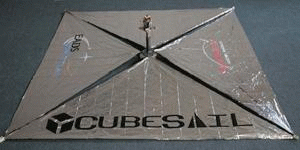
A tiny spacecraft measuring less than a foot in length is the first designed to end its own life by using a solar sail as an orbital brake. Putting itself through the fiery atmospheric plunge would let it avoid becoming part of the growing cloud of space debris surrounding Earth, New Scientist. You seeing this, DARPA?
The CubeSail craft would use the 16-by-16-foot sail to harness the pressure of sunlight and test the power of solar sail propulsion, before deploying it to de-orbit at the end of its mission life. Launch is scheduled for sometime late next year.
This preventive approach to tackling space junk could prove invaluable to keep the debris cloud from growing, but only if many more future space missions adopt this. Just keeping track of all the tiny bits of debris has proven a challenge, but represents a necessary task for human space missions to get out of harm's way.CubeSail's design comes from the University of Surrey in Guildford, UK. Funding for the project came from EADS Astrium, the biggest European aerospace company that has previously investigated similar death shrouds for satellites.
On a more life-affirming satellite note, the company also recently announced plans to put a solar-power-harvesting satellite into orbit before the decade is out.
[via New Scientist]

140 years of Popular Science at your fingertips.
Each issue has been completely reimagined for your iPad. See our amazing new vision for magazines that goes far beyond the printed page
Stay up to date on the latest news of the future of science and technology from your iPhone or Android phone with full articles, images and offline viewing
Featuring every article from the magazine and website, plus links from around the Web. Also see our PopSci DIY feed
The 6th annual Invention Awards are here, from an inflatable tourniquet to a better lobster trap to spring-loaded hocket skates. This issue is all about the celebration of invention.
Plus: Making synthetic biology breakthroughs in a garage, building a constantly-moving ping-pong table, and a ridiculously overpowered barbecue.
When is this?
@javor jav Good question -- sometime next year
Why destroy itself? I'm sure on board that satellite are very expensive components and parts that can be recycled or reused. Why not tell it to rendezvous with a space craft returning from its own mission and get packed up in the cargo hold and brought back to Earth?
Maybe some of them are too big to fit in the space craft? Well, take whatever isn't too big and not bolted to the floor and save yourself some money.
People wonder why NASA costs billions of dollars a year to operate. Well, you wouldn't be so amazed if you knew that they're literally burning up multi-million dollar satellites with expensive components when they're done with them.
To me, that's FWA, or Fraud Waste Abuse.
Would what NASA does make sense if DoD departments practiced the same thing? Does the Navy sink it's carriers once they've finished with a mission? No. They get stripped for parts and mothballed until they need it again. The USAF doesn't just throw away entire working airplanes that are decommissioned. Those planes also get stripped for parts, and the fuselage hangs out to dry in a desert climate somewhere until it's needed for something else or melted into raw materials again.
it should take out the trash with itself. everytime one commits suicide, it can take down a decommissioned satellite or something. couldnt we put a satellite up higher than the rest of them, which shoots a BB gun at things that need to crash back to earth? except a BB in space would take out the ISS and anything else we got up there. but thats why it needs to be so accurate that it can shoot a BB at a stray BB and send them both to earth. or i could go up there on a suicide mission where i go collect space junk and if i get hit by space junk then i die but i have at least put some of the space junk into my giant space recycling bin.. even safer idea: launch ice cubes at the target with springs/compressed air. then you dont have to worry about stray BB's it could even be dry ice so you are not wasting water.
the reason why we dont try to recover this stuff and would rather have it disintegrate in the atmosphere because it cost way to much money to recover it. It is much more economical to send it up, have it do its mission and then forget about it. (or in this case have it destroy itself)
Watch it be the first "emo" satellite and plan and plot its own suicide but, due to some kind of glitch, never execute its plan to execute itself.