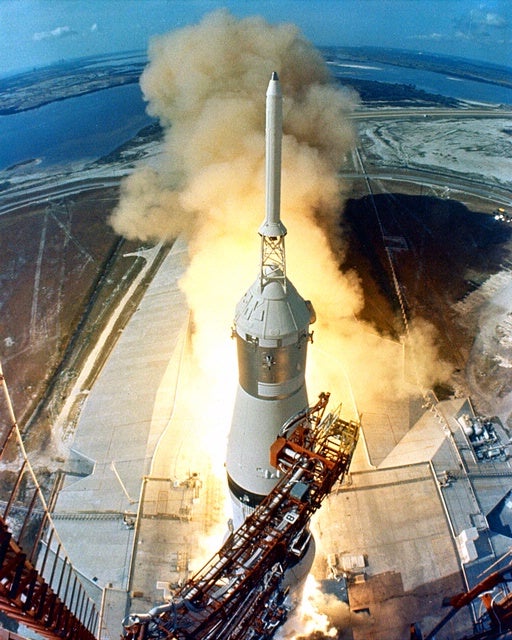
China's new moon rocket design is in the class of the old Saturn V that once launched U.S. Apollo astronauts to the moon. The China Academy of Launch Vehicle Technology says that the proposed rocket would have a thrust of 3,000 metric tons, just shy of the 3,470 metric tons of thrust generated by the Saturn V's first stage, Aviation Week reports.
The announcements through Xinhua and the China Daily come barely a month after the Obama administration decided to cancel NASA's Constellation program and the Ares rockets that represented NASA's successors to the mighty Saturn V -- the proposed Ares V might have had a thrust of more than 4,000 metric tons. The Constellation program had long been criticized for being unrealistic in its goal and over-budget given NASA's existing funding levels.
The U.S. space agency has since focused on developing technologies such as inflatable space stations, orbital refueling and new robotic missions. It has also reached out a hand to help the growing U.S. commercial space industry.
China's latest rocket development was first reported by the Xinhua news agency and the China Daily. Besides the giant moon rocket in the class of the Saturn V, China is also working on a medium-lift Long March 7 rocket that will join the Long March 5 and 6 rockets.Such lift power will help China launch its own full-fledged space station before 2020, as well as the first of perhaps several "Tiangong" space labs next year, Aviation Week notes.
Chinese officials also recently announced China's second batch of astronauts that includes the first two women taikonauts, Xinhua reports. The candidates mainly come from a pool of fighter pilots and must undergo stringent health checks. You can't have bad breath on the moon, you know.
Five amazing, clean technologies that will set us free, in this month's energy-focused issue. Also: how to build a better bomb detector, the robotic toys that are raising your children, a human catapult, the world's smallest arcade, and much more.


Online Content Director: Suzanne LaBarre | Email
Senior Editor: Paul Adams | Email
Associate Editor: Dan Nosowitz | Email
Assistant Editor: Colin Lecher | Email
Assistant Editor: Rose Pastore | Email
Contributing Writers:
Rebecca Boyle | Email
Kelsey D. Atherton | Email
Francie Diep | Email
Shaunacy Ferro | Email
Perhaps the Chinese want to denture weaponization of space and the moon by being able to surpass the lift capacity of the USA. Maybe we should match lift capacity to prevent the temptation they may have to weaponize space.
If prestige was a reason for the huge expense to go to the moon then Europe would have three or four bases on it already. More in space means more of something and fast.
So, now it's a race to the moon. Too bad in Obama's country, we will be stuck on the Earth for sometime now. Other countries are going to advance much faster than us if we don't do something.
We are going to mars, forget the moon. Obama has a great plan for space. Also the chinese are not going to weaponize space, but even if they did, they would not be the first. The russians has machine guns on salyut stations, and the US has had plenty of secret missions in space, and it is almost certain they had weapons up there. But weapons in space isn't even a problem. The chinese has peaceful ambitions in space, and we should cheer them on. The exploration of space will benefit all mankind.
I agree with pop. We need to work together at something important and exciting. Its like when you get bored what do you do??? Go to war right. We need something exciting to keep our minds thinking.
the Chinese wouldn't bring weapons, they would bring 'ma fen', according to www.hempfood.com/iha/iha02111.html
because they want to be the first to cultivate moonajuana, and mars-ajuana, both of which fall into the category: Spacebuds, along with InternationalSpaceStationajuana.
The Chinese want to beat the US at its own game. They will send people to the moon and on an Saturn V size rocket. There is NO new technology Obama talks about to reach orbit. Chemical rock will be the only way to get in to, orbit, to moon or mars for next 30 to 50 years. The US needs The Constellation program with Aries I and V. The only privet rocket that can almost lift Orion(66,000lbs) is Atlas V(55,000lbs). Obama wants tax payers to invest 6 billion in privet companies when we just paid 9 billion for Ares/Orion and will take 2 billion more to cancel. NASA should keep its goal for the Moon and Mars Let's finish Aries I/Orion and delay Aries V a few years.
I seriously doubt Humans will be using chemical rockets 50 years from now, but I'm an optimist with a huge imagination, so I tend to forget reality. Even so, looking at the rate and progress of scientific and engineering discovery, I think some accurate predictions can be made with what kind of propulsion technology we'll have 50 years from now, and I don't believe it will still be purely chemical rocket.
Every nation on Earth should be united, we should all be working together in our efforts to explore and colonize the galaxy. It's a shame we still live in a violent world, with greed, wars, etc. I'm waiting for my Star Trek Utopia to come, lol.
And when I say we, I don't just mean the United States, I mean the entire world, all of humanity. I honestly could care less who develops the technology first, we're all humans here.
Ground to orbit maybe scram jet but not lifting what chem rockets are lifting. In space, plasma (VASIMAR) and ion engins with nuclear power source.
This is not what I wanted to happen to the NASA, China is going to beat us back to the moon because our dumb president thinks that human spirit of exploration can be put on hold.
Perhaps we have something better, and could already be back on the moon or farther out. How else can we get the rest of the world to play catch up?
Bring back NASA funding!!!!
Everybody here is missing the point. There is conclusive evidenence, that the chinese space agency has already reversed engineered a Saturn V Rocket., (see NASA watch website article Saturn V Sighting in China). The Saturn was our nation's greatest rocket. Nothing has matched its thrust, or payload capablity since the rocket was decommissioned in 1974. Both the Ares I and Ares V Rockets, are plagued with design problems. They are both over budget. Over 9 billion dollars has been spent on Project Constellation before it was cancelled. Also, the original Apollo Program occurred on a much shorter time frame 1961-1969( from Proposal to first lunar landing). Constellation (2004-2019). If the United States is serious about returning to the lunar surface, NASA and its contractors should start up production of a updated Saturn V. This would include improved F-1 Engines for the S-1C Stage, new J-2 Engines for the SII Stage, improved SIVB Stage with J-2X Engine. and a new Instrument Unit. Also with today's technology, the redesigned command module & lunar module could possibly accomodate up to six astronauts. I hear from all these naysayers that it would be impossible to reproduce this great rocket. This is not true. Contary to popular belief, the saturn's blueprint have not been lost. They can be located on microfilm and other computer formats. Concurrently, if the Chinese can use reverse engineering, so can we. The new Saturn V might look like the classic rocket on the outside, but on the inside it will be a new vehicle. This is especially true with guidance control and electronics. Finally, the Moon Rocket is still very popular today. It is very suprising how many teenagers are impressed with the Saturn V. At the KSC Gift Shop, Saturn V Merchandise was outselling Space Shuttle stuff. What does that tell you. It is time to get serious let's get the rocket back into production.
On 6-9-10, I made the comment that the saturn v could be put back into production. Here is how it should be done. First NASA should select contractors that have had experience building the orginal Apollo Rocket and spacecraft like Boeing, IBM, and General Electric. The former companies that were major saturn V contractors; like Mcdonald Douglass, North American Rockwell, and Rocketdyne, have been absorbed by Boeing. Lockheed Martin the current contractor for the cancelled Project Constellation, has zero experience constructing the Apollo Spacecraft. Second, by using off the self technology, NASA would save a large amount money on development costs. The Saturn is a flight proven rocket.
I find it incredible than we can build such things. The advancements of technology over the last years has become both fascinating and terrifying. I read an article the other day about space travel www.mytravelarticles.net it was called something like 'Technology is moving faster then we are evolving'. And it talked about how it could potentially be very unhealthy for us to travel to space and do other activities that technology is allowing us to do nowadays.
I love appollo16's argument for the re-introduction of the Saturn 5 rocket, I would also love to see a new and updated version. As for not allowing someone the opportunity to travel to space, something they would have spent their life in training for simply because of a small problem like bad breath is ludacris. There are a ton of sites out there http://www.badbreathgone.com that show you how to get rid of the problem so if they can invest millions in making rockets surely they can solve this problem too.
And when I say we, I don't just mean the United States, I mean the entire world, all of humanity. I honestly could care less who develops the technology first, we're all humans here.Perhaps we have something better, and could already be back on the moon or farther out. How else can we get the rest of the world to play catch up?
www.tran33m.com/vb/
www.tran33m.com
There isn't a doubt in my mind that with all of the existing F-1 engines we have we can take castings and laser scan and design a new version of the F-1. With modern materials, our payloads would be much higher than they were in the Apollo years. We save a couple tons just in computer now. What are we afraid of? The harmonics problem? Please. We wouldn't even have to fire the engine to know if we've got it dealt with nowadays. That's not saying we still wouldn't want to be sure to have precautionary explosives charges on hand at full test just to be sure we could take problems out of the equation the same way it was done before. So what's the big deal? Kerosene too plentiful a fuel to be considered in our 'cost plus' space program? Do we think there is some lack of willing personnel that would jump at the chance to work on it?