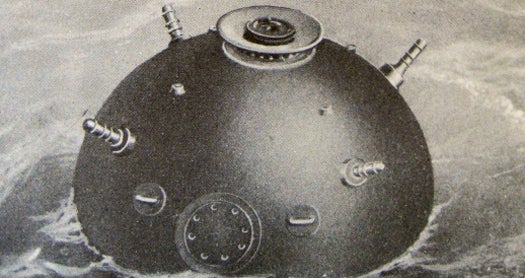
Retro Sea Mine via Bactec

In a dangerous legacy of the world's deadliest conflict, 150,000 World War Two-era sea mines litter the Baltic Sea. The danger these bombs pose to a proposed gas pipeline has prompted Russia to hire the British firm Bactec International to clear the sea of unexploded ordnance. And for Bactec, that means it's time to bring out the robots.

Bactec, which previously worked clearing mines from around the Falkland Islands, will use a specially designed robot to scour the ocean floor in search of the 70 bombs blocking the path of the pipeline. When the robot finds a mine, a surface ship releases a high-pitched wail to scare away nearby marine mammals, sets off a small explosive to scare away any fish, and then plants and detonates a small charge on the mine. Altogether, it takes Bactec two days to clear each mine.

Naturally, there are some who object to Bactec's clearance method. The Baltic Sea is already one of the world's most polluted waterways, and filling it with the detritus from exploded mines won't make it any cleaner.

To that end, Russian Prime Minister Vladimir Putin recently signed a pact with the other Baltic Sea countries promising to clean up the 40,000 tons of chemical weapons, and dozens of ships, that Russia sank beneath the Baltic Sea during the Cold War. Hopefully, Russia will follow through on that pledge, and offset the new pollution resulting from the mine clearance.

[Infrastructurist]

4 Comments

Couldn't the mines be used for some kind of energy source?
It seems like a waste to just destroying them all. I would take them and figure out if there is away to take the chemicals inside them and convert them to a gas or liquid form. Since they are already planning on using robots to do the jobs, they could probably make the robots bring the mines to land safely.

ajohnson1986

from Sioux Falls, South Dakota

The problem with attempting to harvest the unexploded mine's for "fuel" is that they are unpredictable. The device was designed to go off whenever it is touched so trying to move it could prove disasterous. Also, just like with old gunpowder or tnt the longer it sits the more unstable it gets meaning attempting to move the innards could set it off. None of those scenarios sound good.

Why do they need to scare the animals away? it would be a lot faster and more efficient if they didn't.

well it might a lot faster and more efficient but becouse all the pollution we are facing an eco dissaster and killing all those animals would just make it worse.


138 years of Popular Science at your fingertips.

Innovation Challenges


Popular Science+ For iPad

Each issue has been completely reimagined for your iPad. See our amazing new vision for magazines that goes far beyond the printed page


Download Our App

Stay up to date on the latest news of the future of science and technology from your iPhone or Android phone with full articles, images and offline viewing


Follow Us On Twitter

Featuring every article from the magazine and website, plus links from around the Web. Also see our PopSci DIY feed


February 2012: The Future of Fun

Science is reinventing play, from extreme sports to gamification to ridiculous roller coasters to the playgrounds of tomorrow, and this issue is chock full of fun. Also, on a less fun note: Did global warming destroy my hometown?


circ-top-header.gif
circ-cover.gif
bmxmag-ps