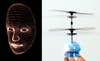
The concept is simple: As with any digital image, the picture is made of groups of tiny dots of varying colors that, at the right scale, appear as one large image. Now imagine the pixels in a pointillist painting like a Georges Seurat aren't tiny flecks of paint, but thousands of miniature helicopters with varying color LEDs arranged as the image.
Flyfire, though, takes things one further by adding depth. The face of the Mona Lisa, for example, can be blown out and backward to create a 360-degree rendering of the painting.
The helicopters are about the size of a golf ball, each with a color-changing LED. It took the expertise of the ARES flying robotics lab to make small 'copters that fly steadily enough and that can adapt quickly and with utmost precision.
Right now, Flyfire is best suited for large-scale art installations, since the 'bots are still a bit hefty. In the future, though, smaller parts will mean smaller 'copters and more exact displays that don't need to take up a whole room.
{MIT]
Five amazing, clean technologies that will set us free, in this month's energy-focused issue. Also: how to build a better bomb detector, the robotic toys that are raising your children, a human catapult, the world's smallest arcade, and much more.


Online Content Director: Suzanne LaBarre | Email
Senior Editor: Paul Adams | Email
Associate Editor: Dan Nosowitz | Email
Assistant Editor: Colin Lecher | Email
Assistant Editor: Rose Pastore | Email
Contributing Writers:
Rebecca Boyle | Email
Kelsey D. Atherton | Email
Francie Diep | Email
Shaunacy Ferro | Email
This just a CGI demo of how it might look if it worked... :(
ooooh......... electronic fireflies.
Ooooooh! Vaporware!
No kidding, perhaps when we can communicate through Subspace this will be a possibility. Currently this would require communication levels equal to the central cell phone hubs in NYC.
I don't think it would take too much communication bandwidth. 'Certainly possible on any mundane Wi-FI. (I have developed many communication protocols and have real experience with what can be done. If you can watch video on your Wi-Fi, you can surely tell a 100 robots where you would like them to be a 100 times a second)
The real trick is getting all those little robot helicopters to hover exactly in place despite turbulence both from wind and from their siblings' down draft. If you have ever flown a tiny R/C helicopter you'll know exactly what I mean. Even with really capable software onboard each robot (e.g.: see cool software driven hovering rockets at www.armadilloaerospace.com) it is unlikely that they would be very stable.
'Cool idea, though. Might be possible with a nano-swarm where the cloud was turbulent with sparkles only from the nanos in correct position. ...that is still Sci-Fi for now....
Turbo Two tone.... not necessarily if they daisy chained or leapfrogged their communications.. lightbot "a" is the only one actually recieving a command then passes it on to lighbot "b" and so on and so forth.. i agree that the random air turbulance would be a problem.. as would bots being out of calibration, or off center, concentrically speacking. pretty cool idea though.. i liked it when it was fish in finding nemo
And when one of them hits a patch of turbulence, it collides into the one next to it, and the one next to it, and so on and so forth. Like a bunch of dominoes falling and crashing to the floor in a splended carnage of light and little broken propeller blades. I'd love to see that happen.
can think of all sorts a problems implementing that: Flight time would be short (Maybe 5min) you also need to need to power the on board processing, communication and position sensing. Weight would be a problem too.
Would be an interesting programming exercise, would love to mess around with it. But the carnage while I got it right and can you imagine the hassle trying to charge them all?
Could use some sort of variation on a flocking algorithm to keep them apart with each one assigning itself to a point in an 3d grid as it flies into the air. Can't see it as being very stable or accurate though.
Have you ever heard about the book Prey.
AO
I could imagine a future where many nano-versions of these fly fires would follow you along, creating images such as video from a person that called you, and text from an email. They could disperse instantaneously if an object or person crossed their path, or if they crossed the path of the other.
AO
Prey, however scares me. The thought of nanobots out of control like that, there is no way to escape.
Most likely use is bigger, better and grander fireworks for all of us, because sponsors can advertise during the fireworks display. Imagine Macy’s fireworks display with creatures marching in the sky and forming their logo as fireworks flash by. Picture Disney’s sky parade with flying Mickey and Mini blowing kisses above the enthralled crowed. And above the Vegas strip with sky size screens passing over head with seense like god giving life to man from the Sistine Chapel or Poseidon with trident literally rising out of the fountains of the Bellagio. I think I want to be an Imagineer.
You mean it's only a computer generated display??? Aw c'mon!
I love the Bellagio idea though.
Wouldn't they be more effective in creating better images without that "huge" propeller? That thing is just as big as the light.
Thats a pretty neat idea. Even though i think it would be more effective if the states would put more effort into getting everything in shape with the economy instead of making flying helicopters that make pictures.
Seems like a lot of energy could be saved, and turbulence reduced if the flying pixels were neutrally buoyant. More akin to tiny dirigible/blimps.
That way once an image was created, there are adjustments to maintain it, but not burning energy to stay afloat.
(Also, some of those pixels in the demo video were awfully close together... seems unrealistic given the ratio of the point of light to helicopter contraption.)
I can predict one of the first applications it will be used for. Advertisers will be able to pester us everywhere we used to be able to go for privacy. The little helicopters could also be equipped with tiny video cameras making it impossible to have privacy anywhere on the surface of the earth.
The next housing boom will be for ones built deep under ground for privacy.
Typical MIT vaporware. Plus, again, a reporter says "have created" when they should have said "may someday be able to make."
Thenk you very much very nice sesli chat
Thw ability to see more than one video input at the same time for increased clarity of thinking is fogged out here.
Similar to increasing highway density to 240%, it's sensors on X Y Z and sensors in the choppers. Shall we dance ...valcaries...smells like victory.
Air turbulance greatest disturbance here.
No it's molecular choppers guiding my blood supply.