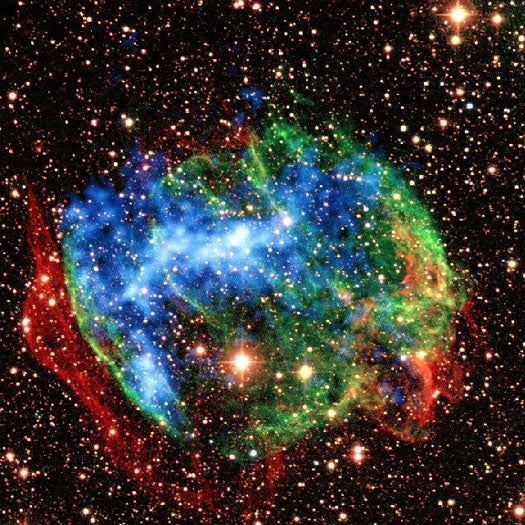
If there’s one thing that’s true about all science – and especially science of the cosmos – it’s that the body of knowledge we consider to be fact is extremely fluid. A prescient reminder of this came late last week via a paper published in the journal Nature, which found that contrary to popular theory, there is indeed more than one way for a white dwarf to die.
But while astronomers absorb this idea and rethink popular assumptions about the nature of Type 1a supernova, there’s another body of assumptions that might need re-thinking as well. After all, we’ve been using the Type 1a supernova – which we thought were uniform explosions – as cosmic measuring sticks for decades, and this recent discovery of a second type of supernova could require us to go back and double-check some of our galactic math.
White dwarf stars were thought to typically enter their death throes by accreting mass from other nearby stars; one massive star begins absorbing mass from a neighboring star until it reaches what is known as the Chandrasekhar limit, a critical mass that triggers a violent nuclear explosion that is visible across the universe. Because the stars collapse upon reaching a common critical mass, the explosions are more or less uniform, and this has allowed researchers to use these explosions as bright, standard candles by which to measure distances across the universe.
But the new data, gathered using the Chandra X-Ray Observatory, shows that while accreting dwarf stars may very well be the source of Type 1a supernova in spiral galaxies like our own filled with relatively young stars, supernova in elliptical galaxies containing older stars more often stem from star collisions. Since these impromptu collisions can occur between stars of varying, inconsistent masses, their supernova, as observed from Earth, could provide misleading data for making spatial measurements of the universe.Which essentially means a good deal of what we thought we knew about distances between galaxies and other celestial bodies could be wrong.
Potentially. The real takeaway here is not that our previous science wasn’t quite right, but that our measurements going forward will now be better informed now that we know that all Type 1a supernova are not created equal. And as it turns out, most of the dark matter studies that used supernova as distance markers drew upon uniform explosions in spiral galaxies anyhow, so it’s not as though two decades of cosmic measurements will have to go on the rubbish heap. And this certainly isn't the first time we've adjusted our cosmic calculations. But the findings are a solid reminder about how much we still have to learn about the goings-on in the universe; and that it never hurts to double-check.
Five amazing, clean technologies that will set us free, in this month's energy-focused issue. Also: how to build a better bomb detector, the robotic toys that are raising your children, a human catapult, the world's smallest arcade, and much more.


Online Content Director: Suzanne LaBarre | Email
Senior Editor: Paul Adams | Email
Associate Editor: Dan Nosowitz | Email
Assistant Editor: Colin Lecher | Email
Assistant Editor: Rose Pastore | Email
Contributing Writers:
Kelsey D. Atherton | Email
Francie Diep | Email
Shaunacy Ferro | Email
Just wait... Next someone will find something that proves E does not = mc^2 or that some other part of general relativity is fundamentally flawed. What will we do then?
the body of knowledge we consider to be fact is extremely fluid
But global warming is settled science.
There's a bit of a difference between our knowledge of cosmic events and our knowledge of measurable ratios here on Earth. Global Warming cannot be proven, and it is indeed a theory. But then again, so is gravity... that doesn't make it any less true. The theory of global warming (or more to the point, man made global climate change) has such a mountain of data behind it that yes, we can pretty much call it settled science.
Don't think that our civilization is large enough to effect the Earth's atmosphere? Take a look at LA, or Shanghai... tell me what that smog is. Take a look at the oceans, and the fact that we've had to put limits on fishing vessels because if we didn't, we'd wipe out entire species. Think about that for a minute. We've been able to fish out the freakin' oceans with what amounts to a handful of fishing vessels (compared to the size of the seas).
One last point... what's the more likely scenario... that a group of scientists got together to form the worlds biggest scam in an effort to gain funding for 'green sciences', or that big oil, coal and all of the other companies that follow them realized the negative effect that they have on the environment, and then put out contradictory information to allow them to continue unabated in their businesses?
Global warming, caused by men or not, is probly true. But the fact is, if any given country stop using fussil fuel energy, it will lower demand and make the price of fossil fuel go down. In return, it will make it easier for other less rich country to buy it and burn it, which in return wont change anything to the overall emission. Also, burning all the fossil fuel in 100 years or 150 will probly make no difference in the end result, since fusil fuel took thousands of years to accumulate.
So one of the way to stop global warming caused by man, if its even true, would be to kill alot of people like the nazi did in WW2. In that sense, I think ecologism could easely share the same ideology as nazism, so lets not be too emotional and fanatic over that theory.
But the best way to stop Global Warming, prevent mass extermination ''a la nazi'' and help civilise humanity would be to pay women to get a depo-provera injection every 3 months where contraception is not cheaply accessible to lower the human population growth. But to do this, we would have to start now and for that alot of people would have to give up there so precious religious beleive around women contraception. Otherwise, I think if we dont slow down the human population growth, we are going to end up in front of the extermination scenario wrapped in an ecologism ideology.