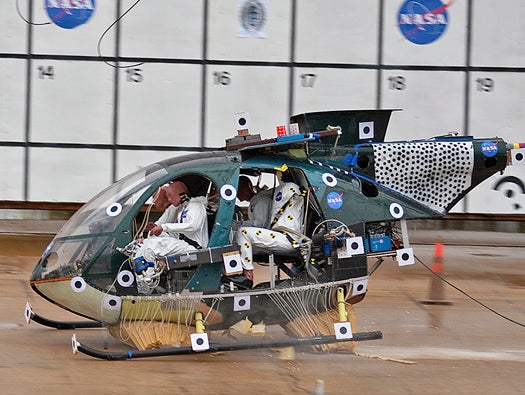
No stranger to rough landings, NASA just engineered a crash of its own design to test a new crash countermeasure for helicopters. NASA dropped a donated Army MD-500 carrying four crash test dummies from 35 feet, to determine whether a new honeycomb cushion made of Kevlar strapped to the bottom of the copter could absorb the brunt of the impact. The result: a more or less intact MD-500, and the cool impact video below.
The helicopter swung by cables from a 240-foot-tall structure once used to teach moon-bound astronauts how to delicately impact the lunar surface. As it approached the ground at a 33-degree angle, pyrotechnics were used to sever the guide cables so the aircraft would impact and react as though in a real crash. All said, the impact simulated a crash landing at about 33 miles per hour vertical speed.
Aside from the test dummies -- one of which contained simulated organs within its torso -- the aircraft was fitted with instruments recording 160 different channels of data. While all that data still needs to be crunched and compared, the initial outlook appears to be good. As for the dummies, NASA said they appeared "only a little worse for wear."The honeycomb cushion was developed as a way to protect the next generation of spacecraft, but NASA quickly realized it could just as well save the lives of aerial travelers here on Earth. Though the skid landing gear took a beating, the deployable energy absorber preserved the MD-500 well enough that engineers plan to recycle it so they can drop it again sometime next year -- this time without protection.
[NASA via Network World]
138 years of Popular Science at your fingertips.
Each issue has been completely reimagined for your iPad. See our amazing new vision for magazines that goes far beyond the printed page
Stay up to date on the latest news of the future of science and technology from your iPhone or Android phone with full articles, images and offline viewing
Featuring every article from the magazine and website, plus links from around the Web. Also see our PopSci DIY feed
Science is reinventing play, from extreme sports to gamification to ridiculous roller coasters to the playgrounds of tomorrow, and this issue is chock full of fun. Also, on a less fun note: Did global warming destroy my hometown?
KH
They can easily manufacture the kevlar cushions into the body of the aircraft. All one needs to do is wrap thin, aircraft-quality aluminum around it and it'll be aerodynamic. It might increase the overall dimensions of the aircraft, but at least it'll be safer should your engines die or rotors are shot off a la Black Hawk Down.
NASA doesn't deal with trees very often, does it? But what are the odds of that happening?
- Scott Thourson
(Mechanical Engineering)
this would be a great thing to see on all helicopters, and i wonder why people never thought of this before...
How about shrinking the honeycombs and made them inflatable or replace them with some sort of airbags.
Those dummies are always crashing things!
What this could mean for aircraft safety could be a topic of speculation.
this is all great news...as long as you plan to land flat on your butt. what about if the tail breaks and you land on your side? for down drafts this system would be a help, but not even close to an all-around solution.
locutus,
I personally value my butt so any butt protection is welcome whether it protects my head or not. Not that I do not value my head.
TX77092,
in that case this is the system for you. as the rest of you may be lost, your butt will remain intact. please be aware that the identification process may require your loved ones to provide embarrassing personal mementoes so that authorities may prove that it is indeed your butt that was salvaged.
if your a good pilot you dont need this
Inflatable Airbags needed
Yes,why not airbags? They would not disturb the aerodynamics of the copter before being deployed.The only advantage of the honeycomb cushion is that it is permanently deployed.Some sort of deployment mechanism would have to be designed for an airbag system.
It fell a 33 mph right? But what would happen if you fell at say 50 or 60 mph or more. For instance if the chopper fell from 5,000 feet and hit a downdraft and impacted at 100 or 150 mph, then what would happen? What if it hit trees or buildings? Obviously the chopper would be destroyed. Most likely all aboard would be killed. The idea isn't bad, but improvements should be made before they strap that thing to a chopper with real people in it.
I am not an engineer, but maybe a flat metal plate jointing the 4 legs of the helicopter at the bottom, and then let the legs run into the helicopter, with liquid and spring shock absorber, maybe better ?
Looks like the system works well for crashes with forward momentum (2 forward 1 down approx.). What % of chopper crashes have that much forward momentum? My guess would be the crashes where auto-rotation was used - engine failure?
This protection would be ineffective in most other scenarios.
that aint a anti crash system its not supposed to do that its supposed to keep the helicopter from crashing
@mjbeverly - you can be the best pilot in the world, but if something catastrophic happens to the hardware there's not much even seasoned veterans can do. Any step in making aviation safer is a positive step!
Wow that test is amazing, technology these days amazes me. Keith - www.3kmobile.com