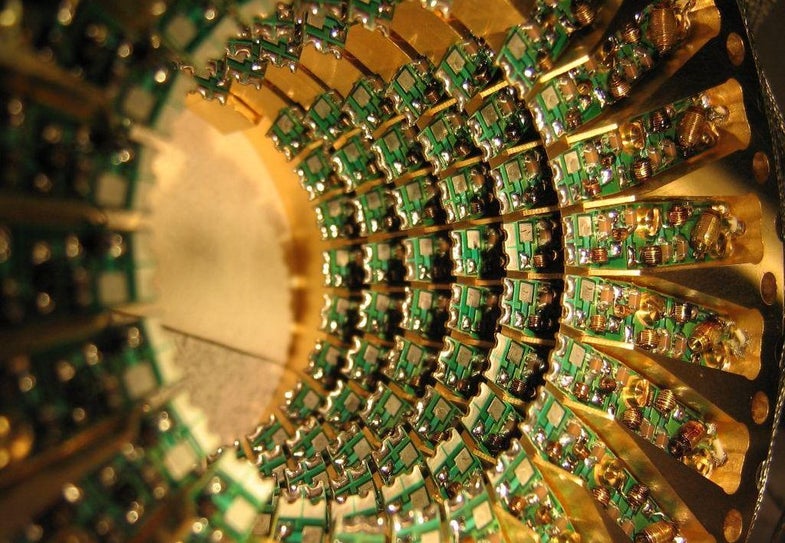
Quantum computing has long dangled the possibility of superfast, super-efficient processing, and now search giant Google has jumped on board that future. New Scientist reports that Google has spent the past three years developing a quantum algorithm that can automatically recognize and sort objects from still images or video.
The promise of quantum computing rests with the bizarre physics that occurs at the subatomic level. Different research teams have worked on creating quantum processors that store information as qubits (quantum bits), which can represent both the 1 and 0 of binary computer language at the same time. That dual possibility state allows for much more efficient processing and information storage.
To take an example cited by Google, a classical computer might need 500,000 peeks on average to find a ball hidden somewhere within a million drawers. But a quantum computer could find the ball by just looking into 1,000 drawers -- a nice little stunt known as Grover's algorithm.
Google has been using a quantum computing device created by D-Wave, a Canadian firm. But a lack of information about how D-Wave's chip works has led to outside skepticism regarding whether it does indeed count as a quantum computer.
"Unfortunately, it is not easy to demonstrate that a multi-qubit system such as the D-Wave chip indeed exhibits the desired quantum behavior and experimental physicists from various institutions are still in the process of characterizing the chip," wrote Hartmut Neven, head of Google's image recognition team, on the Google research blog.
Whatever D-Wave built has apparently worked for Google. Neven described a new algorithm based on the work of MIT that can sort images of cars from among 20,000 photos faster than anything running in a Google data center today -- although the team first trained the algorithm by hand-labeling cars in a test photo batch.Google's image recognition team has previously made its algorithms work for better online image searches and automatic photo organization. Perhaps we shouldn't be too surprised that the Google folk have also delved into quantum computing, or at least something much faster than existing classical computing.
[via New Scientist]
138 years of Popular Science at your fingertips.
Each issue has been completely reimagined for your iPad. See our amazing new vision for magazines that goes far beyond the printed page
Stay up to date on the latest news of the future of science and technology from your iPhone or Android phone with full articles, images and offline viewing
Featuring every article from the magazine and website, plus links from around the Web. Also see our PopSci DIY feed
Science is reinventing play, from extreme sports to gamification to ridiculous roller coasters to the playgrounds of tomorrow, and this issue is chock full of fun. Also, on a less fun note: Did global warming destroy my hometown?
Sounds like a possibly good start to nearly instant facial recognition systems... train once at the DMV when you pick up your license...
Now, Iron Man is finally a possibility of reality!
I cannot wait to see what people can do with this. It has so many options and can be applied to so many fields!
Interesting prospect.
Another to soon to say what will happen article, POPSCI is famous for them.
maby you could make a human level intelligence using quantum algorithms insted until actual quantum computers can be developed
the question is would they have less free will than a true quantum AI?
Is this the technology they will be using so you can upload a picture of someone and it scans the entire web (including facebook)for their face?
This is great - Now I can get an answer to question before I ask it - I might get the Girl friend one - I wonder if Santa has it in blue .........(Dreaming) ...Ah well.. Happy Christmas
Faster computers may be useful at the facilities where they are installed. But, how much can they actually improve the Internet? My high speed line crawls at certain time of the day. It is overcrowded because we still use outdated technology. In other countries, the governments are pressing forward to update their Internet systems and to make it available to everyone. How much has our government achieved? It just creates more and more barriers.
Well, Google themselves are working on that, as they're test-marketing home fiber optic systems. It doesn't get any better than plugging your WLAN straight into backbone.
Presumably, though, this is all about server-side search processing. Search by the content of an image instead of its labels. That'll be really damned cool, even aside from the bonuses for cops and stalkers.
This is great
www.eprostateproblems.com/
It is pretty amazing how much better google is at search results then yahoo and bing. There seems to be a huge difference.
www.cameta.com/Nikon-D90-Digital-SLR-Camera-Body-36657.cfm
That is kind of crazy
www.cameta.com/digital-cameras.cfm