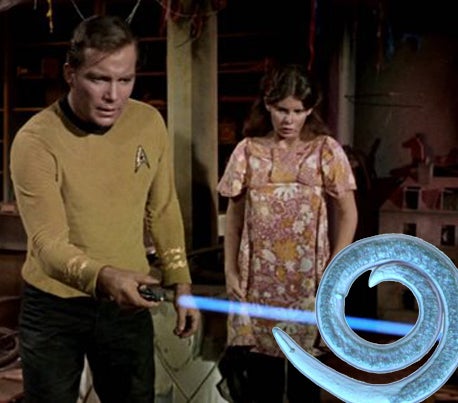
This Probably Violates The Prime Directive Man, it really looks like Kirk's standards have dropped.

Star Trek introduced the world to a wide range of fictional technology, most of which, like beaming or warp drive, will likely remain fiction. However, a team of scientists from the University of Canada has taken the phaser, the show's famous stun-laser, out of the TV and into reality. Unfortunately, right now it only works on worms.

The scientists fed the worms a chemical called dithienylethene, which changes shape when exposed to UV light. The altered dithienylethene absorbs electrons better than its natural shape, and interrupts the worms' metabolic processes when it does. When the scientists zapped the worms with a beam of UV light, the chemical changed shape, stopped the cellular processes, and paralyzed the organism.

Dithienylethene is but one of many chemicals that change shape when exposed to different wavelengths of light. These photo-activated compounds hold promise as targeted, cancer-fighting drugs, and this is the first time they have ever been shown to work in a living animal.

As for their future as a part of a super stun weapon, lead researcher Neil Branda of the University of Canada was oddly noncommittal, telling the BBC, "I'm not convinced there's a legitimate use of turning organisms on and off in terms of paralysis, but until somebody tells me otherwise, I'm not going to say that there isn't an application."

Um, so, are we getting our phaser or not? Get on this, Branda!

[BBC News]

15 Comments

so you have to feed the target this chemical before you zap him? hardly comparable to a phaser.

just another shitty article.

haha

not to mention if its UV light, doesnt that mean if he goes out in the sun he will be stunned just the same?

PopSci you need to read these articles before you post them. Even Neil Branda knows this has nothing to do with a phaser.

university of canada???

They developed a really got stun tech though. If you put dithienylethene in a blow gun and shot it at people in sun light.

First of all, there's no such thing as "University of Canada". Secondly, this is absolutely nothing like a phaser, as anyone even remotely familiar with the concept of a phaser (i.e., everyone) could tell you. And finally, both the photochop and the caption are completely ridiculous, and not in a good way.

Nice try, though. Really.

@ sci-hi-fi

Sorry to tell you the article is real. Where as it is not the University of Canada, it should read the Simon Fraser University in Canada. You should read the original article before you make loud statements.

Um... Warp drive is about to be figured out kids... Since Dr. Alcuberri created a metric for warp bubble energy usage there have been loads of scientists working on all aspects of warp bubble theory. From Sheer on the ship, to perception of photons from inside the bubble.

I wish there were more reports on Warp Bubble theory so the research would get more attention.

i love bubbles!!! yay

To Seattleite: from technologyreview.com/blog/arxiv/23292/

Not to burst your bubble but physics wins out over that bubble theory. Issues with Quantum mechanics and instability at the leading edge of the theorized bubble seem to refute the possibility of it working.

"The conclusion is the result of classical thinking using the ideas of general relativity but physicists have long wondered what would happen if you threw quantum mechanics into the mix? Now Finazzi and pals have worked it. For a start, they say that the inside of the bubble would be filled with Hawking radiation, making life rather uncomfortable for any spacecraft within it.

They have also studied a property of a quantum field called the renormalised stress-energy tensor which should be well-behaved under normal circumstances. But in the front wall of Alcubierre's bubble travelling at superluminal speeds, the renormalised stress-energy tensor grows exponentially.

That strongly implies that such a bubble would be unstable. So it looks increasingly likely that, after a brief few years of excitement, Alcubierre's warp drive is impossible."

Nothing is impossible, just highly improbable to succeed. If it can be imagined, it can be worked on. Since when has a perceived impossibility stopped us from making the discoveries necessary to make the impossible possible?

lol thats totally retarted now what if we get this thing to work on humans how are we going to feed them the hemical

dumb as fuck


June 2013: American Energy Independence

Five amazing, clean technologies that will set us free, in this month's energy-focused issue. Also: how to build a better bomb detector, the robotic toys that are raising your children, a human catapult, the world's smallest arcade, and much more.


Online Content Director: Suzanne LaBarre | Email
Senior Editor: Paul Adams | Email
Associate Editor: Dan Nosowitz | Email
Assistant Editor: Colin Lecher | Email
Assistant Editor: Rose Pastore | Email

Contributing Writers:
Rebecca Boyle | Email
Kelsey D. Atherton | Email
Francie Diep | Email
Shaunacy Ferro | Email

circ-top-header.gif
circ-cover.gif