A new carbon sponge can soak up 180 times its own weight in organic matter
Carbon Sponge Can't touch this Peking University and Tsinghua University

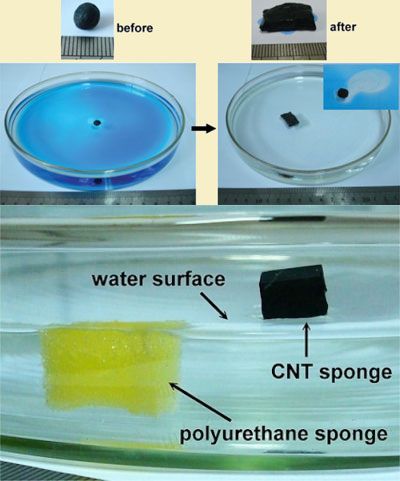
Spongebob may want to look into a nanotech upgrade that could permit him to walk on water. Chinese scientists have created carbon nanotube sponges that don't absorb water, leaving them plenty of room for absorbing oil or other icky organic goo.

The new sponges rely upon interconnected carbon nanotubes that naturally repel water, and can absorb 180 times their weight in organic matter. Current sponges used for oil spill cleanups and industrial applications can only absorb up to 20 times their own weight.


Nanotube researchers typically aim to create highly ordered arrays of tubes. But the Chinese researchers behind the new study, published in Advanced Materials, focused instead on creating a highly disordered structure where tubes could form a close interlocking network. That reduced the sponge size by 95 percent and created a product exceptionally resistant to breaking, according to Materials Views.

A single sponge can absorb an oil slick up with an area up to 800 times that of the sponge. Those interested in a quick look at the miracle of squeeze science can check out the video below.

[via Materials Views]

9 Comments

i wish there was a video of it in action

Why would you want a video of it absorbing something, when you have this nifty video of it being squished? Don't you like sponge mechanics? Don't you?

A perfect place for this is in a methane or hydrogen gas tanks where if it can soak up gas like it soaks up oil. They tried in the past to have a sponge-like system to store the gas with some expensive rare earth metals therefore eliminating the high pressure problems of gas storage systems, some gas storage tanks store hydrogen up to 10,000 psi, we live in a 14.73 psi environment, it would be very explosive if in an accident happened. It also would be time consuming filling up the tank and energy dependant to get to that high of pressure.

Storage of methane or hydrogen gas without high pressure tanks would be a game changer storage system for fuel cells and even for regular combustible hydrogen or methane gas engines...

One final note from my post above. If this can be used for hydrogen or methane gas tanks then all you need to do to extract out the gas from the tank would be the same thing that they show in that video in the article above, just squeeze the carbon sponge enough to extract out the necessary amount of gassssss....

Introducing the new and improved SPONGE BOB!

There is a much easier, more cost efficient and less environmentaly burdensome method for cleaning spills from water. For anyone who has worked in the oil field I have a question. Have you ever looked at the sheep who keep the weeds down? There I have given away a secret that could have made me tons of money. Use it science kids. You all try to make things too hard...

lnwolf41Would be nice if its economical to make. Also how easy would it be to remove the oil from the sponge and reuse over.

Hi all, thanks for the interest in this article! For those of you with further questions, we've set the original paper behind this story free to access; you can access through the MaterialsViews link in the story above.

Adrian Miller
Advanced Materials

how expensive is this, exactly?


138 years of Popular Science at your fingertips.

Innovation Challenges


Popular Science+ For iPad

Each issue has been completely reimagined for your iPad. See our amazing new vision for magazines that goes far beyond the printed page


Download Our App

Stay up to date on the latest news of the future of science and technology from your iPhone or Android phone with full articles, images and offline viewing


Follow Us On Twitter

Featuring every article from the magazine and website, plus links from around the Web. Also see our PopSci DIY feed


February 2012: The Future of Fun

Science is reinventing play, from extreme sports to gamification to ridiculous roller coasters to the playgrounds of tomorrow, and this issue is chock full of fun. Also, on a less fun note: Did global warming destroy my hometown?


circ-top-header.gif
circ-cover.gif