Jarheads work almost 50 percent faster wearing heads-up display goggles that replace technical manuals
AR Goggles Seeing the world differently through augmented reality, and becoming more efficient to boot Steven Feiner and Steven Henderson

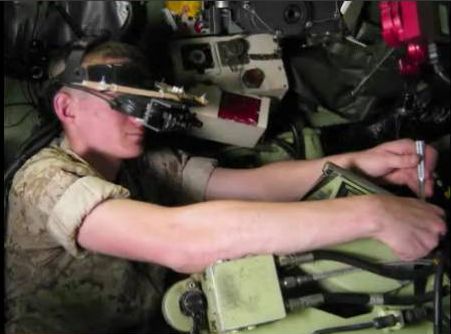
New augmented reality goggles are helping Marine mechanics perform maintenance on vehicles in about half the usual time. The futuristic headgear displays precise instructions on top of real-world settings, and shows how to complete certain tasks, such as wiring up an ignition coil.

Similar augmented reality (AR) devices have already helped astronauts carry out repairs on the International Space Station, and could aid civilians tinkering with their BMWs in the home garage. But the new goggles developed by Columbia University researchers provide solid proof of how the devices can improve human performance.


A test with six Marine mechanics found that they performed up to 46 percent faster on making repairs to a light armored vehicle when using the AR goggles, according to Technology Review. The jarheads typically rely upon technical manuals displayed on laptops.

Besides the heads-up display, the AR system uses text instructions, floating labels, arrows and even 3-D models of tools needed for various tasks. An Android smartphone provides the wrist interface for cueing up new instructions.

We're looking forward to seeing this and other AR devices seep into both military and civilian life in ever greater numbers. An MIT augmented reality device previously won one of PopSci's Inventions Awards, showing the possibilities of interfacing online information with the real world. Some PopSci readers may also remember our July issue, which allowed people with webcams to play with virtual wind turbines popping off the magazine cover.

[via Technology Review]

2 Comments

Awesome, now when is the Navy getting this new toy?

Proud Sailor of the USN

A large amount of this improvement is due to the generation of information not available today. In this case, multiple camera scans were made, and sophisticated instrucional scenes were developed.

Yes, the tech enables good presentation, but developing the information is a large effort that's not discussed.

Also not discussed is where this might be used. The military uses mainly hand tools in a lot of applications because they're rugged and extremely portable. Maintenance instuctions are similar -- tech orders are cheap to duplicate, and essential ones are packaged in tough portable bindings.

I worked on aircraft electronics. As much as possible, the components were made to be easily replaceable in the field.

Shop repair was similar in that most items had some type of modular construction. Units requiring sophisticated repair were shipped to centralized depot facilities.

Perhaps this system could be useful in a depot like environment. The military spends a lot of effort to make field maintenance straightforward and simple.


June 2013: American Energy Independence

Five amazing, clean technologies that will set us free, in this month's energy-focused issue. Also: how to build a better bomb detector, the robotic toys that are raising your children, a human catapult, the world's smallest arcade, and much more.


Online Content Director: Suzanne LaBarre | Email
Senior Editor: Paul Adams | Email
Associate Editor: Dan Nosowitz | Email
Assistant Editor: Colin Lecher | Email
Assistant Editor: Rose Pastore | Email

Contributing Writers:
Rebecca Boyle | Email
Kelsey D. Atherton | Email
Francie Diep | Email
Shaunacy Ferro | Email

circ-top-header.gif
circ-cover.gif