Creators of CCDs and Fiber Optics Win 2009 Nobel Prize In Physics
We may earn revenue from the products available on this page and participate in affiliate programs. Learn more › We...
We may earn revenue from the products available on this page and participate in affiliate programs. Learn more ›
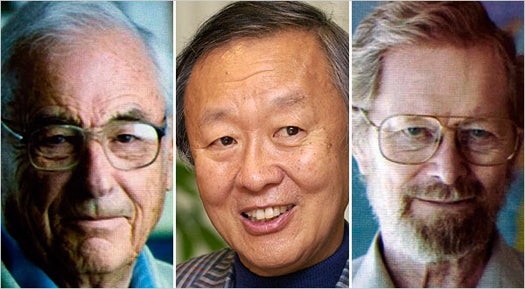
We live in a world designed by Charles K. Kao, Willard S. Boyle, and George E. Smith. Their work on the physics of light made possible the fiber optic cables carrying this web page to your phone, and the digital camera on the other side. And on December 10th, King Carl XVI Gustaf of Sweden will award them the Nobel Prize in physics for their work.
Boyle and Smith started their career together at Bell Labs, and in 1969, created the foundation of digital cameras. Utilizing the phenomena that won Albert Einstein his Nobel, Boyle and Smith devised a way to measure the electrons knocked lose when light strikes silicon. This essentially created the first digital camera pixel.
When Kao began working on fiber optics, the most advanced cables could only carry a light signal about 65 feet. By determining how the purity of the glass and the manufacturing methods influenced the transparency of a fiber optic cable, Kao laid down the principles that would lead to a half-mile-long cable within 4 years.
With these three wins, the number of American Nobel Laureates rises to a world-leading 76. Britain remains in second place with 21 wins. Which is to say, USA! USA! USA!
[via The New York Times]