Phase-Change Memory
Phase-Change Memory Samsung

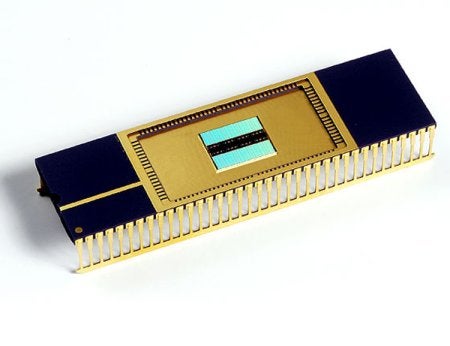
It's been 40 years in the making. This week Samsung finally announced they've kicked phase-change memory (PCM) into mass production. In a nutshell, PCM stores information by melting and freezing microscopic crystals. In gadgets like cell phones, its frozen-in-place nature means lightning-fast bootup times--instantaneous, even.

Part of PCM's current appeal is that it actually works better the smaller it gets, unlike flash memory, which is the current go-to for small devices. Since flash memory saves data as small groups of electrons, the smaller the area you have to work with, the fewer electrons will fit, thus making the memory increasingly unstable.

PCM, on the other hand, actually benefits from shrinking, for a simple reason: smaller crystals melt and freeze faster. Matthias Wuttig, a physicist at RWTH Aachen University in Germany, has developed PCM cells that can switch on in 19 nanoseconds.

The concept of PCM has been around since the 1960s, but has presented persistent challenges for physicists. The first attempts used crystals that required extremely high temperatures in order to melt. By the time new crystal materials that shifted forms at lower temps were developed, gadget memory had already given way to the transistor (yes, flash).

Samsung's PCM memory, for now, is only 512MB. But, Gregory Atwood, a senior fellow at Numonyx Memory Solutions in Switzerland, speculates in Nature that, as the demand for smaller and smaller memory eclipses what flash can handle, more time and attention will be paid to PCM and its potential to succeed flash as the mobile go-to.

Want to learn more about breakthroughs in electronics, medicine, nanotech, and more?
Subscribe to Popular Science today, for less than $1 per issue!

9 Comments

The device Samsung is putting into production is actually a 512Mbit device. That's 64MB.

We will see where this takes us, maybe there won't be ram added to computers anymore and you carry your computer on a stick like this one?

At what temperature do the crystals melt?

rlb2, volatile RAM memory is several tens times faster than flash or possibly this. Noone is going to want to swap it with this.

Its true what you said Neuubeh for now, as I said we will see where this takes us, they're several other new devices coming out so I predict that RAM will someday be outdated like the soon to be Incandescent light bulb.

2billion$.

To Mr. purfus, I commend you on your education. I thank you for your having rectified the mistake in the statement about the storage capacity of the phase change datus storage chip.

I believe that an explanation will benefit some of us.

There are 8 bits in a byte.
(512/8) mega bits are equal to 64 mega bytes.

locjuwtus.

2billion$.

To Mr. purfus, I commend you on your education. I thank you for your having rectified the mistake in the statement about the storage capacity of the phase change datus storage chip.

I believe that an explanation will benefit some of us.

There are 8 bits in a byte.
(512/8) mega bits are equal to 64 mega bytes.

locjuwtus.

maby it can run on low enough electricity to have a workable watch phone that doesnt burn your wrist...

Is PCM less vulnerable to E/M Pulse (weapons) ?

My question is this. Seeing as how this is physical state memory, and (as I understand it then) non-volitile, even if the speed issue can't be overcome for memory wouldn't this start to replace permanent storage mediums? The size factor alone would allow for smaller and smaller hard drives. Or at least hybridize them with the crystal state used for long term storage where speed isn't an issue.


June 2013: American Energy Independence

Five amazing, clean technologies that will set us free, in this month's energy-focused issue. Also: how to build a better bomb detector, the robotic toys that are raising your children, a human catapult, the world's smallest arcade, and much more.


Online Content Director: Suzanne LaBarre | Email
Senior Editor: Paul Adams | Email
Associate Editor: Dan Nosowitz | Email
Assistant Editor: Colin Lecher | Email
Assistant Editor: Rose Pastore | Email

Contributing Writers:

Kelsey D. Atherton | Email
Francie Diep | Email
Shaunacy Ferro | Email

circ-top-header.gif
circ-cover.gif