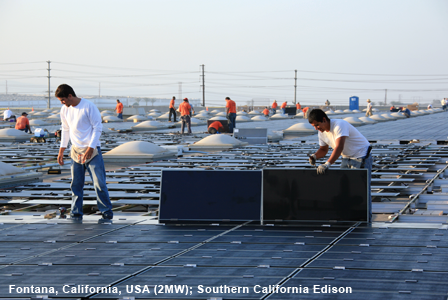
First Solar Here the company installs a 2 megawatt solar plant in California. Up next, one that's one thousand times the wattage, in China. First Solar

First Solar just signed an agreement with China to build the biggest solar power plant yet, according to a statement released today by the company. The 2-gigawatt plant in the Mongolian desert will generate enough electricity to power three million homes.

That's a heck of a lot of cadmium telluride, the semiconductor they use for their thin film cells.

The largest solar plant currently in operation is a mere 60-megawatt plant in Spain, according to pvresources.com.

First Solar and China officially signed a memorandum of understanding, which is still up for final negotiations. The plan is to start building a 30-megawatt phase this summer, adding more and more until the final phase is complete in 2019.

Earlier this year, First Solar became the first company to produce solar cells at less than a dollar per watt, crossing the boundary thought to make solar power competitive with traditional energy sources.

[Via First Solar and NY Times: Green Inc.]

Want to learn more about breakthroughs in electronics, medicine, nanotech, and more?
Subscribe to Popular Science and enter to win $5,000!

16 Comments

If anyone can do it it's china, just look at three gorges dam. But it made me lol myself a little when I realized that the panels often don't work too well after 10 to 15 years so once they finish building it they will have to start re building it.

Wouldn't a solar concentrator plant make more sense at this scale? Mirrors are a lot cheaper than photovoltaics and easier to maintain,

quote: "Wouldn't a solar concentrator plant make more sense at this scale? "

You would think so, and especially the use of very inefficient thin film solar cells that would probably melt if you used concentrated sunlight on it....

Probably there is something else going on...

Why China threw First Solar a 2 GW Bone
www.rimlifegreentech.com/solarchronicles/?p=7

If this statement is right, "Earlier this year, First Solar became the first company to produce solar cells at less than a dollar per watt, crossing the boundary thought to make solar power competitive with traditional energy sources."

The cost of the solar thin film panels will be 10 billion dollars. Thin film are less efficient than most, about 8 to 12 percent efficient, but spread out over such a huge desert with the cost as low as 1 dollar per watt that may be a game changer for solar power. However that being said at this price it is about what you would pay for two large nukes and get about the same amount of energy out of them for a little under 1/2 the time. The difference is that nukes operate 24/7 and solar approximately 9 hours a day in Mongolia and is dependent on the weather. If the sun don't shine how will they make up for the deficit of losing 2 Gigawatts of power during the peak time of the day and what are they going to do at night? They would need to build an equally massive energy storage system.

When the Chinese say that they can power over "3 million homes", does that mean that they're powering the homes of the slave labor that they're using to build the thing, or the homes of the people who live in the high rises in the larger cities?

In all likelihood they're building this thing so that they can say that they are "trying" to be more green, and the they are "innovators" of green tech.

Until solar energy becomes more efficient and viable on the type of scale being discussed, nuclear is the way to go for large scale power generation.

Keep in mind that a typical home in China uses less energy then a typical American or European home. 3 million there is not quite 3 million here, but it is still a bunch. By the time they finish in 2019 the last of the panels will almost definitely have improved durability, efficiency, and reduced cost per energy.

Stop being so critical, it's a step in the right direction, and solar technology is bound to get more efficient in the years to come, patience. =)

I pretty sure that this is just a PR stunt to help stave off the cried from environmentalists. China takes a lot of flack for being a large CO2 emitter.

What if desert sand and dust cover the panels? What if clouds form and block the sun? How far are the loads from the solar generating facilities? Deep western boundry ocean currents are much more feasable and offer power generation 24/7/365.

A state of the art 2 gigawatt facility destroying forever 26 sq miles of Chinese desert (who cares in China anyway) which they claim would cost $6 billion to build in the US if even possible with the regulatory difficulties. This farm would produce 2500 kwh per annum per collector peak watt at a 25% load factor (ie nighttime, clouds, winter etc). First Solar's claim of $1000 a Kilowatt for the cells, becomes $3000 a kilowatt in a field collector farm, becomes $12000 a kilowatt when the load factor is added in. Absolutely no way in sight to economically store the power for nighttime, clouds, winter.

Westinghouse research claims with a long detailed study that with mass production techniques and political action for a one time nationwide regulatory approval of a standard design plant, they can build nuclear for $1000 a kilowatt or less than 2 cents a kilowatt hour. They've put their money on the table with a $1200 a kilowatt $5.5 billion nuke sale to China.

I'd say the Chinese just want a giant plant to produce solar cells to sell to idiots in Europe. Notice no commitments to buy power from First Solar.

Good for them. I want to see what sort of output they get when this is up and running. And hopefully they will transition to more efficient cells in the future.

quote: "The difference is that nukes operate 24/7 and solar approximately 9 hours a day in Mongolia"

That's the reason why I said it makes no sense to use thin film PV. However, if they use solar thermal plants then with molten salt storage you do get overnoght production of electricity.

Like this said, China basically wants to throw a bone at the US and First Solar:

www.rimlifegreentech.com/solarchronicles/?p=7

Quote: "they're powering the homes of the slave labor that they're using to build the thing"

That "slave" labor would probably include befuddled Americans who can't find jobs here in the US....
Hey, it's better than being unemployed! ;-)

www.nytimes.com/2009/08/11/business/economy/11expats.html

solar panels are nonsense if they had any clear thinking experts in charge this would never happen...even if the worst comes to the worst and you build it just for providing jobs.... couldnt they think of something better to build?

NUCLEAR POWER

billdale

from Los Angeles, CA

.
TechnoFreakFace:

Your smugness, arrogance, and misplaced confidence are amazing.

The (heavily subsidized) nuclear power plants that were decommissioned decades ago are still causing us problems and still costing us billions trying to find storage for steadily accumulating nuclear waste. No one wants a nuclear power plant or radioactive waste in THEIR back yard-- you're such a pious nuclear proponent, here's a thought: what's your address? We'll send it to YOUR house, and they can store all their spent fuel in YOUR basement. Oh... I hope your basement is really, really big-- they've got a lot of it for you to store for them for the next 15,000 years or so.

Nuclear plants have problems solar will never have-- you'll never have problems with terrorists trying to steal solar waste for dirty bombs or trying to blow up the plants to trigger environmental disasters. They have no earthquake hazards, there's no wasting billions of dollars doing environmental reports trying to convince nervous neighbors that your plant won't become another Chernobyl, no worries how you'll decommission your solar plant and keep it safe for thousands of years for future earthlings. If I make solar cells, my kids could brag about it to their friends-- if you make nuclear power plants, your kids might wanna say you're really a plumber just cuz they don't wanna be ostracized by their peers.

Solar has no problems that will haunt our children's children-- it's not a perfect technology, but don't dare try to point out its problems, because in every way it's a more benign power solution than anything else with the possible exception of wind.

Solar is still in its infancy, and the more we deploy it, the more efficient it will become and the more ubiquitous it will be. 233 watts of power fall on every square foot of noontime earth surface, and all we need to do is pump up the efficiency marginally to make it the most cost-effective way to generate power. Nanocrystalline-based solar cells, quantum dots, Schottky barrier/junctions and other strategies that increase efficiency could one day be combined in a mass-produced printing process to yield efficiencies far in excess of anything we have today. And with proven technology such as Altair NanoSafe batteries that can last for tens of thousands of charge cycles-- decades or more of use-- we will be able to store that power for use at night or whenever we need it.

Whenever I see such skewed comments as yours, I have to wonder-- do you work for the nuclear industry, perhaps? What axe do you have to grind that you would seek to steer anyone away from such clean technologies as solar and EVs?

thumbs up -- China :)


Download Our iPhone App

Stay up to date on the latest news of the future of science and technology from your iPhone with full articles, images and offline viewing


Follow Us On Twitter

Featuring every article from the magazine and website, plus links from around the Web. Also see our PopSci DIY feed


Become a Fan On Facebook

Share links with friends, comment on stories and more


December 2009: Best of What's New

In our December issue, Popular Science names the 100 best innovations of the year: bombproof wallpaper, self-parking cars, the fastest helicopter, and 97 more. Plus inventor profiles and videos.

Check out the best of what's new here.

Popular Science Photo Pool


Share your photos in the Pop Sci pool at www.flickr.com!
tags_sprite.png
POP_embeddedForm_cover_May09.jpg