DNA Transplantation Yields Monkeys with One Father, Two Mothers
The technique could cure genetic problems in human babies
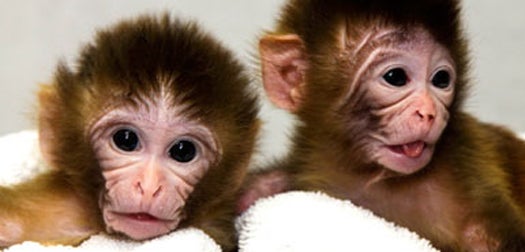
In a procedure that’s sure to lead to plenty of interesting family dinners, scientists have created monkeys that have one father, but two genetic mothers. The scientists created these hybrids by transplanting mitochondrial DNA into the monkey embryo, opening up the possibility that this technique could be used to produce healthy children for human women who have mitochondrial DNA disorders.
To create the hybrids, researchers from the Oregon National Primate Research Center at Oregon Health and Science University transplanted the DNA of a monkey with damaged mitochondrial DNA into the cells of a monkey with healthy mitochondrial DNA. They managed to produce 15 viable embryos, that were then planted into nine host mothers. Four of the monkeys have already been born: a pair of twins named Mito and Tracker, and two other monkeys named Spindler and Spindy.
Mitochondria, the component of cells that produces energy, has a set of DNA all its own, separate from the rest of a person’s DNA. That mitochondrial DNA is only passed on by the mother, and diseases of the mitochondria can cause blindness, deafness, multiple sclerosis-type symptoms, dementia, and diabetes. These diseases appear in one in 6,500 births, leaving a large pool of people who could benefit from the advance.
However, the idea of a single person having two biological mothers raises a host of ethical and legal questions. Additionally, unlike gene therapy performed on adults, changing the mitochondrial DNA of a female baby would introduce genetically engineered changes that could be passed on through the generations. There is a general scientific taboo against implementing genetic changes in humans that might get passed on, due the possibility of unforeseen mutations.
Currently, there are no plans for this technology to be applied to humans. But the scientists did manage to perform the transplant in a fellow primate, proving that the hurdle of transferring this this technique to humans shouldn’t be that hard to clear.