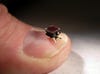
I-SWARM Microbot:  Edqvist, et al. via PhysOrg
While Hollywood focuses on robots several times taller than humans, some researchers are building tiny robots that could fit on your fingernail. These microbots would work in swarms to collect data for a variety of applications, such as surveillance, micromanufacturing, and medicine.

The researchers, from institutes in Sweden, Spain, Germany, Italy, and Switzerland, use a novel approach to allow robots to be built cheaply and in large quantities. Working on a limited budget, they built an entire robot on a single circuit board.

Single-chip designs have previously been hard to design and manufacture. However, instead of soldering the components together using conventional methods, the researchers used conductive adhesive to attach different modules to a flexible printed circuit board using surface mount technology. They then folded the circuit board to create the robot.

Different modules allow the robot to communicate, move, store energy, and collect data. The tiny robots, less than 4mm in any direction, contain a solar cell on top for power, and vibrating legs, three of which they use to move and one that acts as a touch sensor.

A single robot wouldn't be able to do much by itself. However, the project is based on the concept of I-SWARM (intelligent small-world autonomous robots for micro-manipulation), inspired by the behavior of insects. According to this concept, a large number of these robots, interacting with their environment and able to communicate with each other using infra-red sensors, could mimic the swarm intelligence of insects like ants.

The researchers hope to improve the fabrication techniques, particularly the efficiency of adhesion, and to automate the process of folding the circuit board. With further funding, they aim to mass-produce these tiny robots. Unlike some previous attempts, the researchers hope that their methods will allow them to manufacture enough microbots to truly mimic insect behavior and swarm intelligence.

[via PhysOrg]

Want to learn more about breakthroughs in electronics, medicine, nanotech, and more?
Subscribe to Popular Science today, for less than $1 per issue!

14 Comments

im surprised it hasnt been done earlier, im sure they could
create a program that would instruct you on how to make these "bots" so that you could send them in and you could get some reward back like a contributers name to be featured on their website, the more you send in the higher up your name would be, along with other prizes like your name engraved on a special cool looking bot to be used in the swarm. Im sure lots of DIYs would pick up on this....

Michael Crighton's Prey, anyone?

This a great idea. Low cost data collection.

There are some really compelling videos of the micro robots moving around over on Hizook.com -- http://www.hizook.com/blog/2009/08/29/i-swarm-micro-robots-realized-impressive-full-system-integration

3.????
4. PROFIT

Idea: You Rate it-
What if you could make a large swarm of these which could polish odd shaped surfaces, Just drop them on a large uneven surface and shine light on them, and 3 hours later the surfaces is totally polished or cleaned?
What do you think?
---------
Application is one of the main items missing in micro-robotics, in combination swarm robots can perform micro tasks on a macro scale, it is just a question of what application they can put to work on.
--
Dr. Brian Glassman
Ph.D in Innovation Management & Commercialization

lmaoo duckysaurus i was thinking the exact same thing...prey is such a great book and almost a mirror image of what these guys are trying to do. although we still have a good amount of years before we make nano robots that can mimic humans and take over the world.

damjancd - This is science, where all economics are underpants gnome economics!

NEAT! THIS IS SO COOL! It can help us with so many things....... Until they turn on us. DA DA DA. LOL

It blows my mind how they can fit so much technology into something so small.

John-Family Therapist San Diego
http://www.johnboesky.com

Ugly thumb.

I could see letting a couple thousand of these loose in a disaster zone (Twin Towers, or the like? Military bombed houses?) to search for survivors. My question is, do they self-right? And could they survive a fall from 4 meters? If they could, you can disperse them using dispersal pods dropped from airplanes or helicopters for rapid deployment

im quite certain their size would minimize damage done...
this tech can be used in ANY industry, from espionage to inspecting cheese quality
Most dont realize the impact of development in this area, like electricity, comuters and plastic...it would be REVOLUTIONARY and used ANYWHERE and EVERYWHERE

Just don't teach these things how to build more of themselves.

Replicators from Stargate SG-1?

These are similar to the little blocks they are made out of...


June 2013: American Energy Independence

Five amazing, clean technologies that will set us free, in this month's energy-focused issue. Also: how to build a better bomb detector, the robotic toys that are raising your children, a human catapult, the world's smallest arcade, and much more.


Online Content Director: Suzanne LaBarre | Email
Senior Editor: Paul Adams | Email
Associate Editor: Dan Nosowitz | Email
Assistant Editor: Colin Lecher | Email
Assistant Editor: Rose Pastore | Email

Contributing Writers:
Rebecca Boyle | Email
Kelsey D. Atherton | Email
Francie Diep | Email
Shaunacy Ferro | Email

circ-top-header.gif
circ-cover.gif