Green Dream
Drilling a geothermal well to help cool and heat the dream home
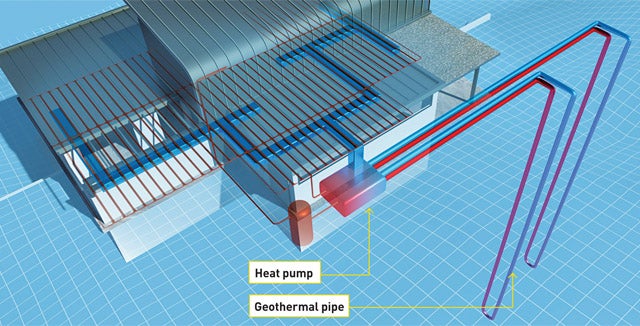
Put the Earth to Work John B. Carnett, PopSci’s staff photographer, is using the latest green technology to build his dream home. Follow his progress at popsci.com/greendream. Peter Bollinger

Any green home worth its weight in compost draws heavily on solar energy. Mine is equipped with all the standard offerings, such as a solar-powered boiler, the subject of my last column. Trouble is, the sun doesn’t always shine. So to make up the difference during cold, dark winters and rainy spells, I’m turning to another eco-friendly energy source: my backyard. The two 325-foot-deep geothermal wells I’m boring there will use the constant 50°F temperature of the Earth at that depth to meet all my extra heating and cooling demands.

A geothermal heat pump works like a regular heat pump, only it pulls heat out of the ground instead of the air. During the winter months, the pump circulates a mix of water and glycol (antifreeze) into the wells through loops of pipe. The fluid absorbs warmth from the ground and travels back up to the pump, which absorbs the extra heat, compresses it to make it even warmer, and then transfers it to the heat exchangers inside the tanks that supply my hot water and radiant heating. In the summer, the process reverses, with the pump sending water and glycol into the pipe to help cool the house.

The upfront costs of geothermal are steep. I paid $16,800 for the whole installation, even after the tax credit [see “Get Green for Going Green”] and doing some of the work myself. But the system should pay for itself within six years. Geothermal is four times as efficient as fossil-fuel-burning furnaces and twice as efficient as a conventional air conditioner. And unlike gas and oil, the price of dirt is steady, so my energy bill won’t spike with the market.

Next up: building energy-efficient windows.

The Specs

House: 3,500-square-foot, four-bedroom contemporary
Location: Greenwich, N.Y.
Project: Geothermal heat pump
Cost: $16,800 (after tax credit)
Time to install: 5 days
Eco-advantage: No emissions; consumes 33 percent less electricity than typical HVAC systems
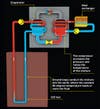
The Geothermal Heat Pump: The pump uses a small amount of electricity to pump a mixture of water and antifreeze through two loops of pipe in the ground  Paul Wootton

single page
Page 1 of 2 12next ›last »
Want to learn more about breakthroughs in electronics, medicine, nanotech, and more?
Subscribe to Popular Science today, for less than $1 per issue!

15 Comments

I do not understand this concept.The inground temperature is a constant 50 degrees so how can I heat to lets say 70 degrees.Where does the extra 20 degrees come from?Chuck

I would really like to know more info about this project. I would like to know if your 3500 sq ft included any attic or basement space? Also, can you provide the name of the company that you used? I have a house in NE Pennsylvania. The house is about 3600 sq ft without the attic and basement, although I would like to heat and cool those spaces too. I had one company come out to give an estimate for geothermal and I got a price of $80,000. I had figured myself that I would spend about $24,000.. My house, unfortunately, sits on a hill and has a long driveway.. The driveway we have coined the term 'the mansion walk', only because it seems every contractor that comes out, multiplies the price of jobs by the number of steps and the height of the house.. It's really just a simple house though. I cannot seem to find a good, reputable contractor to give an honest price for anything.

I would really love to use geothermal. The house currently has a very old and wasteful gas boiler that seems sized for a school, rather than a house. It's 400,000 btu. One of the heating contractors said the house only needs 179,000, though, I don't know if I can believe it.

"Spliceguy" The first thing that you need to do is factor your heat load- I have no idea how your house was built- what sort of windows, insulation you have- but once you get your values established by an engineer you will have a solid idea of what your true requirements are- Geothermal setups are based on Ton's your house could require a five ton system-just a guess- That would be three vert holes of about 375 ft each and your internal hardware- If you were paying someone and not doing any part of it as a DIY'er it could easily be $30,000- $36,000- if you did some work I could see you getting closer to $28,000. VERT and HORIZ come in at about the same cost when you factor everything in and your site with it's steep location sounds like VERT. Get your house loads established FIRST. Contact a good local HVAC company that does GEO work- They should be able to give you a number breakdown that shows the cost of drilling (Outside work) and the hardware (Inside work)-then it's all clear and you can compare APPLES to APPLES. Also understand that drilling rigs also work outside of GEO installers and you can hire them on your own to work for you- again markups exist in every business and the more time that you take to educate yourself and run the job the more you stand to save

Staff Photographer
Popular Science Magazine

I too would like the name of the company you used to install your geothermal heating system.

I have a house with similar surface area, but have an existing 312 ft hole drilled for my on site water use. Could this hole also be used to supply some portion of my hot water and heating needs? Have you talked to any of these companies about such an approach to reducing the large start-up cost? This might be a good article to consider in the near future. There are a lot of people in my area that supply their own on site water needs.

We are currently in the midst of installing a Horizontal system which is only good if you have a very understanding wife (we have 5 acres of which a third now looks like scorched earth). Unfortunately the rebates in Ontario Canada are a bit smaller (approx $7000) bringing our final cost in around $23000.

Still, it will be great not to have to order furnace oil this winter.

I look forward to further progress updates.

Hi John

I'm planning a build in Argyle. Interested in your geoexchange choice. One long-term geoexchange guy in the area is a strong proponent of vertical standing water column. I'm wondering if you looked into that? I'm also interested in lateral - we have a long (read very long)drive and potentially buried electric trench to install. VSWC guy sez you need to get a horizontal system to 15' before you can be assured of no thermal losses - that's alot different than 6'! Any input would be great.

We installed the equivalent of a 5 ton loop (we only need 3-4 but the excavation is the expensive part so while we had the equipment I made sure the loops were over engineered). That resulted in approximately 3000ft of pipe and 1500ft of trench 6ft deep. I've heard of systems going to 8', but 15' seems extreme (and expensive).

Where can I get more info on these DIY efficient windows. We are building our own SIPs home right now and are nearing the cutouts for the windows phase. I would love to make my own windows and expected that article in this month's Popsci after it was mentioned in last month's geothermal article...I was disappointed to see that it was not in the magazine. Whats the story?

Thanks,
Matt

Oh, and on the geothermal topic: For a measly $677 we are installing SDR pipes to pump our air through for free cooling (and preheating makeup air in the winter). The pipes will be 6' below ground using the trenches that were already dug for pouring the footings. As a bonus, humidity in the house will be controlled by the rate at which the air is pumped through the SDR tubes (a simple speed control switch on our blowers). The house is small (20x24) and highly insulated with SIPs, so the 9400 BTU/hr system that these pipes provide should be plenty of free geothermal AC.

To Greyman and others - I'm looking to install geothermal in Ontario and would like to know how to evaluate the various vendors. All the sales people say they've got lots of experience, but I want to use a company that has real experience with real reference customers. The information that you've all supplied here, re. sizing, etc. has been really useful. I'll post up my final specs when they're ready so that you have another data point. Contact me at gordongordon@canada.com. Thanks!

We installed the equivalent of a 5 ton loop (we only need 3-4 but the excavation is the expensive part so while we had the equipment I made sure the loops were over engineered). That resulted in approximately 3000ft of pipe and 1500ft of trench 6ft deep. I've heard of systems going to 8', but 15' seems extreme (and expensive).
www.promdresspicture.com

لدي منزل مع مساحة مماثلة ، ولكن لديها القائمة ثقب حفر 250 قدم لبلدي موقع على استخدام المياه. ويمكن لهذا الثقب أن تستخدم أيضا لتوفير جزء من المياه الساخنة وبلدي احتياجات التدفئة؟ هل تحدثت إلى أي من هذه الشركات عن مثل هذا النهج في تخفيض كبير البدء التكاليف؟ قد تكون هذه المقالة جيدة للنظر في المستقبل القريب. هناك الكثير من الناس في منطقتي أن العرض الخاصة بهم على موقع احتياجات المياه.
http://www.autonewstoday.net

Vi installerade motsvarande en 5 ton slinga (vi behöver bara 3-4 men utgrävningen är dyr del så hade vi den utrustning som jag såg till att öglorna över ingenjörskonst). Det resulterade i cirka 3000ft av rör och 1500ft av schakt 6ft djup. Jag har hört av system går till 8 ", men 15" verkar extrema (och dyra).

www.carsources.biz
www.carsources.org
www.carstoday.biz
www.thaicarnews.com

'M pianificazione di un costruire in Argyle. Interessato a vostra scelta geoexchange. Un tizio geoexchange a lungo termine della zona è un forte sostenitore della colonna verticale acqua stagnante. Mi chiedo se hai guardato in che? Mi interessa anche in laterale - abbiamo una lunga (leggi molto lungo) di unità e potenzialmente sepolto trincea elettrico da installare. sez ragazzo VSWC è necessario per ottenere un sistema orizzontale a 15 'prima di poter essere certi di non perdite termiche - che è molto diverso da 6'! Qualsiasi input sarebbe grande.

www.topcarsite.biz
www.VEHICLEBLOGS.NET
www.VEHICLE-SITE.COM
www.thaicarnews.com

great idea! thanks to share. I hope people will follow it to save the earth


June 2013: American Energy Independence

Five amazing, clean technologies that will set us free, in this month's energy-focused issue. Also: how to build a better bomb detector, the robotic toys that are raising your children, a human catapult, the world's smallest arcade, and much more.


Online Content Director: Suzanne LaBarre | Email
Senior Editor: Paul Adams | Email
Associate Editor: Dan Nosowitz | Email
Assistant Editor: Colin Lecher | Email
Assistant Editor: Rose Pastore | Email

Contributing Writers:

Kelsey D. Atherton | Email
Francie Diep | Email
Shaunacy Ferro | Email

circ-top-header.gif
circ-cover.gif