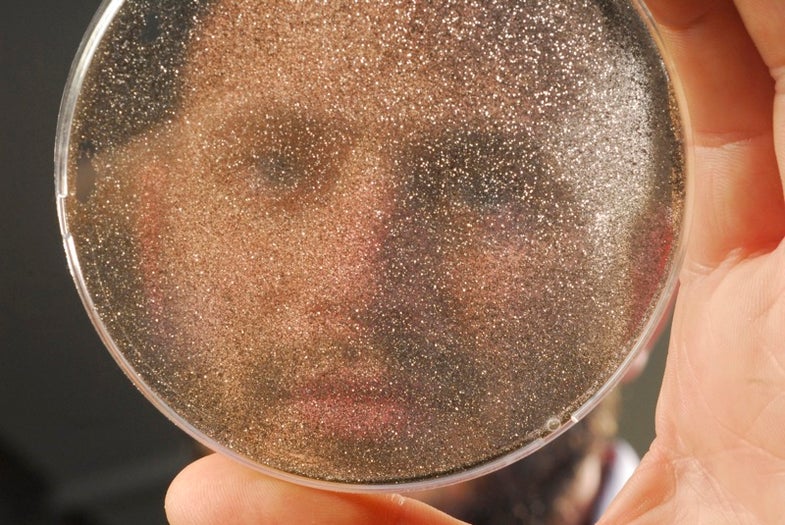
Thermal Ground Plane Conductive Material Georgia Tech

Georgia Tech researchers are working on a new novel material for cooling high-powered military radar gear up to 100 times better than current conductive heat-dissipation technology.

Developed in conjunction with Raytheon and DARPA, the material is a composite of copper and diamond, two of the most effective heat-conducting materials. The composite would serve as part of a sandwich of cooling materials called a Thermal Ground Plane, which, combined with a liquid cooling setup, would surround the transmit/receive module in a radar system.

Right now, the most high-end copper conductors have a heat conductivity efficiency rating of 200 to 300 watts per meter Kelvin. This new material could potentially have a rating as high as 20,000 watts per meter Kelvin.

Because diamond and copper don't bond together particularly well, researchers are still working on designs to create an effective final material, but they're confident their concept will come to fruition.

[via Georgia Tech]

Want to learn more about breakthroughs in electronics, medicine, nanotech, and more?
Subscribe to Popular Science today, for less than $1 per issue!

4 Comments

My very first thought after reading this is -- wow. The uses for this new cooling type system would be impressive if it work as they say it will, here is a few ideas:

1) A much lighter radiator for nuclear powered flight, one of the problems with proposed nuclear propulsion system is the massive heat radiator needed to cool it down -- huge radiators will be needed adding lots of mass to slow the system down and to escape a worlds gravitational well.
If we ever get nuclear power in space, it will not happen if a nuclear rocket lifted off from earth because of the environmental concerns.

If we mined the moon or an asteroid for the uranium ore using a fast breeder reactor in space then we could develop nuclear propulsion systems that would take us to Mars within 39 days not the 9 months it would take with chemical rockets. All we have to do is use chemical rockets to get the unarmed nuclear spacecraft to the place in space a safe distance away from earth before arming it with enriched processed ore. We could spend 6 months on Mars before coming home not the 2 years that is required with a chemical rocket systems. Time in space traveling between worlds would be more limited therefore exposure to the intense radiation of space would be more manageable, not to mention the bone loss and muscle atrophy problem astronaut have in long duration space flights.

2) A much lighter cooling system for highly efficient solar concentrators for use in space travel in our inner solar system, similar to the nuclear radiator problem above, there will be much less mass to lift off earth and to lug around in space. See Beamed Energy www.shineinnovations.com/6112.html If I am reading that right then a 200 + sun solar concentrator would use a very small cooling system to help cool it down at earths distance from the sun, it could be as high as 200 suns depending on the amount of heat the solar cells can take before frying and what type of material the solar cells are made out of.

3) No extra heat reduction source needed for High concentration photovoltaics (HCPV) systems other than the liquid cooling setup increasing the amount of heat currently manageable with certain Multijunction solar cells by a factor of approximately 66 times, so if one could be operational with 10 suns on earth without any additional cooling system then more than 500 suns could be concentrated on one HCPV without a cumbersome cooing system, increasing the efficiency and wattage output drastically reducing the costs.

This was just a quick hypothetical guess not to be confused with reality. Whatever the true heat reduction capability this new material has it is sure to change a lot of the way we cool many different devices including computers in the future. For now a robust computer without an annoying fan would be nice.

Conductance is not all the same as radiation. Dumping heat into space is difficult because space is a hard vacuum, which is an effective >insulator<, not a conductor. Radiator efficiency can be increased by running it hotter, but that's wasted energy.

This is not a new material. CVD Synthetic Diamonds have been around since 1995 or 1996 thanks to Apollo Diamond. Also, claiming 20,000 watts per meter kelvin is absurd. Considering Diamonds max is 2,000 watts watts per meter kelvin. Then throwing in ineffective heat conducter copper in comparison of Diamonds. Use your brain and realize the common sense!

This combination has been tested with terrible results due to naturally smooth nature of diamond and different rates of heat induced expansion.

Oh, btw.. Cost per cubic millimeter = $1.50 and that is no joke. For a 1" x 1" x 1mm heat sink would cost 967.74

Don't get me wrong. It will work.. Yet, cost efficiency is absurd leaving it to select niche applications currently.

Check out Diamond Materials GmbH or Apollo Diamond's website for more information on synthetic diamonds.

Damon Hill said - "Radiator efficiency can be increased by running it hotter, but that's wasted energy."

rlb2 writes - Good point however here is the current design for 40 kilowatt nukes on the moon and Mars. Notice the size of the radiators/conductors, this material if it is as close to its claim as they say it is should make a huge difference on the mass of the radiators envisioned by NASA.

www.spaceref.com/news/viewpr.html?pid=28903

BobDobbs404 said - "Also, claiming 20,000 watts per meter kelvin is absurd. Considering Diamonds max is 2,000 watts watts per meter kelvin."

rlb2 writes - There lies the quandary maybe they were only off by a factor of 10.


138 years of Popular Science at your fingertips.

Innovation Challenges


Popular Science+ For iPad

Each issue has been completely reimagined for your iPad. See our amazing new vision for magazines that goes far beyond the printed page


Download Our App

Stay up to date on the latest news of the future of science and technology from your iPhone or Android phone with full articles, images and offline viewing


Follow Us On Twitter

Featuring every article from the magazine and website, plus links from around the Web. Also see our PopSci DIY feed


February 2012: The Future of Fun

Science is reinventing play, from extreme sports to gamification to ridiculous roller coasters to the playgrounds of tomorrow, and this issue is chock full of fun. Also, on a less fun note: Did global warming destroy my hometown?


circ-top-header.gif
circ-cover.gif
bmxmag-ps