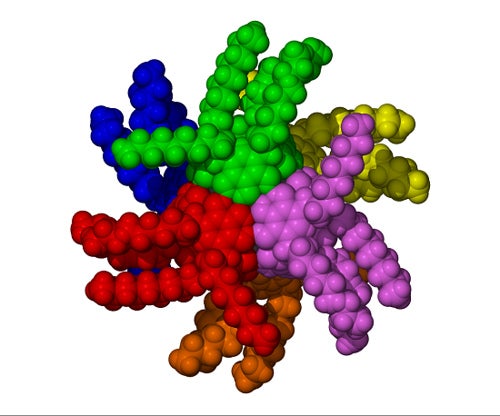
Heat Trapping Nanotech This metal-organic heat carrier (MOHC) can boost the heat-storage capacity of special fluids, and thereby improve power production efficiency from geothermal plants. Pacific Northwest National Laboratory

Tapping geothermal sources for power has proven a tricky proposition, because of costs and hazards associated with deep drilling. But researchers may have stumbled on a way to boost the power-producing potential of low-temperature hot springs close to the Earth's surface, using nanotechnology.

Geothermal power plants typically tap into hot springs miles underground, where the proximity of magma superheats water to between 302 and 698 degrees F (150 and 370 degrees C). But drilling that far down has sometimes led to scary Earth tremors, which have halted some geothermal projects, and caused scientists to fret about triggering major earthquake faults.

As a trade-off, low-temperature hot springs closer to the surface present less of a hazard, but also provide less heat for geothermal plants to tap. But that could change based on a $1.2-million Department of Energy effort backing nanotech as a solution.

Researchers had been developing cage-like nanostructures to store carbon dioxide at the Pacific Northwest National Laboratory. They found to their surprise that the nanostructures could also act as heat-storage particles within special liquids such as alkanes, which are currently used to help turn power turbines in geothermal plants through evaporation.

Now the team is refining different liquid blends using the nanostructures, in hopes of potentially improving power production efficiency at geothermal plants by 30 to 40 percent. Several independent experts expressed enthusiasm about the idea to Scientific American, and noted that the development could help tap shallower geothermal sites without the earthquake hazards.

Still, the dangers of deep drilling for geothermal sources have not prevented Icelanders from going ahead with a plan to tap a volcano for boundless energy. As we reported earlier at PopSci, that plan could literally blow up in their faces.

[via Scientific American]

Want to learn more about breakthroughs in electronics, medicine, nanotech, and more?
Subscribe to Popular Science today, for less than $1 per issue!

1 Comment

Well, it's quite obvious that this has been totally ripped off from the recent Scientific American piece on the same subject (google "Cagey Solution: Will Nano Traps Make Geothermal Power Earthquake-Safe?"), because it repeats some of the same technical errors it did, such as describing deep water as "springs" (these, by definition, are sources of water "issuing from the ground").

It also says "magma" "superheats" the water. The decay of radioactive elements in crustal rock contributes to that heat, too, and "superheats" is hyperbole - superheated water is so hot it can exist only as vapor, whereas most geothermal resources exist under "saturated" conditions cooler than this, where the fluid and vapor phases co-exist.

Also, drilling geothermal wells doesn't trigger the quakes everyone is fretting about -- it's injecting and withdrawing fluids in the wells once they've been drilled.

These are all misstatements that were in the Scientific American piece that you have faithfully reproduced by not researching your own copy. Shame on you.


138 years of Popular Science at your fingertips.

Innovation Challenges


Popular Science+ For iPad

Each issue has been completely reimagined for your iPad. See our amazing new vision for magazines that goes far beyond the printed page


Download Our App

Stay up to date on the latest news of the future of science and technology from your iPhone or Android phone with full articles, images and offline viewing


Follow Us On Twitter

Featuring every article from the magazine and website, plus links from around the Web. Also see our PopSci DIY feed


February 2012: The Future of Fun

Science is reinventing play, from extreme sports to gamification to ridiculous roller coasters to the playgrounds of tomorrow, and this issue is chock full of fun. Also, on a less fun note: Did global warming destroy my hometown?


circ-top-header.gif
circ-cover.gif
bmxmag-ps