Researchers hope the breakthrough could lead to a fully virtual human brain within ten years
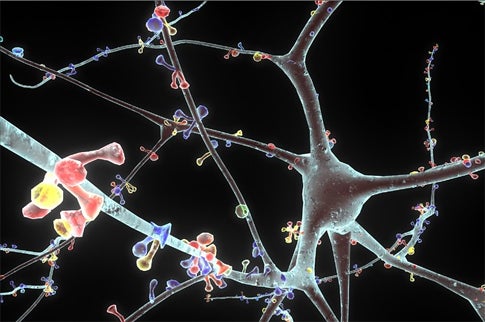
Blue Brain This image is a 3-D model of what the connections in Blue Brain would look like if they were flesh and blood neurons, not computer code. Blue Brain Project, via The Wall Street Journal

Four years ago, a team of researchers at the École Polytechnique Fédérale de Lausanne in Switzerland switched on Blue Brain, a computer designed to mimic a functioning slice of a rat's brain. At first, the virtual neurons fired only when prodded by a simulated electrical current. But recently, that has changed.

Apparently, the simulated neurons have begun spontaneously coordinating, and organizing themselves into a more complex pattern that resembles a wave. According to the scientists, this is the beginning of the self-organizing neurological patterns that eventually, in more complex mammal brains, become personality.

The computer simulation utilizes an IBM supercomputer capable of performing 22.8 trillion operations in a second. And that's just barely enough to simulate one part of a rat's brain. Each individual neuron requires the computing power of a high-end desktop computer, and the small area of the brain that Blue Brain simulates contains 10,000 neurons.

The supercomputer is powerful enough to generate a real-time 3D image of what the simulated brain would look like if it was an actual bundle of biological neurons. The 10,000 neurons and their 10 million connections are color-coded in the 3D image, and that's where the higher-order patterns were first observed. The coordination of the neurons appeared as unified waves of color, gliding from one side of the virtual brain to the other.

The researchers running Blue Brain hope that what they're learning about the organization of neurons in the simulated rat brain will allow them to create a digital human brain within 10 years, even though that is many orders of magnitude more complex than a rat brain.

[via the Wall Street Journal]

Want to learn more about breakthroughs in electronics, medicine, nanotech, and more?
Subscribe to Popular Science and enter to win $5,000!

8 Comments

Fascinating stuff but I have to admit that I don't believe they will get anywhere near a human-like digital brain within 10 years.

We've been hearing for decades that an android like robot with near human intelligence was "just around the corner" but have never seen anything at all like it. Kind of like the flying car dreams of the 50's. Of course its fairly easy to design and build flying cars, but flying and driving are two vastly different worlds and we don't have anywhere near the transportation infrastructure or instructional institutions necessary to handle large numbers of such.

I'm thankful that years ago my robotics professor at university was honest enough to tell us that the real progress is still light years from anything close to the human brain.

Of course if they're going to start using real organic neurons instead of neurochips the predictions could come true sooner than a century or so down the road, assuming continual progress is made. But then that's sort of defeating the purpose of hardware neurons.

Neurochips (or silicon neurons) are space consuming and require a lot of costs, hardware maintenance and they generate heat and use a lot of electricity (especially together in such high numbers). So, real neurons would seem the better choice.

The 10 year figure is pipe dreaming imo, unless some major breakthroughs in processing speeds and miniaturization come very soon.

Well, those major breakthroughs are actually getting there! I recently saw a fascinating article on the very first quantum processor, created at Yale university a few weeks ago (http://www.sciencedaily.com/releases/2009/06/090628171949.htm).

In short, and without being a physicist (so please don't flame me for trying), the principle behind it is that instead of making calculations one after the other until it gets the result, this processor "sees" all possible, simultaneously-existing "states" the "answer" would be in, and "collapses" on the right one, tremendously cutting the calculation time.

I know, I know, it's poorly explained... but it means that a very small (proportionately) quantum computer would out-perform the most powerful standard one in a blink...

Who knows? We live in interesting times...

10,000 neurons is not even simulating the brain of a fly or ant.
A human brain has 100,000,000,000 neurons and moore's law has been running out of steam.
The computer I have today is no where the advance over the one I had 5 years ago that computer I had in 1998 was over what I had in 1993.
They're a lot more then ten years away probably even a century away.
Plus to do a true simulation of even a simple nervous system you'll have to go beyond finite state machines this means use of quantum computers.
You might be able to fake it somewhat on a standard digital computer by adding a true random number generator to the algorithm.
As for Vigiger's comment on using real neurons some researchers are doing this.
http://www.technovelgy.com/ct/Science-Fiction-News.asp?NewsNum=2352

As human technology advances to the point where we can understand just how amazingly advanced living things really are, I hope and pray that scientists will remember to give credit for creating them to God, and not to chance.

Expect the Theory of Biological Evolution to become more and more difficult to believe as evolutionists try to explain how technology that is at least a century away from human comprehension was created by chance.

Found on a piece of American money:

"In God We Trust"

Ruri, while silicon might not be holding up to moore's law any more, new materials are becoming increasingly better options for processors. When they over take silicon moore's law will continue to be true

adam 101

while you are correct that new materials will be taking the place of silicon, and moore's law will be able to continue for a while still, the problem that will be unavoidable using circuitry, etc is that once you get down to one atom thick for transistors you run into not only the mercy of the speed of a single electron running down a path, but also problems with data collisions. And that will be the end of moore's law until we make better advances in quantum/biological computing power

A digital human brain within 10 years is a tad optimistic. Its most certainly not going to be done on a silicon chip. As i understand it quantum computing wouldn't be viable for simulating a brain ether, the type of calculations quantum computers would carry out require very specific problems.

lax4ever1,
if you could fill a entire room with near atom sized transistors you would have more the enough operations per second to simulate a brain. the question isn't so much weather or not moores law can continue indefinitely, but can it continue at least until we have the capacity to simulate a human brain.

Well, there's no need to simulate the entire human brain once we discover the hidden architecture of thought, simply in terms of being abstract, there's no need to go this far to the molecular level. Though it helps, you're simply observing the nature of an overwhelming amount of data, and by studying the unique patterns of the mind and getting to island that is the manual of a human thought you could significantly create even more simplified neurological structure minus the unwieldy amount of hardware.


Download Our iPhone App

Stay up to date on the latest news of the future of science and technology from your iPhone with full articles, images and offline viewing


Follow Us On Twitter

Featuring every article from the magazine and website, plus links from around the Web. Also see our PopSci DIY feed


Become a Fan On Facebook

Share links with friends, comment on stories and more


December 2009: Best of What's New

In our December issue, Popular Science names the 100 best innovations of the year: bombproof wallpaper, self-parking cars, the fastest helicopter, and 97 more. Plus inventor profiles and videos.

Check out the best of what's new here.

Popular Science Photo Pool


Share your photos in the Pop Sci pool at www.flickr.com!
tags_sprite.png
POP_embeddedForm_cover_May09.jpg