Metallic surface altered by laser can reflect any wavelength or cause water to defy gravity.
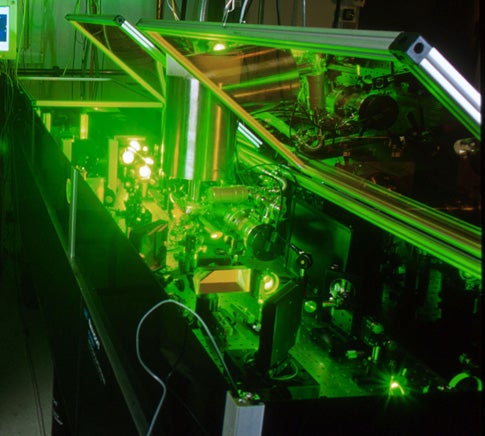
Femtosecond Laser via University of Colorado/NSF

Using an unbelievably powerful laser over an unbelievably short period of time, scientists have been able to alter the surface of metals to control the flow of water across their surfaces down to the individual molecule.

And when we say an unbelievable amount of energy, we’re talking about the power of the entire grid of the United States at once. When we say an unbelievably short period of time, we’re talking about a femtosecond, which is to a second what a second is to 32 million years. Think about both of those for a femtosecond.


The result of this laser blast is that it can change microscopic areas of the metal's surface in such a way that it becomes hydrophobic, or water averse. This causes the individual water molecules on the metal to be more attracted to other water molecules than the metal surface, allowing for hyper-accurate direction of the water's flow--even uphill against gravity.

This could be used for medical diagnostic chips which can re-route bloodflow on a microscopic scale, or for more efficient cooling of incredibly small computer components.

A hydrophobic surface also makes the metal anti-bacterial, since it prevents bacteria, made up mostly of water, from growing. Other advancements that could be seen from this technique are the creation of much more efficient tungsten light bulbs or changing the surface of metal so that it reflects just about any wavelength, effectively "painting" it.

The process shines the laser at points the size of a pin, and it currently takes about half an hour to alter a piece of metal the size of a quarter. The most mind-boggling part of all is that despite the massive quantities of energy it seem to need, the laser can be plugged into just a regular wall socket.

[EurekaAlert]

Want to learn more about breakthroughs in electronics, medicine, nanotech, and more?
Subscribe to Popular Science today, for less than $1 per issue!

14 Comments

HOLY COW! That's pretty dang cool. I'd love to see a video of water flowing uphill lol. Of course in order to start using this process on any consumer product it's going to need to be scaled up (ie. faster, effect more area, etc.).

Do I really need to say this?

Make a ramp out of this stuff, put the low end in a pool of water and have it dump into a higher tank, have that drain back into the lower pool Through a turbine for limitless energy.

Am I crazy or is this possible?

Would the author please comment?

It doesn't -quite- work that way, hans_lubricant... at least, not in my unprofessional understanding (don't quote me, heh). The surface is hydrophobic, so when the water is repelled from the surface and simultaneously attracted to other droplets of water, those towards the bottom of the ramp appear to "roll uphill" as the water collects towards the center. If you had an entire pool of water at the bottom of the ramp, the water would roll downhill towards the pool... which all the water will eventually anyhow after it has all collected.

"we’re talking about the power of the entire grid of the United States at once"

How much power input does it take to output that much power? Unless it's 1 to 1 or higher, then it sounds to me like it has the potential to supply the world's energy needs.

I'm imagining this sort of thing used in everyday life. Maybe like walking on walls or something.

How exactly does a water repellant surface aid in sticking to walls? Repellant =/= Adhesive

im sorry.. the us power grid from a wall outlet? care to clarify?

Yes. Please clarify.

You can output the power of the entire world from a single AA alkaline battery if the unit of time it is discharged over is small enough. A battery isn't likely to have the ability to discharge that quickly but there are probably special capacitors that can handle it.

all of the power in the US grid, duration, one femtosecond. so charge up at 120VAC for an hour and i'd guess you'd be all set, maybe.

P (watts) = I (amps) x E (volts)


July 2013: The Future Of Flight

The incredible innovations, like drone swarms and perpetual flight, bringing aviation into the world of tomorrow. Plus: today's greatest sci-fi writers predict the future, the science behind the summer's biggest blockbusters, a Doctor Who-themed DIY 'bot, the organs you can do without, and much more.


Online Content Director: Suzanne LaBarre | Email
Senior Editor: Paul Adams | Email
Associate Editor: Dan Nosowitz | Email
Assistant Editor: Colin Lecher | Email
Assistant Editor: Rose Pastore | Email

Contributing Writers:

Kelsey D. Atherton | Email
Francie Diep | Email
Shaunacy Ferro | Email

circ-top-header.gif
circ-cover.gif