New Metamaterials Could Produce Sonar Cloaking Device
Acoustic metamaterial bends sound waves to hide ships from sonar, effectively rendering them sonically invisible
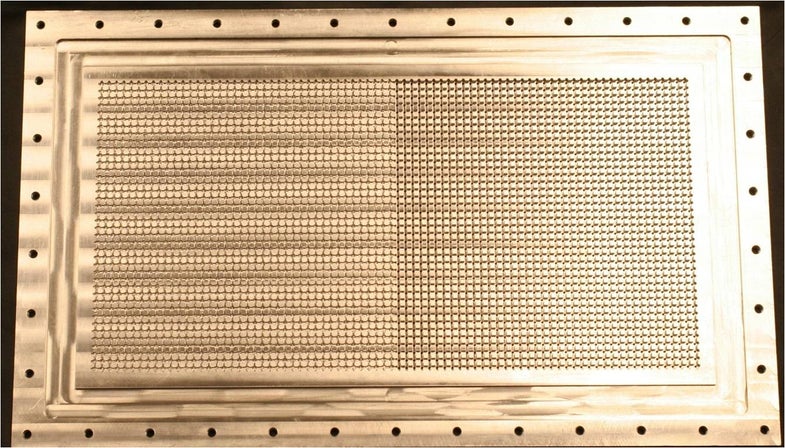
A new material created by researchers can refocus sound around certain objects and effectively render them sonically invisible to sonar. No natural material can do this, so man-made “metamaterials” must be created in order to toy with the laws of physics to essentially bend sound back on itself. Mind blown yet?
The technique, which bends light well beyond its natural tendencies, has been used for years in lenses used ultra-high-resolution imaging and has also been applied to real visible-light cloaking devices. The same theory is in use here, making a sort of acoustic lens, a material covered by a set of cavities which, when filled with water, work together to resonate with each other and refract the sound.
While the concept of this may be bending your brain backwards to understand, we contacted Nick Fang, assistant professor at the University of Illinois in charge of the project to help simplify:
“The sonar can spot out ships by detecting the echoes scattered from the ship. To cloak ships from sonars, we need to trick the sound waves to bend around the ship, like water flows around a smooth rock in a stream without wakes, so it cannot be detected. In order to do that, we are inspired by the similar optical effects such as mirages.
Quite often we can notice a highway mirage in sunny days, where we see a displaced image of distant object into the sky, while the real road with warm air on its surface seems immersed in water. This is because light travels with different speed in the warm air and cooler air; such gradient in light speed causes light to bend away from the road surface. In acoustic, we can bend sound wave in a similar fashion by changing the sound speed in different depth of the cloak. However, this is not a trivial job, as we have to make sure the sound waves from all angles are bent smoothly without scattering.”
When the material is ready for real-world applications, not only will we never find any military ships, but high-resolution clinical ultrasound imaging will be greatly enhanced.

Sound Cloak Created By New Metamaterial

Sound Cloak Schematic

Sound Cloak Schematic 2